Область визначення та область значень раціональної функції

Read · 1 min

##Finding the domain and range of a rational function

When you are trying to find the domain of a rational function, you first need to find what xx values are not included. The asymptotes and any holes tell us what xx's aren't included.

The first step should always be to factor.

Given the rational function: y=x2+6x+83x2+10x+8y=\frac{x^2+6x+8}{3x^2+10x+8}.

We can factor to: y=(x+2)(x+4)(3x+4)(x+2)y=\frac{(x+2)(x+4)}{(3x+4)(x+2)}

Recalling the factoring patterns for quadratic functions will help!

Now, we can check to see if there are any holes.

We can see that there is an (x+2)(x+2) in both the numerator and denominator.

y=(x+4)((x+2)(3x+4)(x+2)y=\frac{(x+4)(\cancel{(x+2)}}{(3x+4)\cancel{(x+2)}}

We can set x+2=0x+2=0, so we know the xx value of the hole is -2. Therefore, we now know one xx value that is not included in the domain.

We can now rewrite the function as:

y=x+43x+4y=\frac{x+4}{3x+4}

Solve for the vertical asymptote, which is x=−43x=\frac{-4}{3}.

Therefore, you know the domain of the function as all values, except the vertical asymptote and the hole.

We can write the domain in interval notation like: (-∞\infty, -2) U (-2, −43\frac{-4}{3}) U (−43\frac{-4}{3}, ∞\infty). Remember, the "U" represents a union of sets!

To find the range of the function, we need to find the yy value of the hole and the horizontal asymptote.

Since we know the xx value of the hole is -2, we just need to solve for yy when x=−2x=-2.

y=(−2)+43(−2)+4=2−2=−1y=\frac{(-2)+4}{3(-2)+4} = \frac{2}{-2} = -1

Then, we need to solve for the horizontal asymptote, which is y=13y=\frac{1}{3}.

Therefore, the range of the function is all values except for when yy equals −1-1 or 13\frac{1}{3}. In interval notation, the range equals (-∞\infty, -1) U (-1, 13\frac{1}{3}) U (13\frac{1}{3}, ∞\infty).

Video · + 1 min read

(Video) Finding Domain & Range of Rational Function

by JEKY Media

We've been introduced to rational expressions and solving word problems with rational expressions, but in order to graph rational functions, we need to first learn how to find the domain and range of a rational function.

Check out this video by JEKY Media to learn how to find the domain and range of rational functions.

Let's follow along with the example given in the video. We are given the function: f(x)=2x−3x+2f(x)=\frac{2x-3}{x+2}

Since the denominator of all rational functions cannot equal zero, as that would make the function undefined, we can set x+2=0x+2=0 and solve to determine the values of xx excluded from the domain. After solving, x=−2x=-2, so we know that whenever x=−2x=-2, the function is undefined. Therefore, the domain of this function is all real numbers except −2-2. In terms of interval notation, the domain is (−∞,−2)(-\infty, -2) U (−2,∞)(-2, \infty).

To find the range of a rational function, we can solve for xx in terms of yy, then find the inverse of that function.

Let's follow the same example as the video:

f(x)=2x−3x+2f(x)=\frac{2x-3}{x+2}.

We can begin by writing the equation in terms of yy, which JEKY Media works through in the video to equal: x=−(2y+3)(y−2)x=\frac{-(2y+3)}{(y-2)}

We can then flip xx and yy to find the inverse function:

y=−(2x+3)(x−2)y=\frac{-(2x+3)}{(x-2)}

We then know that x−2x-2 cannot equal zero, so after setting x−2=0x-2=0, we learn that xx can't equal 22. Therefore, the range is all real numbers except 22. In interval notation, the range is (−∞,2)(-\infty, 2) U (2,∞)(2, \infty)

Keep watching the video to try more examples!

Illustrated · 1 min

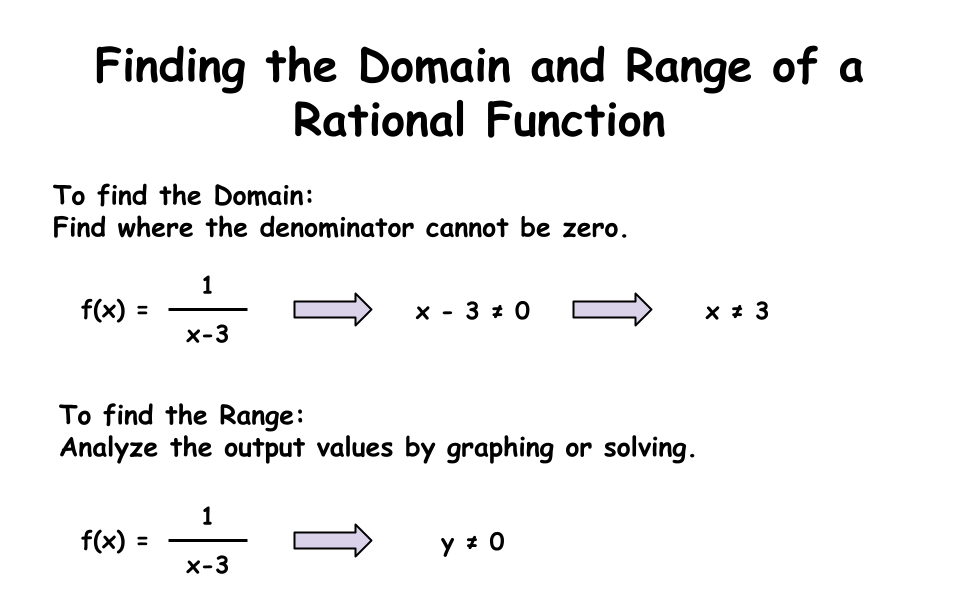
Finding Domain and Range of a Rational Function

In this next lesson on rational functions, we will learn how to find the domain and range.

Finding the Domain and Range of a Rational Function

To find the Domain:
Find where the denominator cannot be zero.
 1
x-3

f(x) = 

x - 3 ≠ 0

x ≠ 3

To find the Range:
Analyze the output values by graphing or solving.
 1
x-3

f(x) = 

y ≠ 0

Image source: by Anusha Rahman

To find the domain, look at the denominator and see what makes it equal to zero. We can't divide by zero, so we leave out any values that do that. For example, in f(x)=1x−3f(x) = \frac{1}{x-3}, the denominator is zero when x=3x=3. That means that the function does not work at x=3→x=3 \rightarrow so the domain is all real numbers except 33. x=3x=3 becomes an asymptote.

To find the range, think about the outputs of the function. Sometimes, there are outputs that the function can never reach, no matter what you plug into the function. For example, in our example, the output can never be 0→0 \rightarrow so the range is all numbers except 00. y=0y=0 becomes an asymptote.

Let's check out what this function looks like when graphed.

Graph with asymptotes

Made using Desmos

The function is graphed in purple, and the asymptotes are graphed in a dashed black.

Type a concept, like “slope” or “photosynthesis”.

↑ ↓ to choose · Enter to openSearch explanations and problems