
Interactive · 1 question
Double-Replacement Reactions
What are double-replacement reactions?
- A double replacement reaction occurs when two reactants swap bonds. The result is two new compounds.
- The generic balanced chemical equation is AX + BY → AY+ BX.
- For ionic compounds, the reactants swap anions. Two new ionic compounds are created.
- For covalent compounds, the more electronegative elements are swapped. Again, the result is two new covalent compounds.
- There are two common varieties of double replacement reactions: precipitation reactions and neutralization reactions. We'll look at each one in turn.
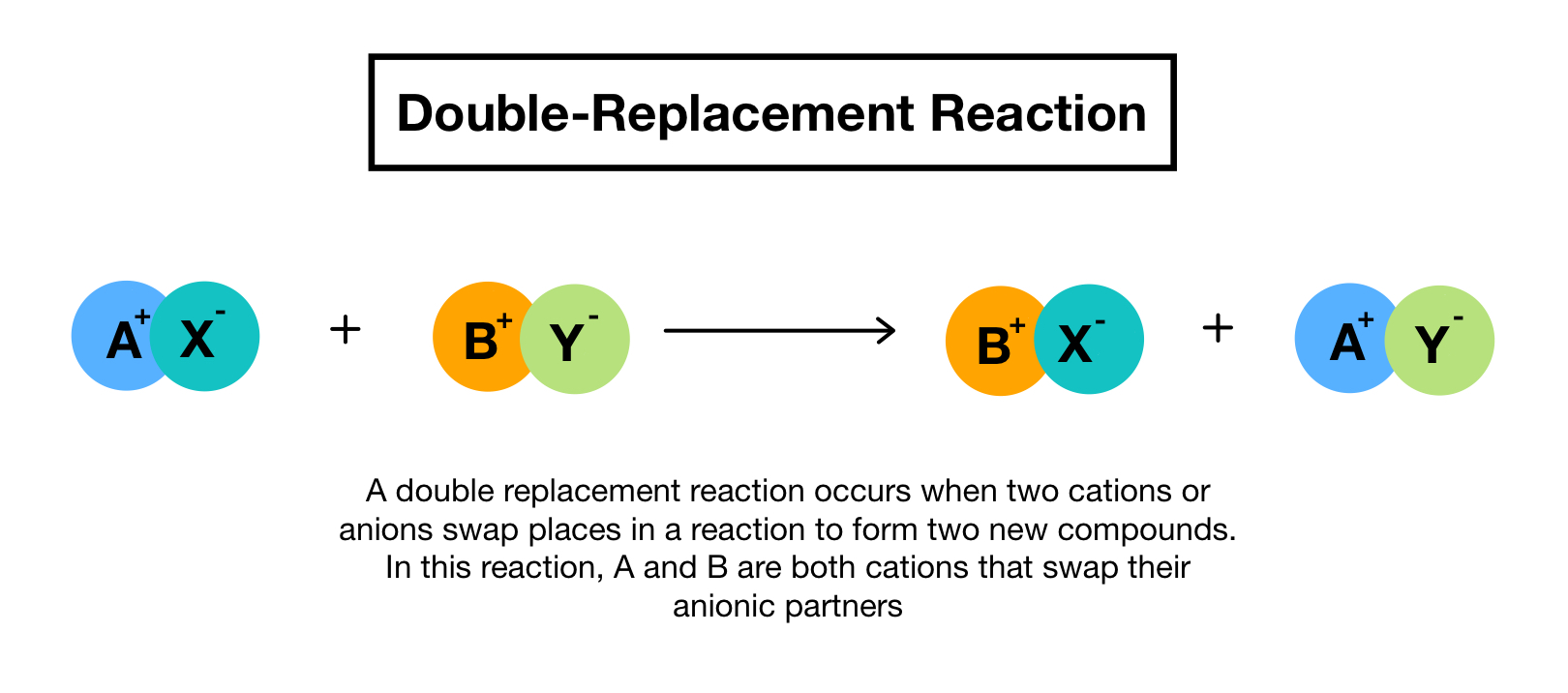
Image source: Caroline Monahan
Precipitation Reactions
- Precipitation reactions are double-replacement reactions that form a solid from two aqueous solutions.
Example: NaF (aq) + AgNO3 (aq) → NaNO3 (aq) + AgF (s)
-
The solid formed from the reaction is based on the solubility of the compounds in the reactants.
-
In order to predict which compound is the precipitate (the solid), follow the qualitative solubility rules (as seen in the cheat sheet below).
- In future lessons, we'll look at solubility in more detail. It turns out that many precipitates are in equilibrium. So, we use the solubility products constant () or molar solubility to calculate the extent of the precipitation.
Solubility Rules
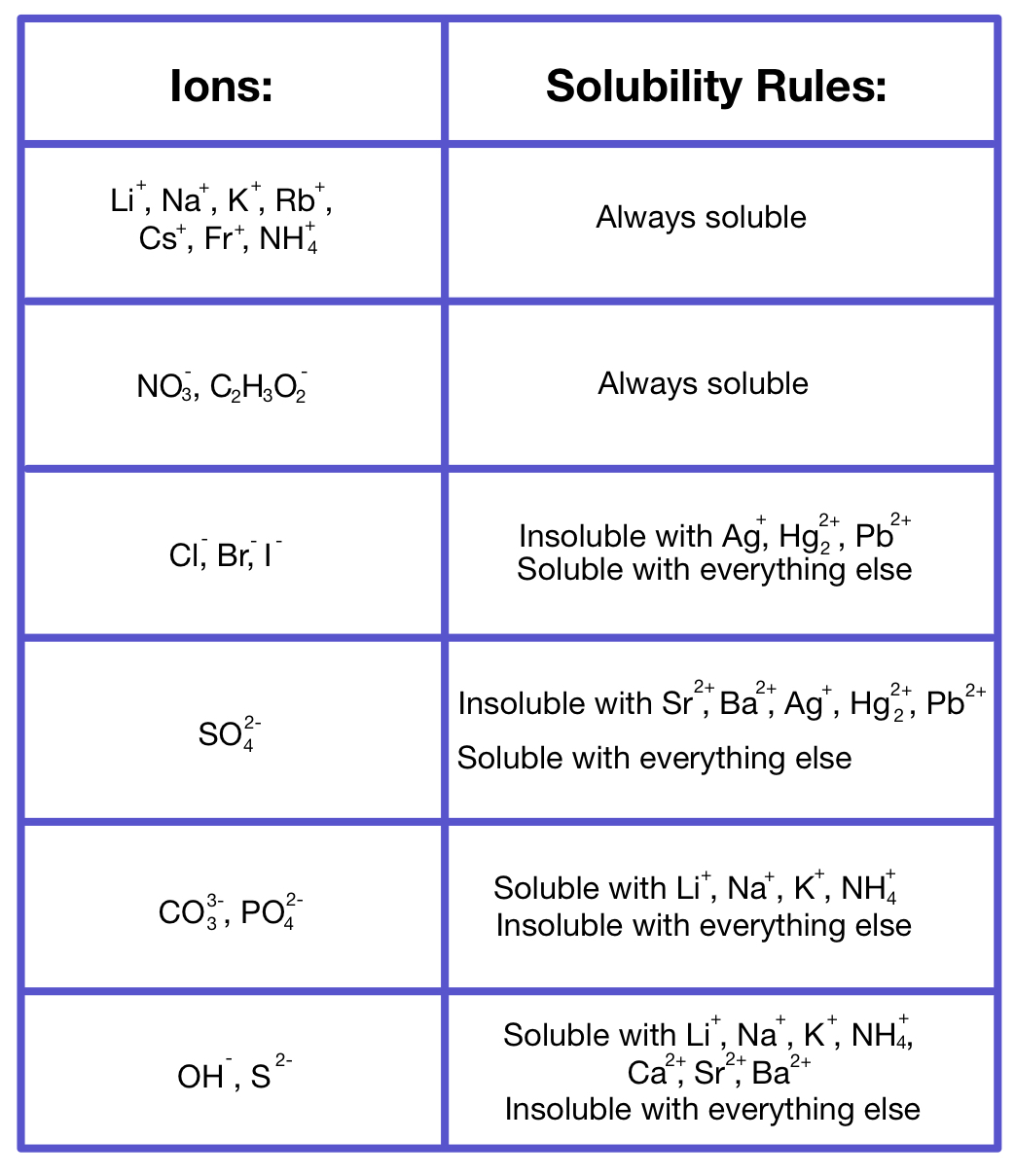
How to use this chart:
-
This chart helps determine which of the new compounds from the double-replacement reaction is the solid (the precipitate).
-
Simply look to see if any of the ions match the ions that are in your reaction, and look to see if it's soluble or insoluble.
Example: (aq) + (aq) → (?) + (?)
- Looking at the rules above, potassium () and nitrate () are always soluble. So, we know that those will be aqueous in this solution. Looking at the chart again, chlorine () is soluble EXCEPT when it's with silver (), which it is. So, silver chloride () is solid in this precipitate reaction!
Answer: (aq) + (aq) → (aq) + (s)
Neutralization Reactions
- Neutralization reactions are a type of double-replacement that occurs between an acid and a base. They always form water and a salt.
- When faced with these reactions, identify and swap the partners of the cations (or anions) and see what it forms. If it generates water and another compound, it's most likely a neutralization reaction!
Example: + → + (salt)
- In this reaction, we're reacting hydrochloric acid with sodium hydroxide. That's a reaction between a strong acid and a strong base. So, we get a double replacement. The hydroxide partners with hydrogen to produce water. The sodium and the chlorine also partner to generate sodium chloride.
Try a practice problem!
Which of the following are double-replacement reactions?
