Read · 3 min
Way back, we studied thermodynamics. Unfortunately, we can't forget everything we learned. Why? Because it applies to all chemical reactions! That includes redox reactions! In this lesson, we'll see how the two relate.
Spontaneous or Nonspontaneous?
How do we know if a redox reaction will be spontaneous or nonspontaneous? Let's recall our standard electrode potentials. Atoms and molecules that readily reduce have large positive voltages. For example, all the halogens! We specifically examined fluorine. It is the most electronegative element. So, it wants electrons. What's its standard electrode potential? It's an enormous +2.87 volts! What about the atoms that efficiently oxidize? They readily lose their valence electrons. Our chief example was the alkali metals. For example, lithium had a standard reduction potential of -3.05 volts!
What does this have to do with spontaneity? Let's say we create a voltaic cell from fluorine and lithium. We would expect this cell to be spontaneous. Why? Because we have a strong oxidizing agent and a strong reducing agent. What's the voltage? We use the equation . So, for a fluorine-lithium voltaic cell . We get a huge positive voltage! So, a positive voltage means our redox reaction is spontaneous. A negative voltage is nonspontaneous. If our voltage is zero, we're at equilibrium.
Relating Voltage and Gibbs Free Energy
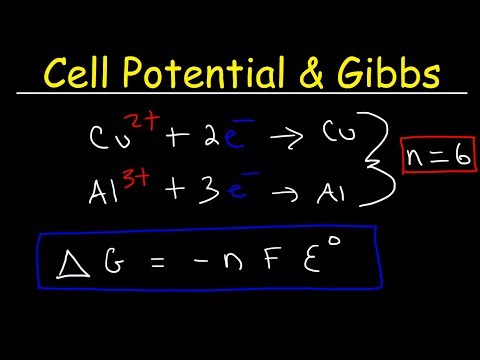
Any spontaneous chemical reaction has a negative Gibbs free energy. We just learned that spontaneous redox reactions have positive voltages. So how do we relate the two? Thankfully, chemists have developed an equation.
-
is the number of electrons transferred. It is unitless.
-
is Faraday's constant. It represents the charge of one mole of electrons. The traditional number is in Coulombs per mol. It's . But, Gibbs free energy had units of . And voltage has units of . So, for voltaic cells, we convert the units to .
-
is the voltage (electromotive force) in volts at standard conditions.
Gibbs Free Energy Calculation Examples
- Above, we calculated the voltage of a fluorine-lithium voltaic cell. What is the Gibbs free energy change?
We should start by writing the two reduction half-reactions.
We need the moles of electrons in the two equations to match. So, we can multiply the top equation by 2. But, voltage is an intensive property. Why? Its units are energy per charge. Doubling the moles of electrons doubles the energy. But, it also doubles the charge.
Now, we can solve for the Gibbs free energy.
- Let's compare zinc and the standard hydrogen electrode. The reduction half-reactions are below. Calculate the Gibbs free energy change.
- What happens to the Gibbs free energy change if we halve the two half-reactions in problem 2?
We see that our Gibbs free energy is halved. Remember, voltage is an intensive property. But, the Gibbs free energy is extensive.
What does it all mean? Electrical Work
Do you remember how we define Gibbs free energy? It's a chemical reaction's energy that's available for work. Wait, what is work again? It's how we measure applied energy. Remember, the unit is the joule. One joule equals one Newton acting over one meter. For example, I use a force of one Newton to push a box one meter. I just did one joule of work.
But, in chemistry, don't move boxes! Where have we seen work? In thermodynamics, we investigated gas pressures. The gases did work by increasing their container's volume. Sometimes, the surroundings did work by compressing the gas. At constant pressure, the work done caused a temperature change. We called it enthalpy. So, we're familiar with the concept.
But, how do we apply work to redox reactions? Let's consider a voltaic cell. We have two electrodes separated by a wire. The released electrons repulse the wire's electrons. What happens? The electrons begin to move through the wire. So, we're exerting a force that's causing displacement. We're doing work and generating a current!
We can use the flow of electrons! For example, consider the battery in your phone or computer. As the electrons flow from the anode to the cathode, we use them to light the screen. The electrons cause your screen's molecules to enter an excited state. To relax, they discharge a photon. The released photon has a wavelength in the visible region. Now you see the picture of your puppy on your home screen!