
Illustrated · 2 min
+1 contributors

What is an Electrochemical Cell?
It is a contained system which uses electrical and chemical energy. There are two types of electrochemical cells: galvanic and electrolytic.
-
Galvanic cells contain chemicals which undergo spontaneous chemical reactions. The energy from the chemical reactions is converted to electrical energy in the form of an electric current.
-
Electrolytic cells have an electric current which is applied to the system and causes a chemical reaction. The chemical reaction is non-spontaneous.
The study of changes between chemical and electrical energy in electrochemical cells is called electrochemistry. The chemical reactions in electrochemical cells are redox reactions. Redox reactions are made up of an oxidation (lose of electrons) and reduction (gain of electrons).
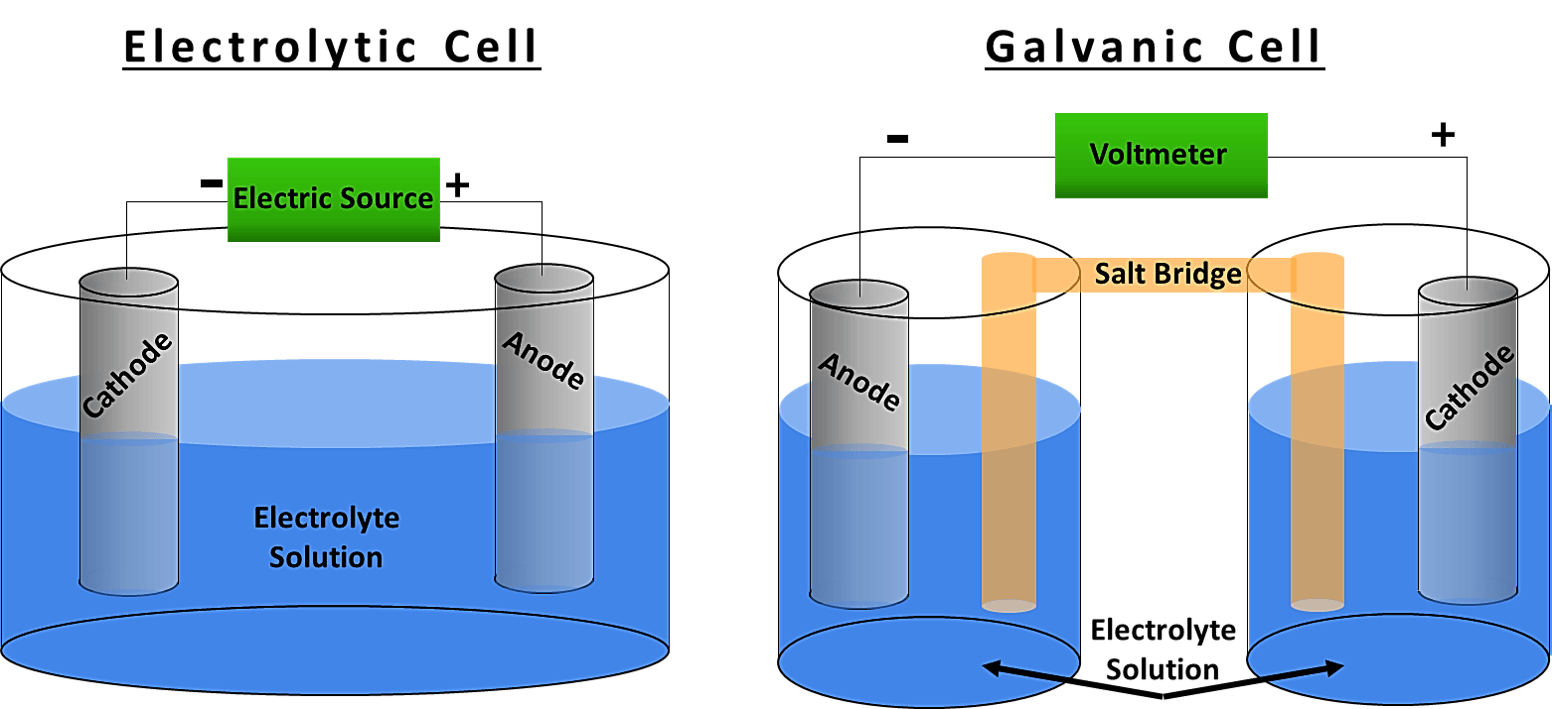
There are two types of electrochemical cells. Notice that the anode and cathode are charged differently. A galvanic cell also contains a salt bridge which connects the two electrodes. The voltmeter measures the electrical current produced from the spontaneous chemical reaction.
Image source: By Cassie Gates
Parts of an Electrochemical Cell
In electrochemical cells there are important features to know and their functions:
-
Electrodes are rods, usually made of metal, which are connected by a conductive wire. There are two electrodes used in a cell.
-
Anodes are the electrodes where oxidation occurs. The oxidation at the electrode can be represented by a oxidation half-reaction.
-
Cathodes are the electrodes where reduction occurs. The reduction at the electrode is represented by a reduction half-reaction.
-
Reducing Agent is the chemical component which donates electrons. Since, the reducing agent loses electrons, it is the oxidized species.
-
Oxidizing Agent is the chemical component which accepts electrons. The oxidizing agent gains electrons and is reduced.
-
Electrolyte solution is a conductive solution. The electrolyte solution allows electric current to travel between the two electrodes in a cell.
Energy in an Electrochemical Cell
In electrochemical cells there is a certain amount of energy required to begin a chemical reaction or created from a chemical reaction. The amount of energy measured as an electrical force to create a reaction is called the cell potential energy, . Cell potential can be affected by pressure, concentration, and temperature. In the cell, when the reactants and products are under standard conditions, this is the standard cell potential, .
Standard reduction potentials or standard electrode potentials can be found in tables. These tables are organized to show the strength of the reducing and oxidizing agents.
Under conditions that are not standard, the Nernst equation can be used: This can be related to standard potential and equilibrium with:
The energy in the cell is related to changes in free energy by these equations: The Faraday constant () is the charge on one mole of electrons.
In spontaneous reactions, and . Spontaneous reactions produce an electric current. In non-spontaneous reactions, and . Non-spontaneous reactions require an electric current.
