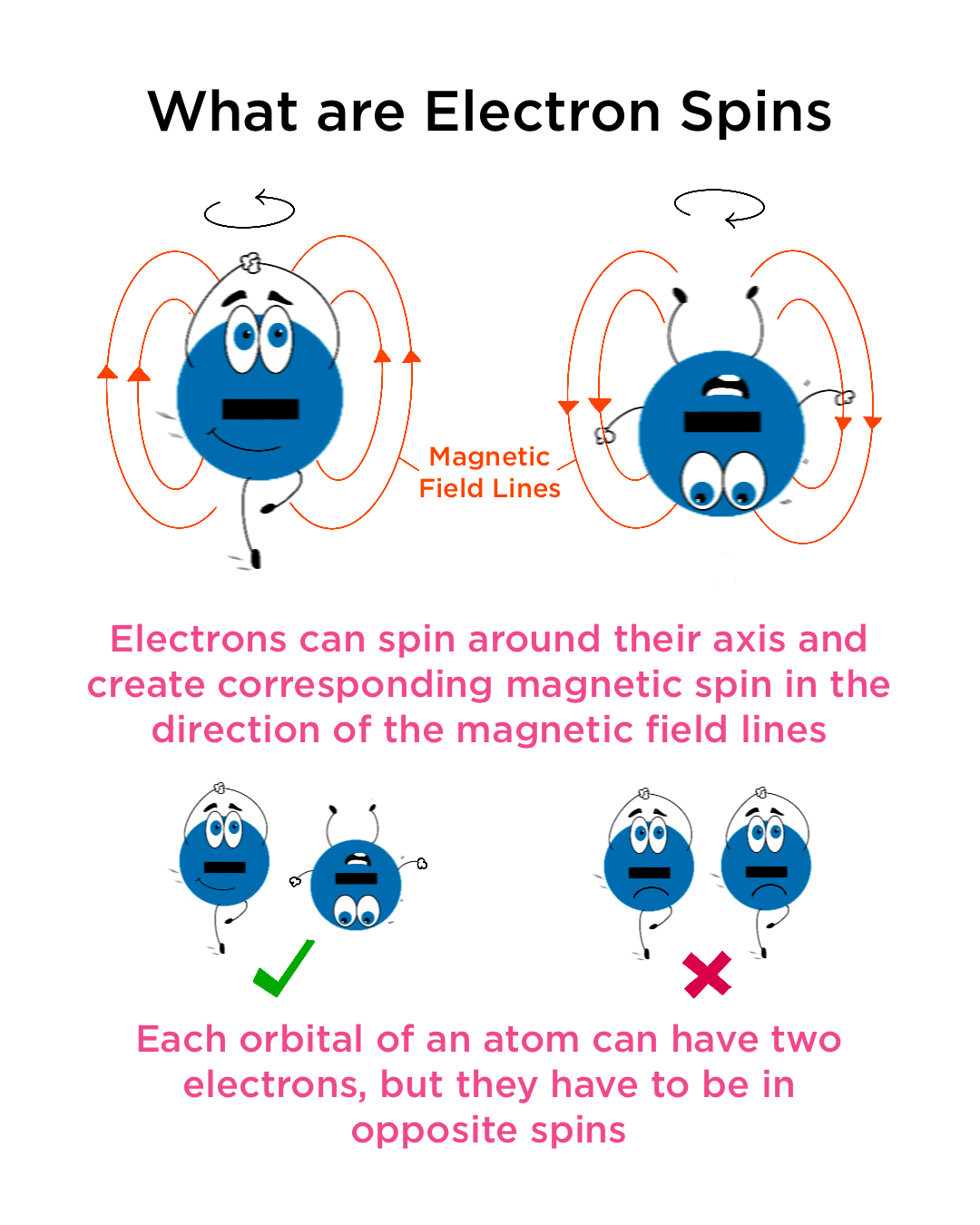
We've been exploring the history of quantum mechanics. First, Max Planck developed quantization while studying blackbody radiation. Soon after, Albert Einstein applied it to light and solved the photoelectric effect. Around that time, he was also working on general and special relativity. Loius de Broglie combined the two into the de Broglie equation. Suddenly, we understood that all matter obeyed the wave-particle duality.
All of this paved the way for the development of quantum mechanics. It started when Erwin Schrodinger wrote down his famous equation. It explained a lot! For example, it helped us to define atomic orbitals, their shapes, and electron clouds. But it was still missing something. It couldn't explain why electrons had an angular momentum. We call it electron spin. It turns out that electrons aren't actually rotating. Instead, it results from the combination of quantum mechanics and relativity. But Schrodinger's equation didn't incorporate relativity. Further developments were needed!
Why do we call it Electron Spin?
So, where did get electron spin? In 1922 Otto Stern and Walther Gurlatch conducted a famous experiment. We call it the Stern-Gurlatch experiment. Remember, Schrodinger published his quantum mechanical model in 1926. So, the working theory at the time was the Bohr model.
What did Stern and Gurlatch do? They shot a beam of silver atoms through an inhomogeneous magnetic field. Remember, atoms of pure elements have a neutral ionic charge. The protons balance the electrons. Based on the neutral charge, we might expect them to travel straight through. But they got deflected! That tells us the atoms themselves produced a magnetic field. It turns out they got deflected into two clusters. So, the deflection seemed to be quantized. That's why we have +21 or −21 spin values.
But what could cause a neutral atom to have a magnetic field? Any charged particle that rotates creates a magnetic field. So, the initial thought was maybe the electrons spin. It is similar to the earth spinning on its axis.
Electrons Don't Spin
So, how do we know electrons don't spin? A few physicists did some calculations. How fast would the electron have to rotate to produce the observed results? It turns out it would be faster than the speed of light. That's not possible! So, electrons can't actually be spinning. It seems that the magnetic field is an intrinsic quantum property. Electrons have a magnetic moment because they are electrons.
What is Spin?
When Schrodinger first wrote his equation and solved it for the hydrogen atom, he didn't include electron spin. His equations produced massive theoretical leaps. We were much closer than the Bohr model. But something still wasn't quite right. Originally, Wolfgang Pauli modified the Schrodinger equation to account for electron spin. But, his approach was a correction. It didn't solve the underlying problem. He was closer, but it didn't quite work.
Paul Dirac solved the problem! He wasn't actually thinking about electron spin. Instead, he pondered how to connect quantum mechanics with special relativity. The math is unbelievably complicated. But he had an incredible breakthrough! First, he incorporated a relativistic energy expression. But, as he did the math, he realized he needed to meet two conditions. The wavefunction for multiple electrons must be antisymmetric. What does that mean? Mathematically, we write Ψ(A,B)=−Ψ(B,A). If we swap the position of two electrons, their wavefunctions are opposite. What was the other condition? The two electrons cannot occupy the same state. Together, these two conditions create the Pauli exclusion principle.
When Dirac implemented these conditions, he created a function with four components. Two of the components correspond to electron spin. It turns out that electron spin gets mathematically described by a spinor. A spinor is a very advanced mathematical concept. But it's just another component of the electron's wavefunction. What's unique about spinors? They require a 720-degree shift to return to normal. Imagine a sine wave. A 180-degree translation moves the function a half-cycle. So, it's out of phase compared to the original. A 360-degree shift returns it to normal. For spinors, the functions behave the same. But the transformations are at 360 degrees and 720 degrees.
But what does any of this really mean? The electron spin is angular momentum. But an electron's angular momentum is an intrinsic property. It just exists. Why? Because it is a component of the electron's wavefunction. But, the behavior of the angular momentum uses spinor mathematics. You'll only need the math if you take graduate-level physical chemistry classes. But remember, electrons travel at close to the speed of light. So, their properties are outside of general physics. Dirac came to these conclusions while combining quantum mechanics and relativity. These properties exist because of the fluidity of space and time. So, what should you take away? Electrons don't actually spin. Instead, they have an angular momentum that is a quantum property.
So What?
A lot of this explanation and the previous topics may seem very theoretical. And honestly, it is. The scientists who developed these theories were all geniuses. We consider them to be some of the greatest thinkers in history. So, what does any of this have to do with general chemistry? These developments paved the way for us to understand the atom. In subsequent explanations, we'll study electron configurations, orbital filling diagrams, and valence electrons. Alongside these topics, you'll learn the rules for orbital filling (Hund's rules, the Aufbau principle, and the Pauli exclusion principle). All of these are the practical outworkings of the development of quantum mechanics. Once you synthesize it, you'll understand why atoms interact in specific ways.