Illustrated · 1 min

An emission spectrum is a graph of the light a molecule emits against its relative intensity. It corresponds to the electrical de-excitation of the molecule. Since the energy of each molecule's quantum states is unique, every molecule has a unique emission spectrum. This means that fluorimetry (the measuring of emission spectra) is a powerful analytical technique to determine the identity of a molecule. A sample emission spectrum is shown and analyzed below.
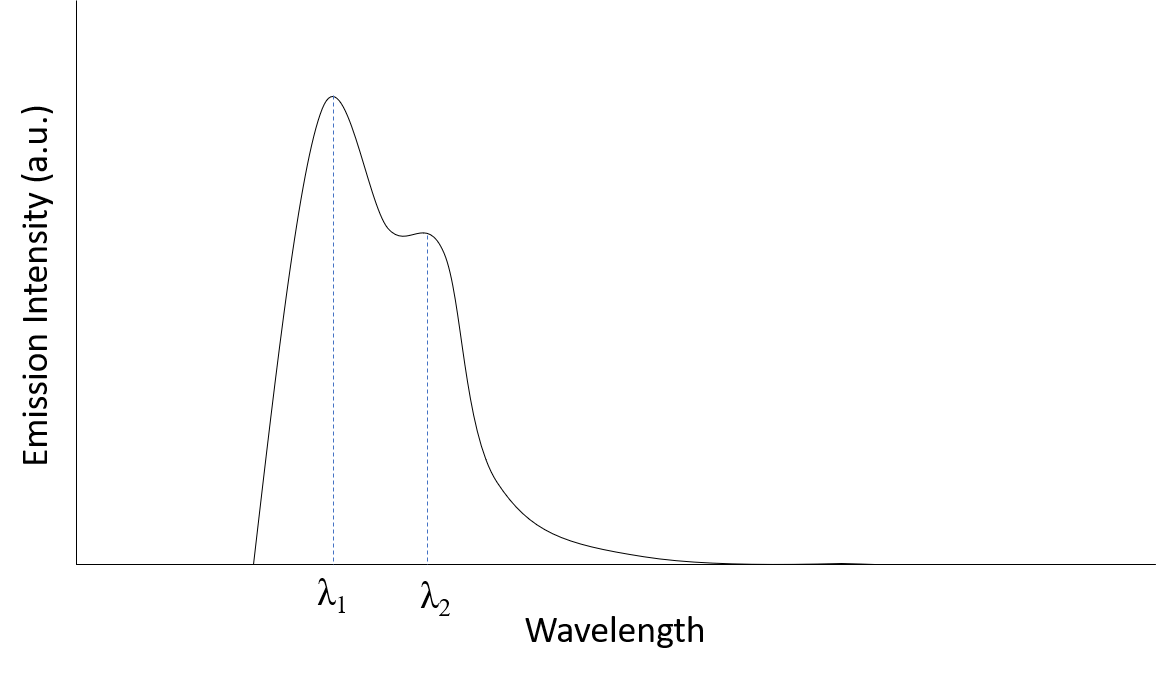
In this graph we can see that our material has a peak at . This peak corresponds to the "-" transition. This is in contrast to the shoulder at which corresponds to the "-" transition. Let's spend a moment to try and understand this.
As stated previously, emission spectra are the result of an electric transition from the first excited state, to the ground state. However, it is possible (common even) that when a molecule has an electric transition, it also has a vibrational transition. Such a transition is referred to as vibronic. Vibronic transitions are the reason multiple peaks appear in emission spectra.
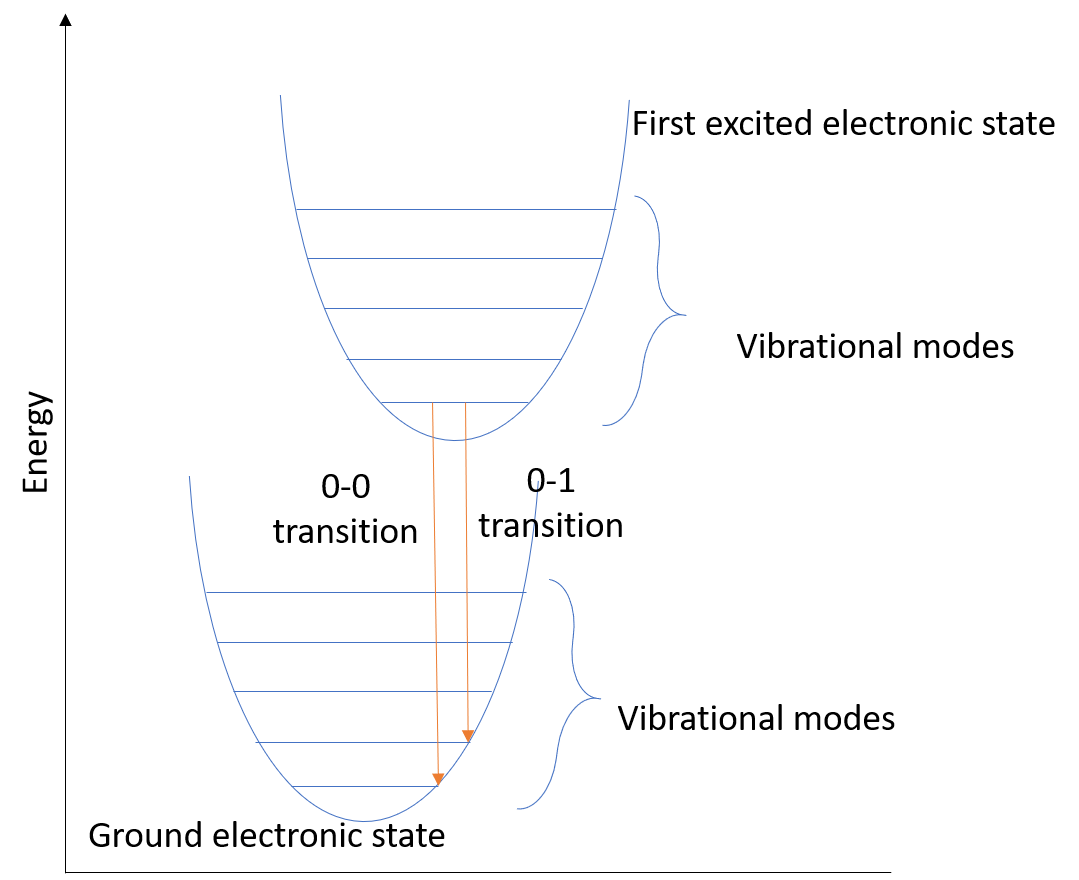
When we enumerate the peaks on the spectra, the first number represents the vibrational mode of the electronic state it originates, and the second number represents the the vibrational mode of the electronic state it finishes in. Since vibrational relaxation is 10 to 100 times faster than fluorescent lifetimes, transitions always begin in the zeroth vibrational state.
You may notice in the spectra that the 0-1 peak is a redder wavelength, and thus lower energy, than the 0-0 peak. This is because the first vibrational mode is higher energy than the zeroth. As a general rule, the 0-0 peak is always the bluest peak, and proceeding to redder wavelengths we see 0-1, then 0-2, etc.