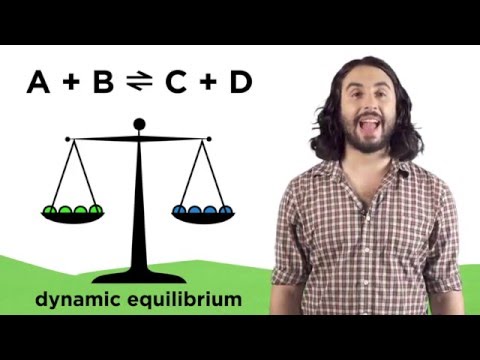
The reaction equilibrium constant denoted Keq, represents the point in a reaction where it is in equilibrium based on concentration or partial pressure of the reactants, products, and the number of moles of each in the balanced reaction. Ultimately Keq gives us a value where the reaction is not moving in a particular direction.
How do I write an equation for a reaction equilibrium constant?
This is related to the reaction quotient which is based on the molar concentration of the substances in our reaction or the partial pressures of these substances. The key is though, it is always a ratio of your products to your reactants, just like any other time you are trying to figure out the current point of your reaction or an equilibrium value of a reaction. Remember, molar concentration is always denoted with brackets around your molecule of interest, for example: [substance]. The equation below is how the equilibrium equation is written. Product and reactant concentrations are raised to the power of their stoichiometric coefficients found in the balanced reaction.
In our example above all of our reactants and products are aqueous solutions – a fancy way of saying “in water” – which are always included in equilibrium expressions. Pure liquids and solids are never included in equilibrium expressions.
Why is this important?
Well using this value, we can tell which way our reaction is progressing! If the reaction quotient, Q, is greater than Keq, we can tell our reaction is moving in the forward direction. If Q is less than Keq, we can tell our reaction is moving in the reverse direction. You can almost think of Keq as the tipping point of a scale. A large quotient value means the concentration of the products is large and the concentration of the reactants is small (forward reaction). A small reaction quotient means the denominator is large.