
Скінченні ряди

Video

(Video) Find the Sum of a Geometric Sequence

by Brian McLogan

In this video by Brian McLogan, you will learn how to find the sum of a finite geometric sequence.

Summary

We know that it is pretty simple to calculate the series (or sum) of a finite geometric sequence. But when we get to more complicated sequences, it will be helpful to have a formula!

So let's learn the formula on a simple geometric sequence first.

Brian walks you through an example using the following formula:

Sn=a1(1−rn)1−rS_n = \frac{a_1 (1-r^n)}{1-r}

####Example

3+6+12+24+483 + 6 + 12 + 24 + 48

In this example, n=5n=5, a1=3a_1 = 3, r=a2a1=2r=\frac{a_2}{a_1} = 2

So:

S5=3(1−25)1−2S_5 = \frac{3(1-2^5)}{1-2}

When we simplify this equation, we find that S5=93S_5 = 93.

We can check our work by manually adding the values in the original sequence.
3+6+12+24+48=933 + 6 + 12 + 24 + 48 = 93

Read · 1 min

Evaluating Series by Adding

A series is the sum of the terms of a sequence. While a sequence is simply a list of numbers, a series tells you what happens when you add those numbers together.

For example, the sequence

2,4,6,82, 4, 6, 8

becomes the series

2+4+6+82+4+6+8

Evaluating a series means finding the value of that sum. The sequence lists the terms, while the series adds them together.

#####Finite Series

A finite series contains a limited number of terms. For example,

5+8+11+145+8+11+14

is a finite series because it has only four terms. Since the series ends, we call it finite. That means we can always evaluate it by adding all of the terms. In this case, that would be 3838.

####Sigma Notation

Many series are written using sigma notation, which is a compact way to represent a sum. It becomes especially important when the sequences and series become really complicated.

For example,

∑n=14n\sum_{n=1}^{4} n

We can read this as: the series starts with n=1n=1, ends with n=4n=4, and you can add all of the values of nn. If we write out the terms, we get:

1+2+3+41+2+3+4

We know that equals 1010.

One common mistake is confusing the upper and lower limits of sigma notation. Make sure you include every value from the starting index to the ending index.

Whenever you see a finite series, think of it as a carefully organized addition problem. Write out the terms if needed, make sure every term is included, and add them together. Once you understand this process, you'll be ready to learn faster methods for evaluating larger series. You will also be able to tackle word problems with finite series!

Illustrated · 1 min

Evaluating Geometric Series by Adding

For a short, geometric series, you can find the sum by adding each term one at a time. However, if the series contains many terms, this method becomes slow and inefficient.

Instead, you can use the finite geometric series formula to find the sum quickly.

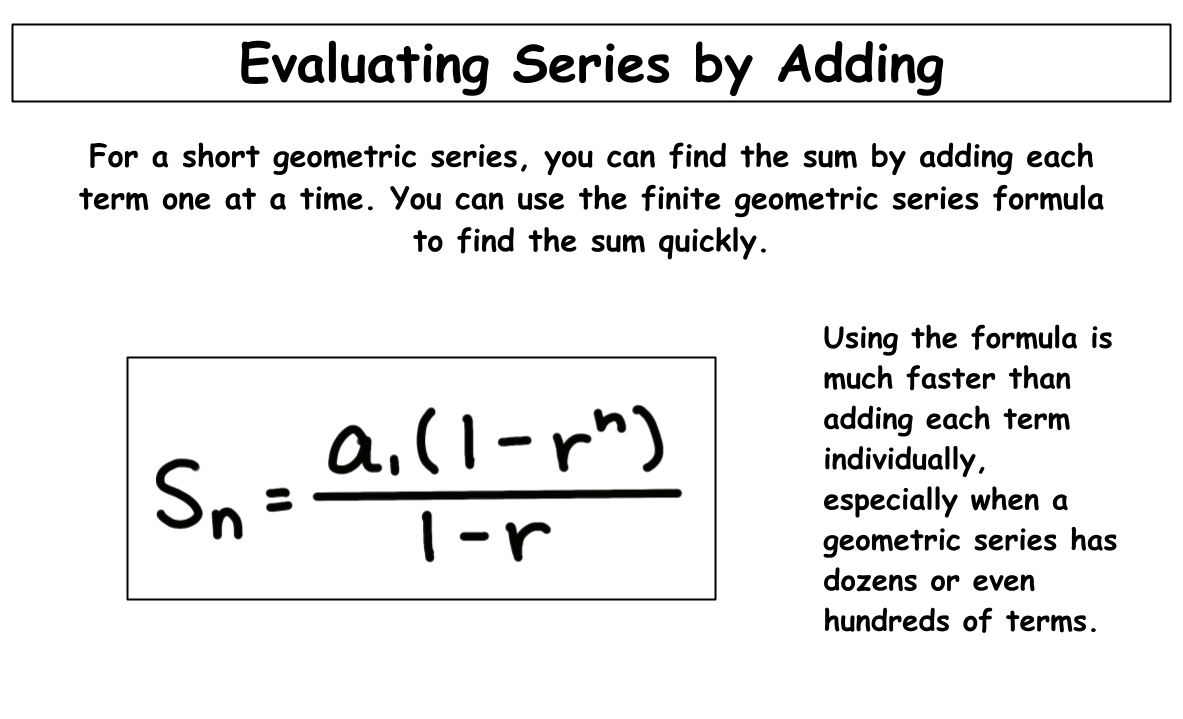
For a short geometric series, you can find the sum by adding each term one at a time. You can use the finite geometric series formula to find the sum quickly.
Using the formula is much faster than adding each term individually, especially when a geometric series has dozens or even hundreds of terms.

Image source: by Anusha Rahman

We can use the formula:

Sn=a(1−rn)1−rS_n = \frac{a(1-r^n)}{1-r}

, where:

  • SnS_n is the sum of the first nn terms
  • aa is the firm term
  • rr is the common ratio
  • nn is the number of terms

To use the formula, first identify the first term and the common ratio. Then, count the total number of terms in the series. Substitute these values into the formula and simplify carefully, remembering to evaluate the exponent before performing multiplication and division.

As you've seen, using a formula makes it much easier to evaluate a geometric series with a large number of terms. Unlike an arithmetic sequence, where the terms change by adding a constant difference, a geometric series changes by multiplying by a constant ratio. In later lessons, you'll extend this idea to infinite series, where the number of terms approaches ∞\infty. You'll also learn when an infinite geometric series has a finite sum and how to use the formula involving 11−r\frac{1}{1-r} to find that value.

Type a concept, like “slope” or “photosynthesis”.

↑ ↓ to choose · Enter to openSearch explanations and problems