Interactive · 1 question

Whole Number Exponents

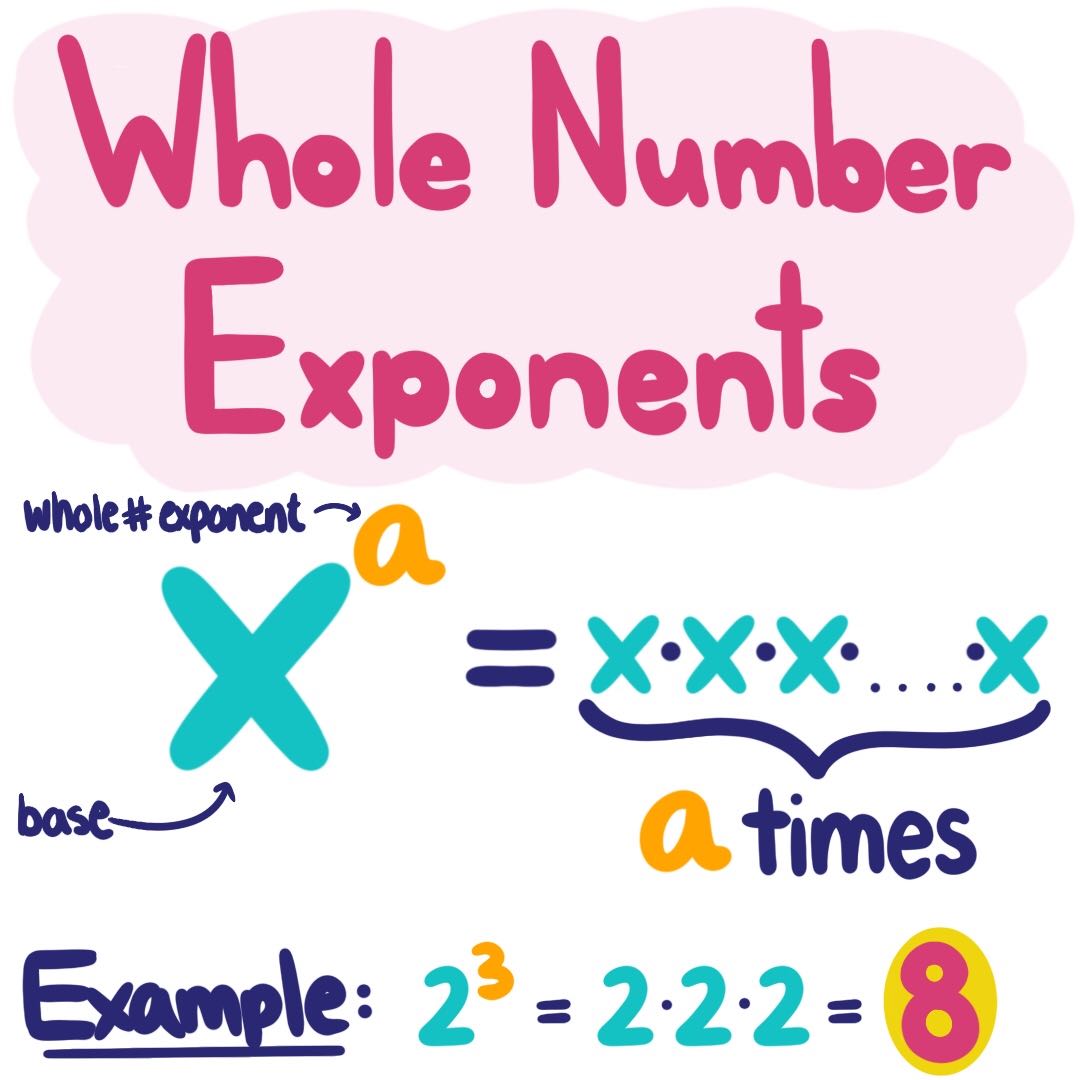
When you raise a number (called the base) to a whole number exponent (called the power), you're essentially multiplying that number by itself however many times the exponent says. Here's how it works:

Whole Number Exponents: x^a = x times x times x times x......times x (x multiplied by itself a times). For example, 2^3 = 2 times 2 times 2 = 8

Image by Caroline Kulczycky

Here's another example: 949^4can also be written as: 94=9⋅9⋅9⋅9=6,5619^4 = 9 \cdot 9 \cdot 9 \cdot 9 = 6{,}561

The exponent might be any natural number. If the exponent is 11, you can remove the exponent. It is the same as the identity property of multiplication.

61=66^1 = 6

What is 53?5^3?

Choose one answer

Spot the idea in disguise

In a contest problem, this idea hides inside a situation you have not seen before. Learning to spot it is the real skill. These are real problems from the AMC 8, AMC 10, AMC 12 and AIME, the national math competitions for middle and high school students, each with a worked solution on LIVE by Po-Shen Loh.

Interactive · 1 question

What are Exponents?

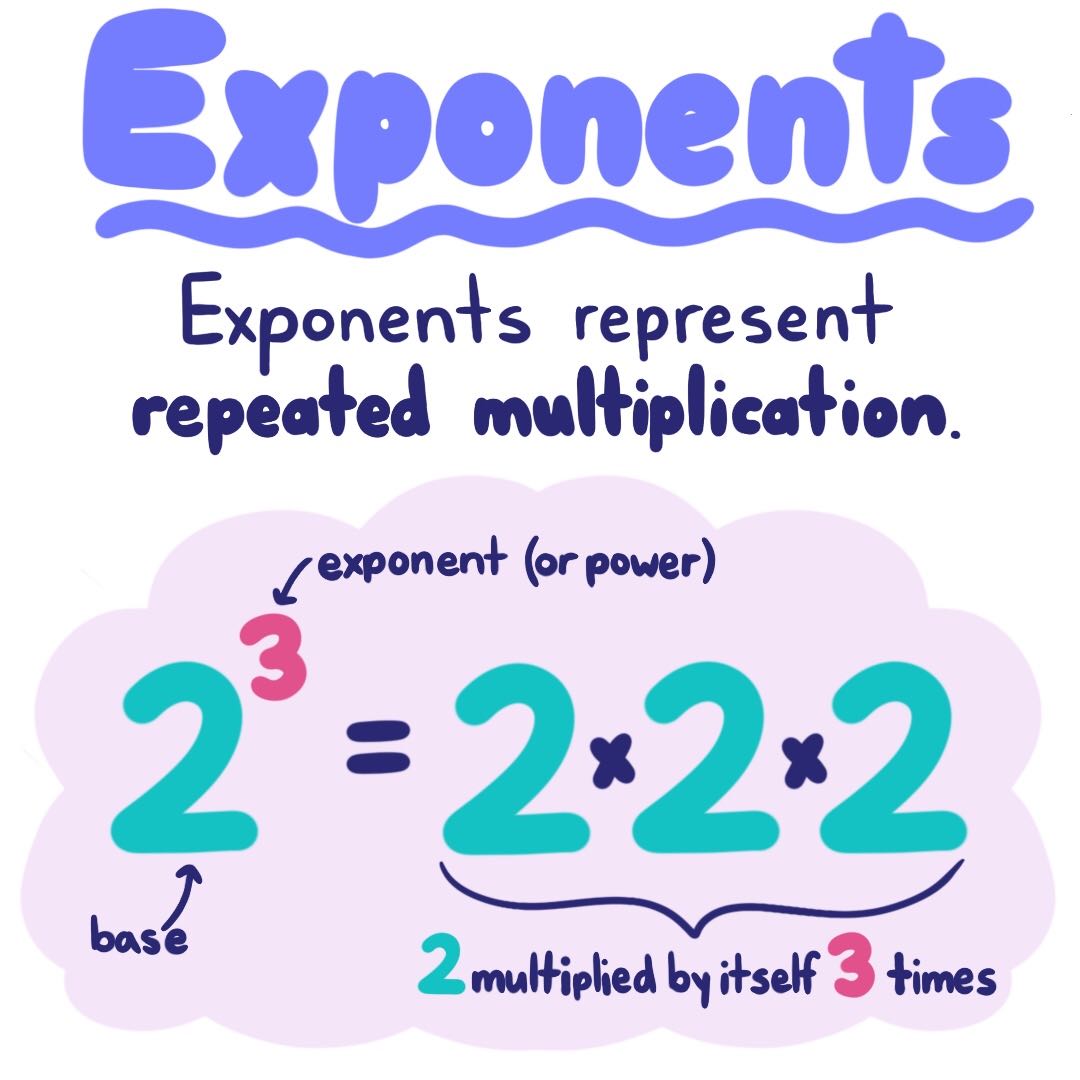
Let's say you have one number (called a base), and to the top right of it, there's another number (called an exponent or a power). For example, consider: 232^3

You can describe this expression by saying two raised to the power of three, two to the power of three, or two to the third power.

But what does this mean?

Exponents: exponents represent repeated multiplication. For example, 2^3 = 2 x 2 x 2. 2 is the base, 3 is the exponent, or the power. 2^3 is 2 multiplied by itself 3 times.

Image by Caroline Kulczycky

So to evaluate these types of expressions, multiply the base by itself a total of the value of the exponent times.

Here's another example: 112345212553353=5×5×5=125\begin{align} &\phantom{} \phantom{} \tiny{1} \phantom{12345} \tiny{2} \phantom{12553} \tiny{3}\\ 5^3 = &5 \times 5 \times 5 = 125 \end{align}

Let's do another example.

Evaluate 34.3^4.

Choose one answer

Video · + 1 min read

(Video) Intro to Exponents

by Math Antics

Here's a good video by mathantics that explains the basics of exponents!

Summary\large{\text{Summary}}

The video draws an analogy to the relationship between addition and multiplication.

2×3=6↙↓↘   2+2+2=62\times 3=6\\ \swarrow \downarrow\searrow\\ \quad \,\,\,2+2+2=6

We can think of multiplication is repeated addition. In the example above, the multiplication of 22 by 33 is representing the addition of 22 to itself 33 times. A number multiplied by another number can also be added repeatedly. That is, 22 times 33 means the addition of 33 to itself 22 times.

He then reviews the anatomy of an exponent: base→23 ← exponent/index\text{base}\rightarrow 2^{3\,\leftarrow \text{ exponent/index}} The base is the number we want to multiply, while the exponent is the number of copies of the base that we have.

  23=8↙↓↘   2×2×2=8\,\,\quad\quad 2^3=8\\ \swarrow \downarrow\searrow\\ \quad \,\,\,2\times 2\times 2=8

Similarly, exponentiation is repeated multiplication. In the example above, the exponentiation of 22 by 33 is representing the multiplication of 22 by itself 33 times total. Note that this is not equivalent to 323^2, which is 3×3=93\times 3=9, so exponentiation is not commutative. Sometimes we'll have negative exponents rather than whole number exponents. Sometimes the exponents will even be fractions! In fact, it can be any real number. But usually they're whole numbers.

Finally, some notation: a power of 22 is often called "squared," while a power of three is often called "cubed."

Test Yourself: What is 545^4?

Choose one answer

Type a concept, like “slope” or “photosynthesis”.

↑ ↓ to choose · Enter to openSearch explanations and problems