Here's a video by patrickJMT where he goes over some more examples using Newton's Method.
The problem he looks at is:
Compute two iterations of Newton's method for the given function and indicated initial guess:
f(x)=x2−8, x1=3
xn+1xn+1=xn−f′(xn)f(xn)=xn−2xnxn2−8
Let's do the first iteration.
x2x2x2=x1−f′(x1)f(x1)=3−2(3)32−8=617
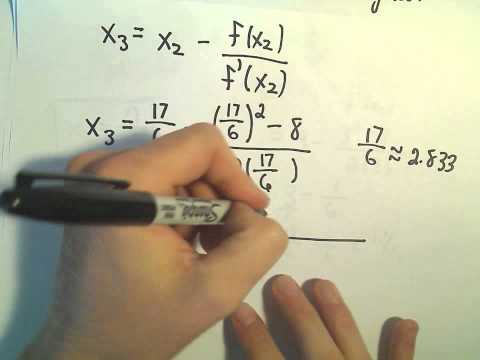
Now the second iteration.
x3x3x3=x2−f′(x2)f(x2)=617−2(617)(617)2−8≈2.82843
Here's another video with another example.
Apply two iterations of Newton's Method to approximate the x-value of a point of intersection of these two functions using the given initial guess:
f(x)=x2−4, g(x)=2x−3, x1=0
What is the value of x3?
If we wanted to find the intersection of these two functions we would set them equal to each other.
x2−4=2x−3
What Newton's Method does is look for where the function equals zero. So we can rewrite this as:
x2−2x−1=0
Now we just apply Newton's Method do our new function which we'll call h(x).
xn+1xn+1=xn−h′(xn)h(xn)=xn−2xn−2xn2−2xn−1
The first iteration gives us:
x2x2x2=x1−h′(x1)h(x1)=0−2(0)−202−2(0)−1=−21
The second iteration give us:
x3x3x3=x2−h′(x2)h(x2)=−0.5−2(−0.5)−2(−0.5)2−2(−0.5)−1=−125
Here's one more video on Newton's Method. This one is to show you how this method can fail.
Given the following equation and initial guess, why would Newton's Method fail to approximate a solution?
f(x)=(x−2)2−1; x1=2
We want to start at an x that gives us something close to zero. If we plug in x=2 we get out f(2)=−1 which is close. So why will this not work? Let's look at the graph.
Newton's Method looks at the tangent line at the point we choose. We then want to see where this tangent line hits the x-axis because that place becomes our new x value. But this point gives us a horizontal tangent line which doesn't hit the x-axis.
Let's see what would happen if we didn't notice this and instead jumped right in to using the method.
xn+1xn+1=xn−f′(xn)f(xn)=xn−2(xn−2)(xn−2)2−1
So our first iteration yields:
x2x2x2=x1−f′(x1)f(x1)=2−2(2−2)(2−2)2−1=2−0−1
And we all know we can't divide by zero.