Типові розклади: Різниця квадратів

Interactive · 3 questions

A difference of two squares is an expression in the form x2−y2x^2 - y^2. It expands to the expression (x+y)(x−y)(x + y)(x - y). When multiplying the two terms (x+y)(x + y) and (x−y)(x - y), the coefficient of the term with both xx and yy is equal to 0.0. That leaves us with only the x2x^2 term and the y2y^2 term.

Here are some examples:

What is the expanded form of x2−25x^2 - 25?

Choose one answer

Preparing for a math contest?

Working through past problems on one idea at a time is one of the most effective ways to prepare. These are real problems from the AMC 8, AMC 10, AMC 12 and AIME, the national math competitions for middle and high school students, each with a worked solution on LIVE by Po-Shen Loh.

Interactive · 7 questions

Difference of Squares

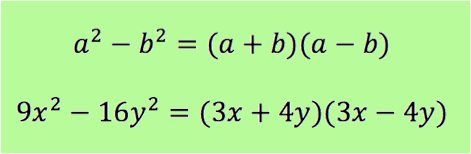
There's only one big thing you need to remember for this topic, and it's this equation:

a^2 - b^2 = (a + b)(a - b)

Image source: By Expii

Notice that the left side of the equation above is literally the difference (i.e. subtraction) of two perfect squares.

Every time you see an expression in which one perfect square is being subtracted from another--as is depicted on the left side of the equation above--you can expand that expression into the form that you see displayed on the equation's right side.

Let's look at some examples that apply this equation to differences of perfect squares.

First, consider the expression 9x2−16y29x^2-16y^2. Is this an example of a difference of squares?

Choose one answer

Video · + 1 min read

(Video) The Difference of Squares

by mathman1024

This by mathman1024 that shows how to employ the difference of squares method in factoring binomials.

Summary\large{\text{Summary}}

This method makes use of the difference of squares equation, which states the following:

a2−b2=(a+b)(a−b)a^2-b^2=(a+b)(a-b)

The first binomial that our instructor factors is:

x2−25x^2-25

However, you might notice that we can rewrite this binomial like so:

(x)2−(5)2(x)^2-(5)^2

As our instructor points out, we can let xx be our aa in our difference of squares equation, and we can let 55 be our bb in our difference of squares equation. Then, we just have to substitute those terms into the right-hand side of our equation:

(x+5)(x−5)(x+5)(x-5)

He then goes over some additional problems, and some of them are more complex than others. See how many you can figure out on your own, and then watch the video above to see if you were correct.

  1. x2−49x^2-49
  2. 4x2−94x^2-9
  3. x2−12164x^2-\frac{121}{64}
  4. x10−16x^{10}-16
  5. 49x4−81y1249x^4-81y^{12}
  6. 100x7−25x3y4100x^7-25x^3y^4 (Hint: do the terms in this binomial have a GCF?)
  7. x4−81x^4-81 (Hint: can either of this binomial's factors be factored again?)

Test Yourself: Factor x2−169x^2-169

Choose one answer

Type a concept, like “slope” or “photosynthesis”.

↑ ↓ to choose · Enter to openSearch explanations and problems