Використання sin, cos, tan для знаходження сторін трикутника

Interactive · 6 questions

SOH-CAH-TOA

We are going to use the trigonometric functions of sine, cosine, and tangent only with right triangles (triangles that contain a 90∘90^{\circ} angle).

These functions will allow us to figure out the lengths of a triangle's sides.

An image of a right triangle.  The two sides of adjacent to the right angle are labeled leg.  The side opposite the right angle is labeled hypotenuse.

Recall that the hypotenuse is the side of the triangle across from the right angle.

NOTE: we are going to be using calculators for these types of problems. Since we've got our angles written in degrees (∘^{\circ}), MAKE SURE YOUR CALCULATOR IS IN THE DEGREES MODE, NOT RADIANS.

This graphic shows the relationships between the trigonometric expressions and the legs of the right triangle.  Sin(theta) is opposite over hypotenuse.  Cos(theta) is adjacent over hypotenuse.  Tan(theta) is opposite over adjacent.

In order to help remember which equation is which, many people use the abbreviation SOH-CAH-TOA.

SOH: Sine of the angle equals Opposite side length divided by Hypotenuse

CAH: Cosine of the angle equals Adjacent side length divided by Hypotenuse

TOA: Tangent of the angle equals Opposite side length divided by Adjacent side length

In the set of equations above, θ\theta represents the measurement of the angle. Let's look at an example to see how to use them.

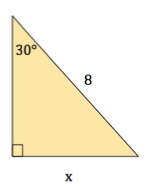
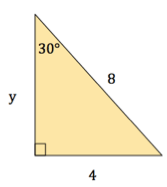
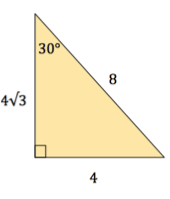
This is a right triangle.  The side opposite the right angle has length 8.  One angle adjacent to the right angle measures 30 degrees.

What is the length of the hypotenuse of this triangle?

Choose one answer

Illustrated · 1 min

SOH-CAH-TOA is in the stars!

SOH-CAH-TOA spelled out as a constellation in the night sky.

SOH-CAH-TOA isn't just some silly memory rule to help you pass your math class. It is used in the real world! Below is an example of how it can be used to find the distance between earth and a star (ROSS 154154) around 1010 lightyears away! That means it takes 1010 years for light to travel from earth to the star.

A right triangle formed by the distances between ROSS 154, the Sun, and the Earth.  The right angle is at the Sun, while the parallax angle is at Ross 154.

In order to solve for this distance we need to know two things:

1) The Parallax Angle (θ\theta)

2) The Distance from Earth to the Sun (11 AU)

Parallax Angle: half the angle the star has been observed to move in six months (from winter to summer).

1 Astronomical Unit (AU): the distance from the Earth to the Sun

The Parallax Angle for our star of interest, ROSS 154 is 9.3533x10−59.3533x10^{-5} (ugly! right?)

An image of the Earth and the Sun.  The distance between them is 1 AU.

Alright! Now we can use what we know about the SOH-CAH-TOA rule to find the distance to the star ROSS 154154 in Astronomical Units. Spoiler: it's super far away!

An updated diagram of the right triangle.  We now see that the parallax angle is .33672 and the distance between the Earth and the Sun is 1 AU.

Recall:

sin⁡(θ)=OppositeHypotenuse\sin(\theta) = \frac{\text{Opposite}}{\text{Hypotenuse}} θ=9.3533x10⁻⁵\theta = 9.3533x10^{-5}

Plug in your theta (the parallax angle)

sin⁡(9.3533x10⁻⁵)=1AUDistance to star\sin (9.3533x10^{-5}) = \frac{1AU}{\text{Distance to star}}

Solve for the Distance to star

Distance to star=1AUsin⁡(9.3533x10⁻⁵\text{Distance to star} = \frac{1AU}{\sin (9.3533x10^{-5}} Distance to star=612,572.8835AU\text{Distance to star} = 612,572.8835 AU

So our star is about 612,572612,572 farther from us than the sun!

Interactive · 5 questions

So, you’ve been cruising along through Algebra 1. You’ve learned everything from factoring polynomials to dealing with inequalities, with your trusty graphing calculator at your side the entire time. But now that you’re starting to delve into a bit of geometry and trigonometry, you’ll be seeing some fancy terms for the first time. What’s a sine? Does a cosine just coexist with a sine or something? What in the world is going on?

We’ll get to all of the juicy details soon, but let’s establish some basics first. The three trigonometric functions you’ll need to know for now are sine, cosine, and tangent. But before we proceed, we’ll have to give some names to the sides of this right triangle with angle θ\theta.

If we label one of the acute angles of a right triangle Θ, then the "opposite" is opposite of Θ, the "adjacent" is adjacent to Θ, and the "hypotenuse" is the longest side of the triangle.

Mathematicians: spicing the world up with creative names since the beginning of time.

Now that we’ve got some names to go with the sides of that right triangle, let’s finally find out what our trigonometric functions are! Essentially, they’re ratios of the sides of a right triangle, as seen in the following image:

Here we define the trigonometric functions. sinΘ = opposite/hypotenuse, cosΘ = adjacent/hypotenuse, and tanΘ = opposite/adjacent.

Wait, a sine is literally just a fraction? I thought it would be harder than that...

We’re just dividing different side lengths by each other. Not too hard at all!

The mnemonic SOH-CAH-TOA is used to remember these ratios -- sine is opposite over hypotenuse, cosine is adjacent over hypotenuse, and tangent is opposite over adjacent.

Here’s some food for thought: if we label the other acute angle of the right triangle β\beta, we can also write out the trigonometric functions in terms of β\beta.

Which of the following would be equivalent to sin⁡θ\sin\theta?

Choose one answer

Video

(Video) Basic Trigonometry to Work out Unknown Sides

by tecmath

In this video by tecmath it is shown how to find the missing sides of a triangle using trigonometric functions.

Summary\large{\text{Summary}}

Trigonometry is not as scary as it sounds! To solve these problems, you need to be able to label the sides of a right triangle based on the angle theta.

triangles showing sin cos and tan

The steps for solving these problems are:

  • Label sides
  • Work out trig function
  • Substitute values
  • Solve

Video · + 1 min read

(Video) Special Triangles

by MySecretMathTutor

This video by MySecretMathTutor explores helpful strategies in applying SOH-CAH-TOA to special triangles.

Summary\large{\text{Summary}}

Special triangles are triangles with specific sets of angles that form consistent relationships with its sides.

An implementation of the approach discussed in the video is finding these patterns within shapes such as squares and equilateral triangles. Though these don’t appear to have angles that work within the 30−60−9030-60-90 or 45−45−9045-45-90 agenda, these shapes can be divided to facilitate the rules of the special triangles.

For example, consider a square with sides “xx” and an equilateral triangle with sides “zz.”

A square contains all 9090 degree angles, but if we sketch in a line that bisects angles in opposite corners, we produce two 45−45−9045-45-90 triangles within the square. Since we know all of the square’s sides are the same, both sides opposite of the 4545 degree angles remain as “xx.” To find the hypotenuse, we simply apply the formula of the special triangle that was explained in the video above, in which the hypotenuse is x2x\sqrt{2}.

By dropping a line that bisects the uppermost 6060-degree angle within the equilateral triangle and is perpendicular to the base, we can produce a similar problem as the one above. This line creates two 30−60−9030-60-90 triangles. The hypotenuse, in this case, remains as zz, and the base, due to its bisection, becomes z2\frac{z}{2}. The bisecting line, based on the pattern of the 30−60−9030-60-90 triangle (which uses the Pythagorean theorem), comes out to length x32\frac{x\sqrt{3}}{2}.

Type a concept, like “slope” or “photosynthesis”.

↑ ↓ to choose · Enter to openSearch explanations and problems