Як можуть числа не потрапити в область визначення?

Before this, knowDomain and Range - Definition & Finding Graphically

Read · 2 min

When you are trying to find the domain of a function algebraically, it may be helpful to find all the values that CANNOT be in the domain −- these are the values that would "break" the function, or make the function undefined. Values that cause you to you divide by 0,0, take the square root of a negative real number, or take the log of a non-positive number will not be in your domain, because they yield undefined functions.

Case 1: Dividing by 0\textbf{Case 1: Dividing by $0$}

When you divide by 0,0, your function is undefined. So, any value that gives you a 00 in the denominator of your function will not be in the domain. For example, let's look at the function f(x)=2x−4.f(x)=\dfrac{2}{x-4}. What value of xx will cause the denominator to be 0?0? x−4=0→x=4\begin{align} x-4&=0\\ \rightarrow x&=4 \end{align}

When x=4,x=4, then f(4)=20,f(4)=\dfrac{2}{0}, which is undefined. Thus, 44 cannot be in our domain. So, our domain is (−∞,4)∪(4,∞).(-\infty, 4) \cup (4, \infty).

Case 2: Taking the square root of a negative real number\textbf{Case 2: Taking the square root of a negative real number}

When we restrict ourselves to working with real numbers (as opposed to complex numbers), recall that the square root of a negative real number is undefined. So, any value that gives you a negative number under the square root will not be in the domain. Take a look at g(x)=x+7.g(x)=\sqrt{x+7}. What value(s) of xx gives you a negative number under the square root? x+7<0→x<−7\begin{align} x+7&<0\\ \rightarrow x&<-7 \end{align} When x<−7,x<-7, then g(x)g(x) will be the square root of a negative number, and will therefore be undefined. Thus, all real numbers less than 77 cannot be in our domain. So, our domain is [−7,∞).[-7, \infty).

Case 3: Taking the log of a non-positive number\textbf{Case 3: Taking the log of a non-positive number}

If you take the log of a negative number or 0,0, the result will be undefined. So, any value that causes you to take the log of a non-positive number will not be in the domain. For example, take a look at h(x)=ln⁡(x2−1).h(x)=\ln(x^2-1). What value(s) of xx gives you a non-positive number? x2−1≤0x2≤1x2≤1, and x2≥−1x≤1, and x≥−1−1≤x≤1\begin{align} x^2-1&\leq 0\\ x^2&\leq 1\\ \sqrt{x^2}&\leq \sqrt{1}, \text{ and } \sqrt{x^2} \geq -\sqrt{1}\\ x&\leq 1, \text{ and } x \geq -1\\ -1 &\leq x \leq 1 \end{align} When −1≤x≤1,-1 \leq x \leq 1, then h(x)h(x) will be the log of a non-positive number, and will therefore be undefined. Thus, all real numbers between (and including) −1-1 and 11 cannot be in our domain. So, our domain is (−∞,−1)∪(1,∞).(-\infty, -1) \cup (1, \infty).

Read · 1 min

The domain of a function is just all the numbers which it makes sense to plug into the function. There are a few things which we can't do:

  1. Dividing by 00

  2. Taking a square root of a negative number

  3. Taking a log of a non-positive number

So, when trying to find the domain of a function, just look for all the values that don't do one of the above things and you should be set!

We can show this with an example. Let's try finding the domain of f(x)=ln⁡(x−2)xf(x) = \frac{\ln (x-2)}{\sqrt{x}}.

We know we can't divide by 00, so we can't plug in x=0x=0.

Since we can't plug in negative numbers into a square root, we know all negative values for xx don't work either.

For the numerator, we know we have to have a positive number in the expression for ln⁡\ln. Therefore, x−2>0x-2 > 0, which means x>2x> 2.

Combining these, we get the domain of the function is all positive values for xx which are greater than 22. In interval notation, this is simply (2,∞)(2,\infty).

Video · + 1 min read

(Video) Finding the Domain of a Function Algebraically

by patrickJMT

This video by patrickJMT shows you how to find the domain of a function algebraically, without a graph.

Summary

When approaching domain functions, there are two key restrictions to keep in mind:

  • We don't want a zero in the denominator of a fraction, so we must omit those values of xx

  • For any square roots or any even powered root, we don't want negative values under the radical after simplifying.

Example

Find the domain of: f(x)=1x2−7x−30f(x)=\frac{1}{x^2-7x-30}

Our first step is to write out the values that are bad. These are the values that cannot be included in the domain. We don't want any value of xx that makes the denominator zero, so we need to find values of the denominator that will make x=0x=0. Factoring tells us that x=10x=10 and x=−3x=-3.

That means our domain is: all xx values, except x=10x=10 and x=−3x=-3. In interval notation, this looks like: (−∞,−3)(-\infty,-3) U (−3,10)(-3,10) U (10,∞)(10,\infty)

Try the next example on your own! Then watch the video to check your work.

Find the domain of: g(x)=2x+3g(x) = \sqrt{2x+3}

Illustrated · 1 min

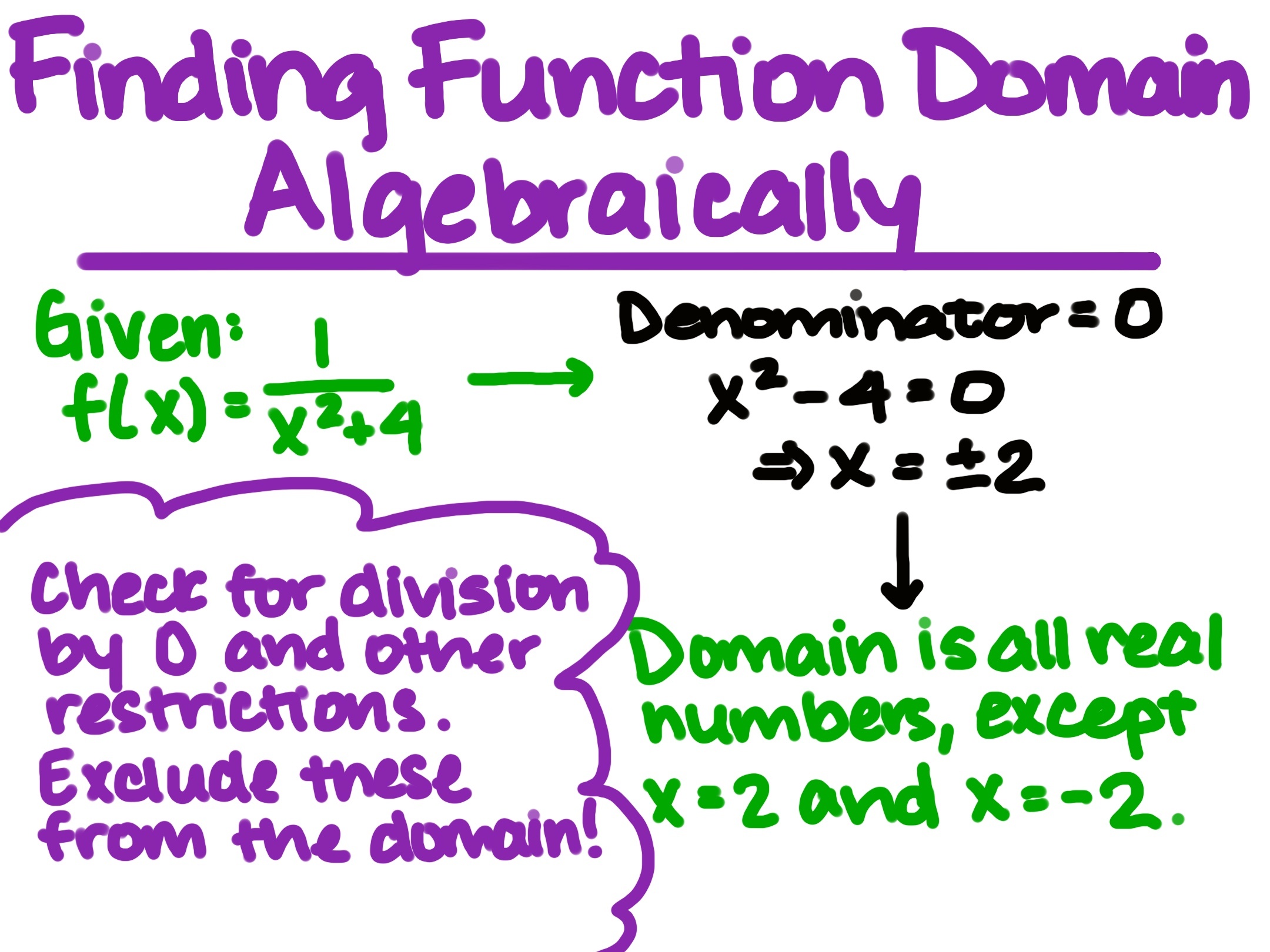
Finding Function Domain Algebraically

Now that we've learned how to find the range of a function algebraically, we can move on to the next lesson.

To find the domain of a function algebraically, we use a counterintuitive method. We find values that xx cannot have.

Finding Function Domain Algebraically
Check for division by 0 and other restrictions. Exclude these from the domain!

Image source: by Anusha Rahman

Given a function, look for the values that xx cannot have. For example, the denominator can never by 00, so we have to find the values of xx where the denominator is 00. Those values of xx are what we will exclude from the domain.

Type a concept, like “slope” or “photosynthesis”.

↑ ↓ to choose · Enter to openSearch explanations and problems