Зворотні тригонометричні функції: знахождення значень

Before this, knowКосекансСекансКотангенс

Interactive · 1 question

We have already learned about the reciprocal trigonometric functions (secant, cosecant, and cotangent) and their relationship with sine, cosine, and tangent. Using this relationship, we can find the exact values these functions!

##Finding Values

Let's look at an example right triangle with the sides labeled:
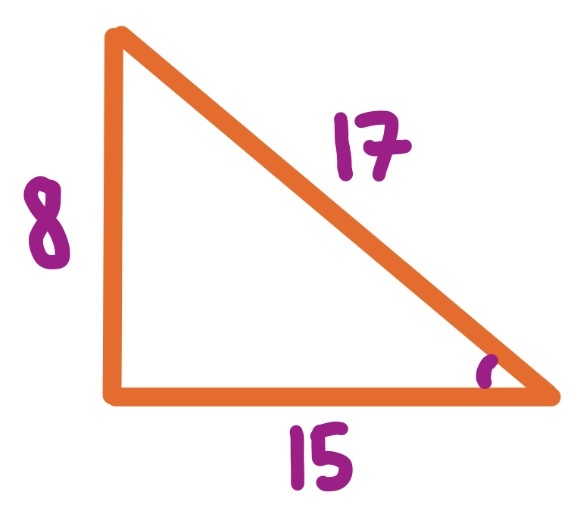
Triangle with sides labeled: 8, 15, 17

Image source: by Trisha

The sine of the angle indicated is 817\frac{8}{17}.

As we already studied...

csc⁡(θ)=1sin⁡(θ)\csc(\theta)= \frac{1}{\sin(\theta)}

Therefore, if sin⁡(θ)=817\sin(\theta) = \frac{8}{17}, then csc⁡(θ)=1817\csc(\theta) = \frac{1}{ \frac{8}{17}}, which =1718=\frac{17}{18}. In other words, to find values of reciprocal trig functions, we can find the reciprocal of it's corresponding sine, cosine, or tangent function.

For a more challenging problem, let's try finding the reciprocal function using unit circle values.

Find the value of cosecant when given sin⁡(π6)\sin(\frac{\pi}{6}).

Choose one answer

Illustrated · 1 min

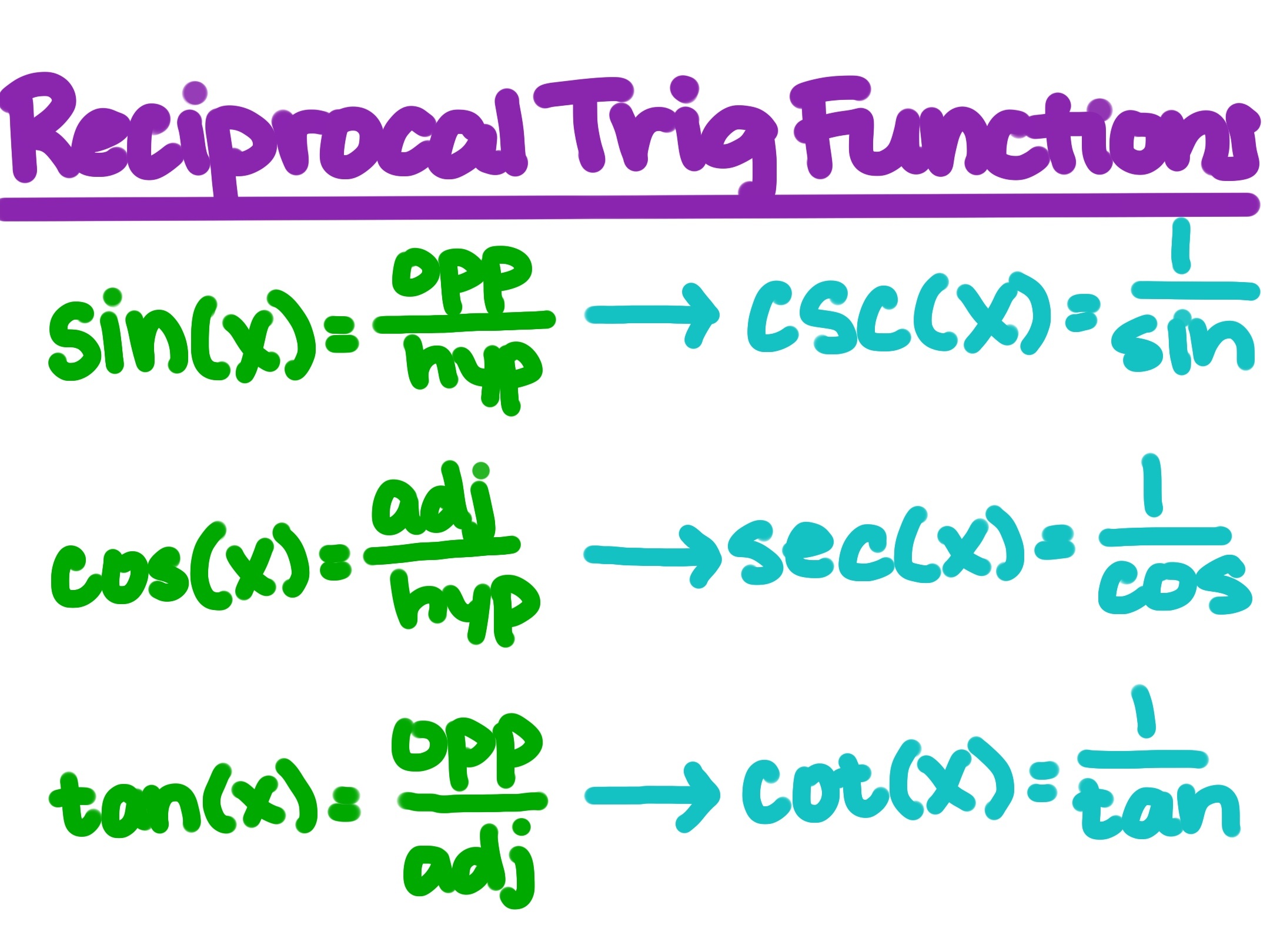
Reciprocal Trig Functions

We've learned about the individual reciprocal trigonometric functions, but let's put them all together!

Reciprocal Trig Functions
sin(x)=opp/hyp --> csc(x) = 1/sin
cos(x)=ajd/hyp --> sec(x) = 1/cos
tan(x)=opp/adj --> cot(x) = 1/tan

Image source: by Anusha Rahman

We can also think of trigonometric reciprocal functions as:

sin(x)=oppositehypotenuse→csc(x)=hypotenuseoppositesin(x) = \frac{\text{opposite}}{\text{hypotenuse}} \rightarrow csc(x)=\frac{\text{hypotenuse}}{\text{opposite}} cos(x)=adjacenthypotenuse→csc(x)=hypotenuseadjacentcos(x) = \frac{\text{adjacent}}{\text{hypotenuse}} \rightarrow csc(x)=\frac{\text{hypotenuse}}{\text{adjacent}} tan(x)=oppositeadjacent→csc(x)=adjacentoppositetan(x) = \frac{\text{opposite}}{\text{adjacent}} \rightarrow csc(x)=\frac{\text{adjacent}}{\text{opposite}}

If you know the length of the sides, you can fill in the given information and solve for what you are looking for! The pythagorean theorem is also an option, but you'll often find that if you know one angle, the reciprocal trig ratios are easier.

Video

Solving Reciprocal Trig Functions

by Joel Speranza Math

In this video by Joel Speranza Math, you will learn how to solve for exact values of reciprocal trig functions.

Summary

Example 1

Solve for θ\theta: sec(θ)=−2\text{sec}(\theta) = -2, 0<x<2π0<x<2\pi

We know that secant is the inverse of cosine, so we can say that:

1cos(θ)=−2−12=cos(θ)θ=2π3,4π3\begin{align} \frac{1}{\text{cos}(\theta)} &= -2 \\ -\frac{1}{2} &= \text{cos}(\theta) \\ \theta &= \frac{2\pi}{3}, \frac{4\pi}{3} \\ \end{align}

Try the next example on your own before watching the video!

Example 2

Solve for θ\theta: cot(x)=1\text{cot}(x) = 1, 0<x<2π0<x<2\pi

Type a concept, like “slope” or “photosynthesis”.

↑ ↓ to choose · Enter to openSearch explanations and problems