Що таке дріб?

Illustrated · 1 min

Fractions have a numerator and a denominator

Fractions (and ratios) are made up of two numbers: the numerator and the denominator.

The denominator is the bottom number, and represents how many parts are possible—in other words, how many parts go into a whole.

The numerator is the top number, and represents how many parts you have. It might be less than the whole!

If the denominator is a 00 that is bad. We are not allowed to divide by zero.

If the denominator is a 11, our fraction is actually an integer. This suggests that we can add, subtract, multiply, or divide fractions. Adding and subtracting fractions is trickier, especially if we don't have common denominators. But it can be done.

For now though, we want to show you a visual of the different parts of a fraction.

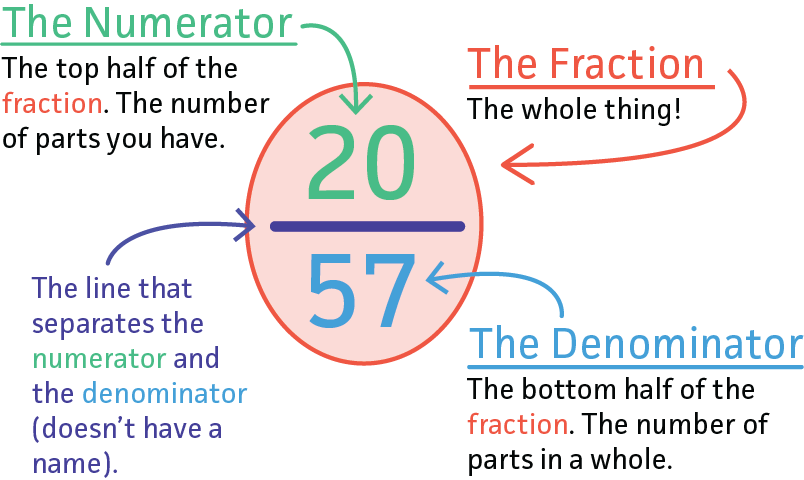
The fraction 20/57. The numerator is the top half of the fraction. The number of parts you have. It is 20. The denominator is the bottom half of the fraction. The number of parts in a whole. It is 57. The fraction is the whole thing. The line that separates the numerator and denominator doesn't have a name.

Image Source: Zora Gilbert

Every fraction has a multiplicative inverse. The inverse of fraction ab\frac{a}{b} is ba\frac{b}{a}, and is also called the reciprocal. If we multiply a fraction by its multiplicative inverse, we get 11. The numerator and denominator cancel each other out.

Math as a puzzle

Many contest problems feel more like puzzles than homework. They are a good way to find out how much fun math can be. These are real problems from the AMC 8, AMC 10, AMC 12 and AIME, the national math competitions for middle and high school students, each with a worked solution on LIVE by Po-Shen Loh.

Video · + 2 min read

(Video) Introduction to Fractions

by mathman1024

This video by mathman1024 explains fractions.

Summary\large{\text{Summary}}

A fraction is a number of the form: ab\frac ab where aa and bb are integers and b≠0b\ne0. A fraction represents the division of two numbers. The fraction symbol means the same thing as ÷\div.

The number on top is called the numerator and the number on the bottom is called the denominator. This provides an alternative to writing a number with a decimal point. If you perform long division, you may get a decimal. In many cases, the fractions are easier to write.

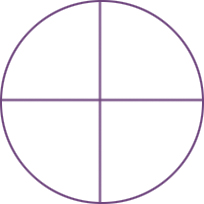
Let's look at an example of a fraction, 34\frac34. What does this mean? Well, let's look at a picture to find out. Say we have a circle. We will break it into a number of equal parts. Just like you would slice a pizza.

A circle

Image Source: Alex Federspiel

The denominator tells us how many parts this circle is broken into. Since the denominator for 34\frac34 is 44, we break the circle into 44 equal parts.

A circle broken into 4 pieces.

Image Source: Alex Federspiel

Now the numerator tells us how many of these 44 parts we have. Since the numerator for 34\frac34 is 33, we shade in 33 of the parts.

Of the 4 pieces, 3 are shaded in .

Image Source: Alex Federspiel

So, here's a picture representation of 34\frac34. For one circle, we have 33 of the 44 equal parts.

You can also use boxes to represent fractions. Look at the picture and see if you can figure out what the fraction is.

3 boxes where 1 is filled in.

Image Source: Alex Federspiel

If you guessed 13\frac13 you are correct!

What about when the numerator is larger than the denominator, like 52\frac52. Well, this means that our shape is broken into 22 equal pieces but we have 55 of these pieces. So therefore, we will need to have more than one of our shape.

3 diamonds. 2 and a half are filled in.

Image Source: Alex Federspiel

So as you see, we have our shapes broken into two equal pieces and we have 55 of those pieces. Notice that we needed to make three diamonds to represent this. Two are filled in completely. This shows that the fraction can also be written in mixed fraction form as 2122\frac12. Both 2122\frac12 and 52\frac{5}{2} have the same value. We can convert from mixed numbers to improper fractions and vice-versa.

A proper fraction is less than 11. These are fractions with denominators bigger than numerators. They have smaller numerators than denominators. 12, 23, 14, 32017\frac12,\ \frac23,\ \frac14,\ \frac3{2017}

An improper fraction has a greater numerator than the denominator. 32, 73, 119, 20172\frac32,\ \frac73,\ \frac{11}9,\ \frac{2017}{2}

Any fraction, proper or improper, is a rational number. This is because every fraction is one integer divided by another. We could divide multiple pairs of numbers and get the same result each time. If this happens we have what are called equivalent fractions.


Interactive · 2 questions

As Above so Below

By now, you've probably seen a fraction.

3/5

Here's a fraction if you've never seen one

Image Source: Alex Federspiel

And now's the part where we introduce two new vocab words just to make your life harder. These two words, the numerator and the denominator, are the parts of a fraction.

  • The numerator is the top number. In the picture above, the numerator is 33.
  • The denominator is the bottom number. In the picture above, the denominator is 55.

When a numerator and a denominator love each other very much, they make a fraction.

Let's look at a real world explanation with everyone's favorite topic, pizza. Say you have a whole pizza, split into fourths, and you eat one piece.

A pizza in 4 equal slices. 1 is missing.

Here's the pizza, plus the after image of the one you ate.

The numerator tells us how many slices we currently have left: 33.

The denominator tells us how many slices we had to start: 44.

Therefore, the fraction 34\frac34 can represent the amount of pizza we have left.

Select everything that is a numerator in the expression: 12+x6\frac12+\frac x6

Choose all correct answers

Type a concept, like “slope” or “photosynthesis”.

↑ ↓ to choose · Enter to openSearch explanations and problems