Read · 2 min
As we've studied thermodynamics, we've seen two ways to think about energy. The first was internal energy. It's the sum of the two energy storage methods: potential and kinetic energy. It forms the basis for the first law of thermodynamics. As chemical reactions occur, we change how energy is stored. For reactions at constant pressures, it is easier to calculate enthalpy. Typically, the pressure is atmospheric pressure. We defined enthalpy to equal heat. So, we found the energy transferred because of temperature differences. Enthalpy's direction indicates an exothermic or endothermic reaction. Negative enthalpies denote energy transferred from the system to its surroundings. Positive enthalpies are surroundings to the system.
We also looked at entropy. It forms the basis for the second and third laws of thermodynamics. It measured energy dispersal. Anything that increased energy's dispersion increased entropy. We looked at the example of gas diffusion. As a gas moves from a high concentration area to a lower one, the energy becomes more spread out. Entropy increased. Another example would be going from two moles of reactant to four moles of product. The product's energy disperses between more molecules.
The combination of enthalpy and entropy is Gibb's free energy. It's the total energy available for a system to do work. Gibb's free energy is paramount for understanding chemical reactions! The value tells us if a chemical reaction is spontaneous.
Changes in Gibbs Free Energy
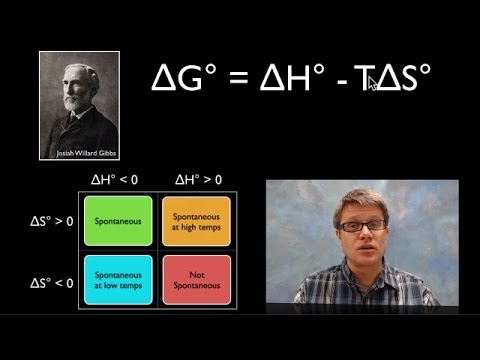
For any chemical reaction, we can calculate Gibb's free energy change. We use the equation . The value of tells us the reaction's spontaneity. Negative is always spontaneous. A positive is always non-spontaneous.
We can see that spontaneity depends on enthalpy, entropy, and temperature. You'll find the relationship between the three in the table below. Notice that in two cases, the spontaneity depends on the temperature. In both cases, the enthalpy and entropy changes are competing. Spontaneous systems want to both release and disperse their energy. Any time that the two compete, temperature becomes the determining factor.
There is a unique case you need to know. What happens when ? The reaction is at equilibrium!
Gibbs Free Energy Practice Problems
- A chemical reaction has an enthalpy change of and an entropy change of at . Find the Gibb's Free energy change. Is the reaction spontaneous, non-spontaneous, or at equilibrium?
- Because is positive, the reaction is not spontaneous.
- What happens if the reaction from question 1 happens at ?
- Because is negative, the reaction is spontaneous.
- For this chemical reaction, enthalpy and entropy are competing. So, its spontaneity depends on temperature. An example of this case might be an exothermic synthesis reaction. For example, the formation of an ionic compound from its elements. An example equation might be, . The mole ratio is 1:1:1. So, we are moving from two moles of reactant to one mole of product. So, entropy decreases. But, the formation of ionic bonds is very exothermic. The electron transfer and the electrostatic attraction release a lot of energy.