Video

(Video) Why Do Geiger Counters Make That Clicking Sound?
by SciShow
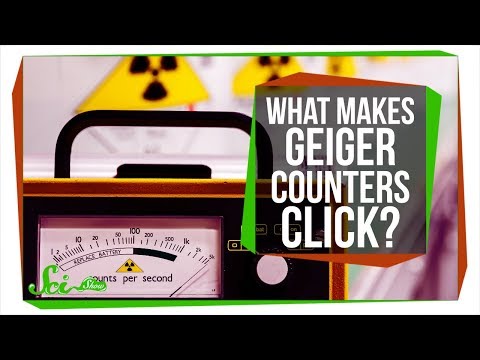
This video will give you a brief overview as to what Geiger counters are, how they work, and what they measure.

Video
by SciShow
This video will give you a brief overview as to what Geiger counters are, how they work, and what they measure.
Read · 4 min
One of my favorite movies is The Dark Knight. I've loved Batman since I was a kid! At the beginning of the movie, the Joker steals a ton of money from a bank. But, it turns out the bank's run by the mob. Batman is trying to track the mob's money. So, he's replaced some of it with radioactive bills. Somehow the Joker knows it and leaves only the radioactive bills. When Batman shows up at the bank, he pulls out a small device and passes it over the money. It begins to make a clicking noise. What was that device? It's a Geiger Counter!
A Geiger counter is an instrument that measures radioactive decay. Hans Geiger developed the original in 1908. At the time, he was working with Earnst Rutherford as a grad student. Later, Geiger received his Ph.D. and became a professor at a university in Germany. Geiger and his graduate student Walther Muller continued to develop the prototype. So, sometimes we call the modern instruments Geiger-Muller counters.
Let's start with how we build a Geiger counter. Inside the instrument is a small, sealed tube. Inside, it is an inert gas. The most common gases are the noble gases helium, neon, or argon. The tube's composition depends on the aim. If the goal is detecting alpha and beta decay, it has a mica window. Mica is a rock formed by the metalloid silicon. But remember, alpha and beta particles have minuscule energy. So, the mica has to have an unbelievably low density. It's super thin! But, for high-energy gamma radiation, we use steel. Remember, steel's an alloy of the transition metal iron and the nonmetal carbon. In both types, the tube connects a circuit. A battery provides the voltage. What do we measure? The detector records changes in the current.
So, how does a Geiger counter work? Let's imagine we're pointing a Geiger counter at a radioactive element. The radiation travels through the air and hits the tube. The collision ionizes some of the gas by knocking out an electron. But remember, the tube is connecting a circuit. So, there is an electric field. So, the ions will move toward the electrodes. The electron accelerates toward the anode. The cation travels to the cathode. But, the movement of charges disrupts the circuit. The disruption causes the current to pulse. The instrument's electronics measure the pulse and convert it to a reading.
Modern Geiger counters have two styles of readouts. The most common is counts. What in the world is a count? It's the number of ionizations. So, every radioactive particle that dislodges an electron generates a count. The display will read the counts per unit of time. So, you might have counts per second or per minute. The other option is to measure a dosage. The SI unit for radiation dosage is the Sievert. It's the product of the quantity and energy of the radiation. But, a standard Geiger counter can't gauge energy. So, we use a modified instrument to measure the dosage.
Finally, why do Geiger counters make a clicking static noise? Some instruments have the option to connect the circuit to a speaker. In general, it produces a static sound. But remember, when radiation hits the tube, it causes the current to pulse. The pulsing is what causes the clicking noise.
The Geiger counter takes advantage of a unique phenomenon. Earlier, I said that the radiation dislodges an electron. The dislodged electron travels towards the anode. But, what happens as it travels? It will hit another electron. But, the original electron still has enough energy to escape the nucleus' attraction. So, now we have two electrons. Both of them get pulled by the electric field. But now, they can both dislodge electrons. So, there is an exponential increase in the number of ionizations. That's why the electric current pulses. It gets really disrupted! We call it the Townsend effect or Townsend avalanche after John Townsend. He was a famous physicist who studied the ionization of gases.
Geiger counters do have some sources of error. The traditional instrument cannot detect a particle's energy. So if we want a dosage, we have to modify it. But, that also means it can't distinguish between different types of radiation. Alpha, beta, and gamma decay are all ionizing. So, they all produce a signal. But, there is no way to distinguish the signals. Another drawback is that the radiation has to be ionizing. For example, neutrons are not ionizing because they don't have a charge. Neutrinos from electron capture are also neutral. So, a source could be producing undetectable radiation. The final limitation is due to the Townsend avalanche. The avalanche quickly amplifies an ionization. This amplification is beneficial for detecting low levels of radiation. But, for large amounts of radiation, it's unreliable. Why? After a certain point, the avalanche has created too many electrons. What's the result? The ions collect at the electrodes. So, the instrument is unable to detect further ionization. All of these can create uncertainty in our measurements.