
Interactive · 6 questions
Most math classes likely have taught the four main triangular points:
Incenter?
Orthocenter?
Centroid?
Circumcenter?
... but there are more triangular centers ...
Gergonne Point and Nagel Point
Gergonne Point: the intersection of the lines through the vertices of a triangle and the points on the opposite sides where the incircle is tangent to them.
We will now proceed to proving this concurrency.
Ceva's Theorem is a tool used to prove the concurrency of three cevians in a triangle. It states that given a triangle , let the lines , , and be drawn from the vertices to the opposite sides. The cevians are concurrent if and only if . Obviously if we obtain this ratio, then the proof follows easily.
Examining the above figure, we see how all the sides of the triangle are tangent to the circle. It follows that and , and , and and are equal tangents. The proof becomes obvious now, as multiplying the three equations results in , and dividing both sides by the right hand side results in , exactly the premises for concurrency as stated in Ceva's Theorem. Thus, we conclude the cevians are concurrent.
Nagel Point is the intersection of the lines connecting the vertices of a triangle to the points of tangency with the excircles on the opposite sides.
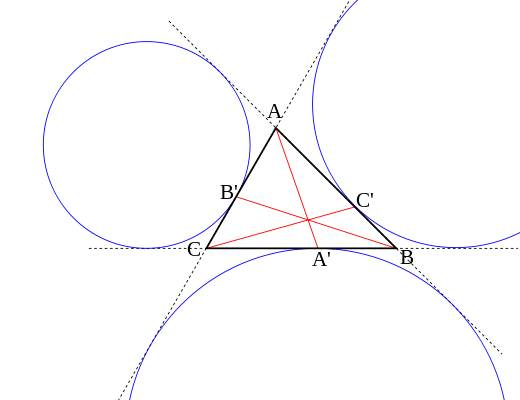
Nagel Point
The proof of this is a little trickier, but is also more interesting. If we look at the above figure, we notice that and the line connecting with the tangent point of the excircle from and line are congruent because of equal tangents. The other corresponding segments are congruent to each other for the same reasoning.
Now what could help us in the proof right now?
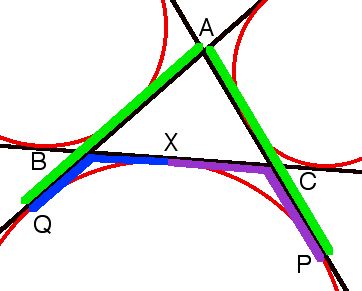
As we can see in the figure, lengths and are congruent because of equal tangents. Also, and are congruent, as well as and . We can note that , where is the perimeter of . Now we can see that , so , where is the semiperimeter of the triangle. Now we can we that, if we denote the length of by , by , and by , and . Applying the same method for the other four lengths on sides and , we see the proof now is obvious.
What can now easily complete our proof?
If we denote the other two points of tangency of the excircle and and as and respectively, we obtain , and by Ceva's theorem the cevians are concurrent, thus completing our proof.
I hope you learned a lot from this article! Thanks for reading!