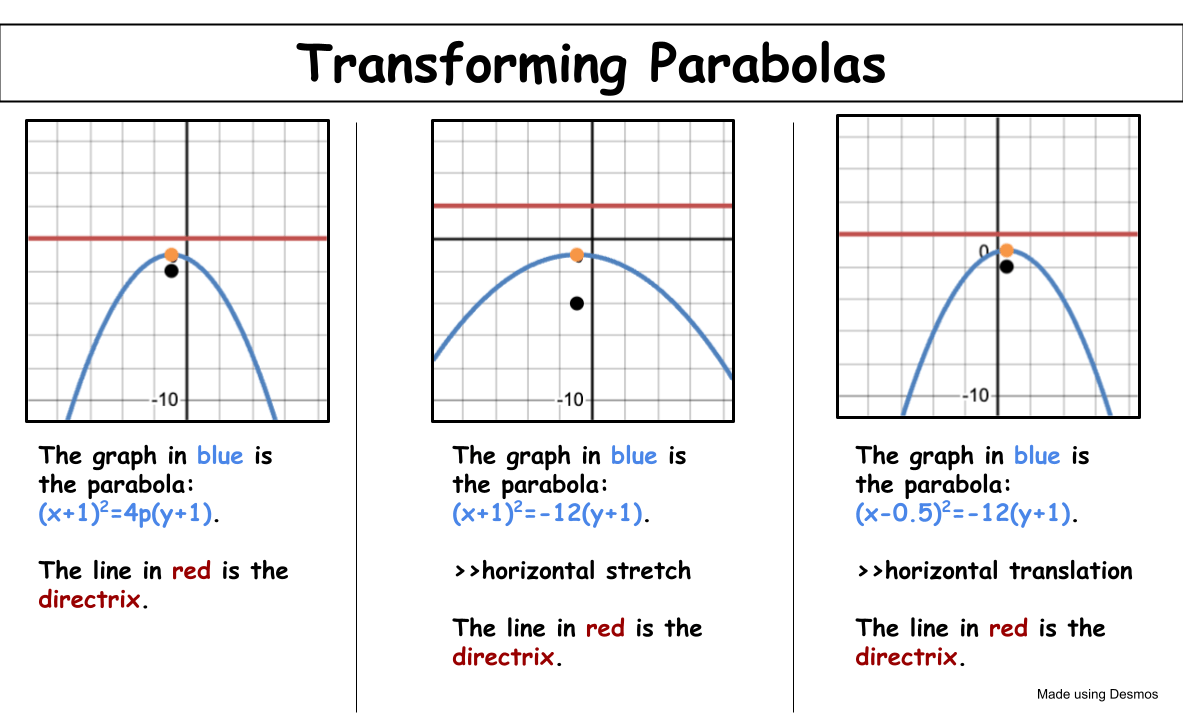
Here's a video by Mrclarkmath explaining the translations of a parabola and what they mean.
Summary
a can tell you the general shape of the parabola. If a is positive the parabola opens upward (like a smile). If a is negative, the parabola opens downward. Is ∣a∣>1, the parabola is narrow, and if ∣a∣<1, the parabola is wider.
Given,y=(x)2, to transform parabola we add or multiply a constant c either to the x term or the y term in various ways:
Translations
To translate left: y=(x+c)2
To translate right: y=(x−c)2+c
To translate up: y=(x)2+c
To translate down: y=(x)2−c
Scalings
To make a parabola wider (horizontal stretch): y=(c1x)2
To makes a parabola more narrow (horizontal compression): y=(cx)2
To make parabola taller (vertical stretch): y=c1(x)2
To makes a parabola shorter (vertical compression): y=c(x)2
(It is important to note whether the constant is inside or outside the squared term!)
Reflections
To reflect downwards or left: y=−c(x)2
To reflect a parabola upwards or right: y=c(x)2
###Graphing a Parabola: Using Focus and Directrix
The focus and the directrix are the two defining features of a parabola. This is because every point on a parabola is the same distance away from the focus as it is from the directrix. When we're given only the directrix and focus, we can use this fact to help us graph the parabola.
Say we are given: Directrix:x=−2Focus:(0,0)
Step One: Find Vertex
The first step is to find the location of the vertex. Since the vertex is always a distance p from the directrix and the same distance p from the focus, to get it's coordinates we need to calculate the midpoint between the two.
Since the directrix is a line, we have to pick a point along it that is in line with the focus.
So, we have, Directrix:(−2,0)Focus:(0,0)
From here to find the midpoint coordinates(vertex coordinates), we can use these formulas:
So, for this example, the Vertex(x)=−1 and our Vertex(y)=0.
Step Two: Determine P
Now, that we have the location of the vertex, we have to find it's distance from the focus (or the directrix, as both distances will be the same). This will be our p value.
So, using the distance formula, p will be equal to:
(Vertex(x)−Focus(x))2+(Vertex(y)−Focus(y))2
From this we get that p=1.
Finally, now that we have the vertex and the value of p, we can write the equation for our parabola in vertex form!
Doing this we get: (y)2=4(x+1)
We know that a parabola is a curved shape that can be described by a special rule involving a focus and directrix. The focus is a fixed point inside the curve, and the directrix is a fixed line outside the curve. Every point on the parabola is equidistant from the focus and directrix.
We can transform parabolas by changing where the focus and directrix are. If we move the focus up or down, the parabola will shift up or down. If we move the focus left or right, the parabola will shift left or right. The directrix moves in the opposite direction of the focus to keep the shape balanced.
The distance between the focus and directrix determines how "wide" or "narrow" the parabola is. We can also flip the parabola by switching the focus and directrix - this makes sense because the focus is always inside the parabola.
The equation of the parabola changes when we transform it, but the rule about equal distances from the focus and directrix will always stay true.
By adjusting the focus and directrix, we can create parabolas in any position or size, which is useful in design, physics, and engineering.