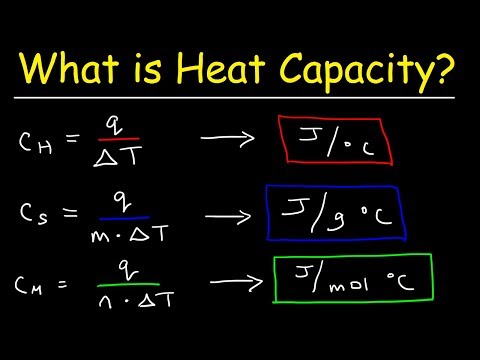
Previously, we studied the relationship between heat and temperature. Heat is the transfer of kinetic energy via atomic or molecular collisions. The temperature is the state variable that indicates heat transfer. For example, we know that chemical reactions can be exothermic or endothermic. In an exothermic reaction, energy gets transferred from the system to the surroundings. So, the temperature increases. In endothermic reactions, it's the opposite. But what's the quantitative connection between heat and temperature? That's what we'll explore in this lesson!
Heat Capacity
We know that when an object is heated, there is an energy transfer. We observe that energy transfer via the temperature change. But how much energy is required to raise the temperature? As you might guess, it depends on the object. For example, we know that metals are often good conductors. That's because of their metallic bonding. So, we would expect their temperature to increase with very little heating. And we see exactly that! For example, imagine I had 5.0 grams of aluminum and 5.0 grams of water. To raise the aluminum's temperature by one Kelvin would require 4.5 joules of energy. But, the water needs 20.9 joules. That's a huge difference!
But how did I get those numbers? I used the heat capacity. The heat capacity is the energy required to raise an object's temperature by one Kelvin. So, it has units of joules per Kelvin (KJ). The problem is that the term object is somewhat vague. We can't define a heat capacity for every object in the world. That's just too much! Instead, we use the specific heat capacity. We'll study it more in a future lesson. But it's the energy needed to raise the temperature of one gram of a substance. It has units of joules per gram-kelvin (gKJ). So, how did I calculate the energy needed to heat 5.0 grams of aluminum and water? I used their specific heat capacities.
Factors Influencing Heat Capacity
We've seen that different materials can have big differences in their heat capacities. But what causes the difference? In our example, why did water require much more energy than aluminum? It depends on the substance's chemical properties.
Let's consider the most simplistic model. Let's imagine we have one mole of helium gas in a container. Helium is a noble gas. So, it doesn't form bonds and has minuscule intermolecular interactions. It meets all the criteria for being an ideal gas. What would happen if we heated our helium gas? The atoms would translate faster. They would have an increase in kinetic energy. So, our temperature would increase.
Now, let's consider a diatomic gas, like hydrogen gas. Again, the intermolecular interactions are tiny. But, this time, there is a covalent bond. What happens when we heat the gas? The molecules will again translate faster. But, the molecules can also rotate around the center of mass. The rotation is still a form of kinetic energy. But, a diatomic gas has various expressions of kinetic energy. So, how would it compare to a monoatomic gas? It would require more energy to achieve an equal average kinetic energy. In other words, it takes more energy to reach the same temperature. Why? Because the kinetic energy gets averaged across multiple kinds of motions. The fancy term for the different types of movement is degrees of freedom. So, the more degrees of freedom a molecule has, the greater its heat capacity.
Now let's consider molecules with strong intermolecular forces. Water is a great example! We've already seen that water has a specific heat capacity of 4.18gKJ. That's a large heat capacity! Why? Because water hydrogen bonds. We know that more powerful intermolecular forces resist the molecule's movement. So, it takes more energy to increase the average kinetic energy.
Heat Capacity Equations
At this point, are you wondering how we use the heat capacity? It turns out that we have two equation that uses heat capacity. The first relates the heat capacity to the internal energy and temperature. The equation is C=TΔU. But, we can manipulate this equation if we apply some different parameters.
Remember, ΔU=ΔQ−PΔV. But what if our system has a constant volume? The pressure-volume work would equal zero. In that case, the change in internal energy equals the change in heat. So, Cv=ΔTΔQ.
What about a system under constant pressure? In that case, we still have pressure-volume work. So, we have to define a new term for heat. We call it enthalpy (H). The enthalpy is the heat energy transferred in a constant pressure system. We mathematically define the change in enthalpy as ΔH=ΔU+PΔV. But let's expand the equation. We know that ΔU=ΔQ−PΔV. So, our equation becomes ΔH=ΔQ−PΔV+PΔV=ΔQ. How does this relate to the heat capacity? At constant pressure, Cp=ΔTΔH. In later lessons, we'll learn many different ways to calculate the enthalpy change.