Графік функції квадратного кореня: що таке горизонтальний перенос?

Before this, knowГрафік функції квадратного кореня

Interactive · 1 question

Horizontal Translations

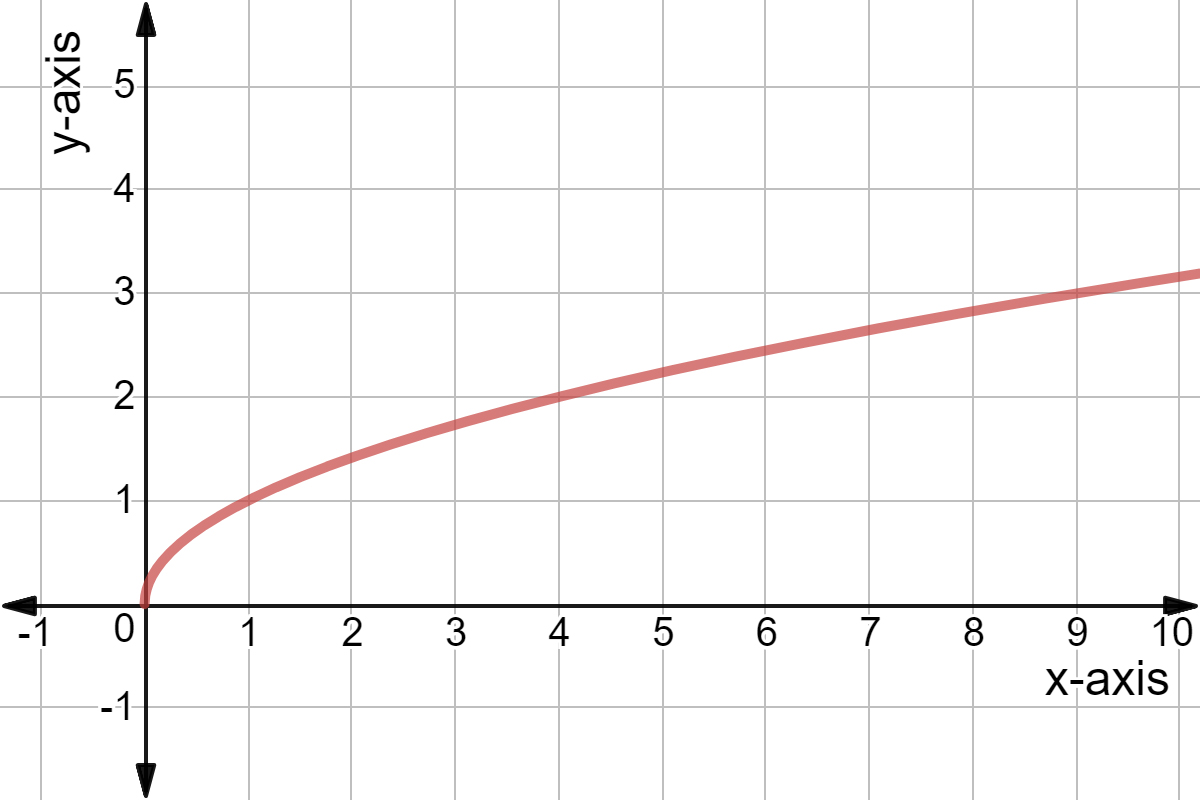
We've learned about the base square root graph: y=xy=\sqrt x

Radical graph y = sqrt(x).

Made using Desmos

And we've learned about vertical translations where the graph moves along the yy-axis.

Vertical translations of a square root function.

Made using Desmos

The Horizontal Shift

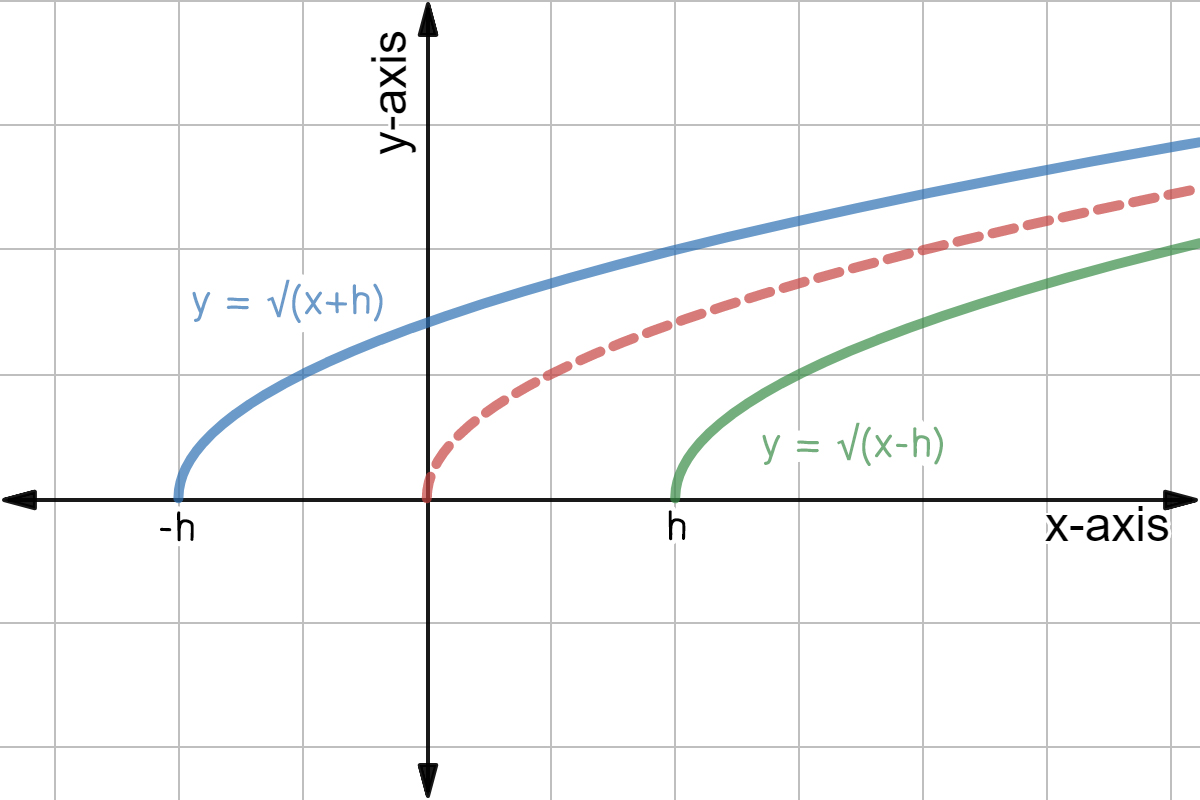
The next translation is along the xx-axis and it's the horizontal translation. Horizontal translations will be constants inside the radical. These are radicals with sums or differences. y=x−h\boxed{y=\sqrt{x-h}} Here hh is the horizontal shift.

  • If hh is positive (of the form x−h\sqrt{x-h}), it moves the graph to the right along the xx-axis.
  • If hh is negative (of the form x−(−h)\sqrt{x-(-h)}), it moves the graph to the left along the xx-axis.
Radical graphs of y = sqrt(x+h) (blue), y = sqrt x (red), and y = sqrt(x-h) (green)

Made using Desmos

Examples\\ Let's look at some more specific examples.

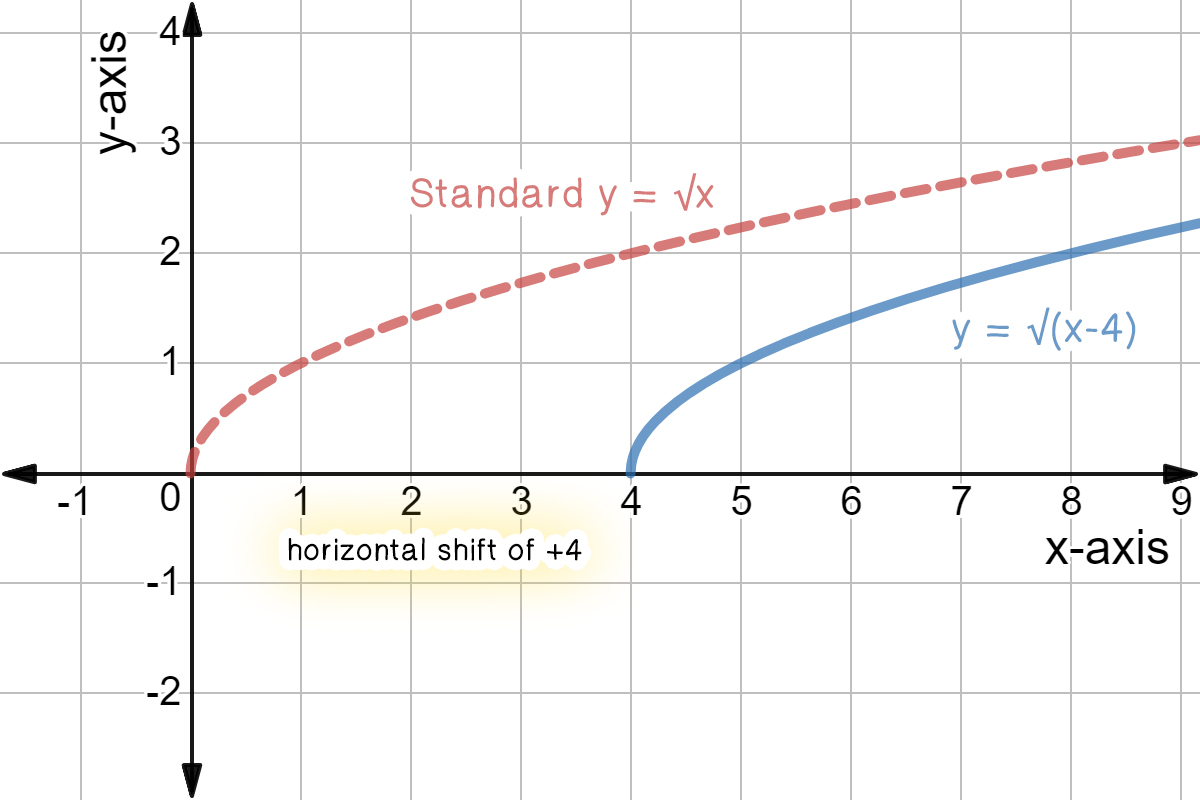
Say we wanted to graph the equation: y=x−4y=\sqrt{x-4} We know this is a horizontal shift because the constant is inside the radical. This means we move the standard square root graph 4 spaces to the right along the xx-axis.

Radical graph of y = sqrt(x+4).

Made using Desmos

What is the horizontal shift of the following radical? y=4x+20y=\sqrt{4x+20}

Choose one answer

Illustrated · 2 min

Horizontal Translation of Square Root Graphs

We have already learned how to graph square roots using a tt-table, and how to apply vertical translations to our square root graphs. Now, we are going to focus on horizontal translations.

In general terms, a square root equation will have a horizontal translation in the graph when there is an addition or subtraction inside of the radical.

y=x±ay=\sqrt{x\pm a}

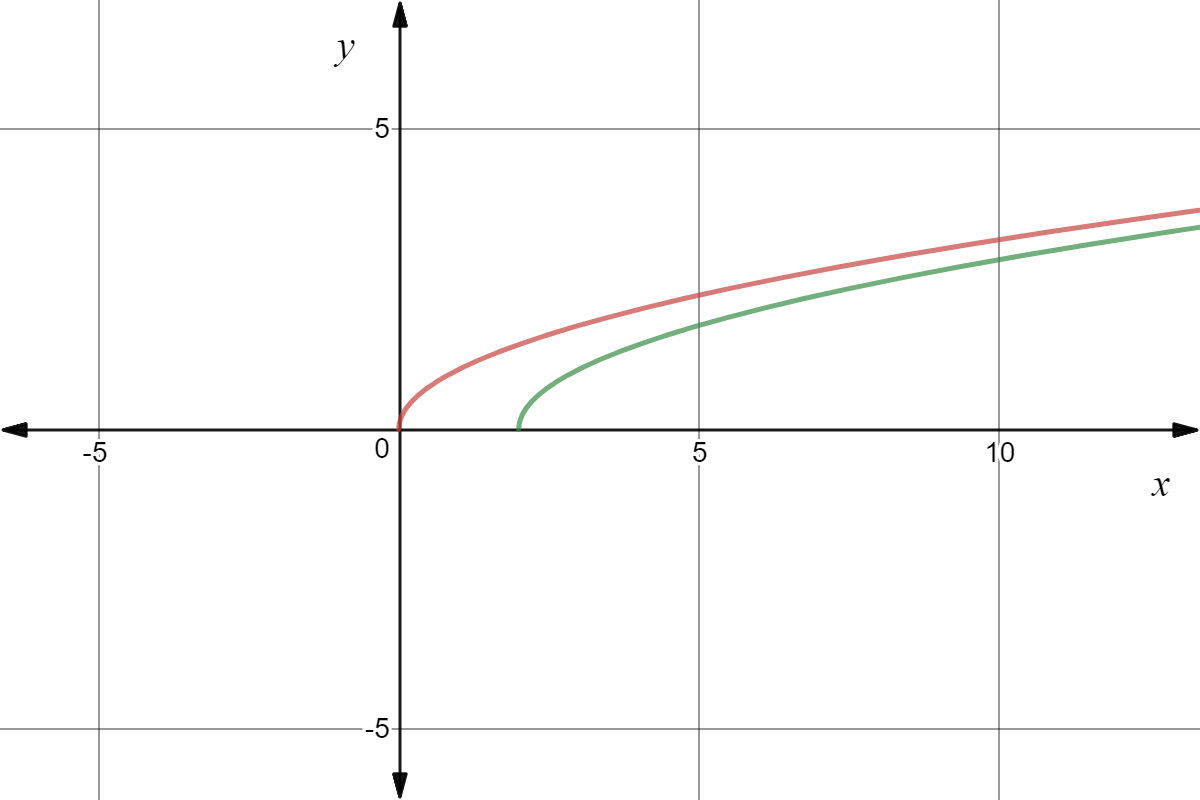
However, the outcome of the translation on graph doesn't exactly match what you would expect. Let's look at a graph comparing y=xy=\sqrt{x} and y=x+2y=\sqrt{x+2}.

The graph of y=sqrt(x) and y=sqrt(x+2). The graph of y=sqrt(x+2) is two units to the left of the graph of y=sqrt(x).

Made on Desmos

This is a graph of y=xy=\sqrt{x} in red and y=x+2y=\sqrt{x+2} in green.

The function y=x+2y=\sqrt{x+2} is two units to the left of the function y=xy=\sqrt{x}. This may not have been what you are expecting, but the graph will move horizontally to the left when a number is added to the function under the radical. When a number is subtracted under the radical, the function will be shifted to the right. Let's look at another comparison.

The graph of y=sqrt(x) and y=sqrt(x-2). The graph of y=sqrt(x-2) is two units to the right of the graph of y=sqrt(x)

Made on Desmos

The graph of y=xy=\sqrt{x} in red and y=x−2y=\sqrt{x-2} in green.

Here the function y=x−2y=\sqrt{x-2} is shifted two units to the right of the function y=xy=\sqrt{x}

Horizontal transformations still apply when there are other transformations added to a square root function.

Graph of y=2sqrt(x-1)  y=sqrt(x-1)+2 and y=-sqrt(x-1). Each one has their own vertical translation (slide or flip) but they all start at x=1  and extend to the right.

Made on Desmos

Graph of y=2x−1y=2 \sqrt{x-1} in black, y=−x−1y=-\sqrt{x-1} in blue, and y=x−1+2y=\sqrt{x-1}+2 in red. Notice they all start at x=1x=1.

Even though each of these graphs have a different vertical translation, they all start at x=1x=1 and extend to the right. The vertical translator of a graph will not effect the horizontal transformations.

Sometimes the equation won't clearly show the translation and will require simplification. Let's look at a problem that has this kind of issue.

y=9x+18y=\sqrt{9x+18}

While this may look like a horizontal translation of 1818 units to the left, the stretch that is applied by the 9x9x changes the overall translation. This needs to be simplified before we can clearly see the translation.


y=9x+18y=9(x+2)y=3x+2\begin{align} y&=\sqrt{9x+18}\\ y&=\sqrt{9(x+2)}\\ y&=3\sqrt{x+2} \end{align}
Graph of y=sqrt(9x+18). Even though the original problem suggests a shift of 18 units to the left, simplifying the equation shows that is only a translation of 2 units to the left.

Made on Desmos

After simplifying the equation from y=9x+18y=\sqrt{9x+18} to y=3x+2y=3\sqrt{x+2}, it is clear that the shift is only 22 units to the left rather than 1818.

Video

(Video) Translations of the Square Root Graph

by mathman1024

This video by mathman1024 covers horizontal translations with square root graphs.

Summary\large{\text{Summary}}

The function he graphs in this example is: f(x)=−2x+7+3f(x)=-2\sqrt{x+7}+3.

So the first thing we look at is the base function. In this example our base function is y=xy=\sqrt x.

Radical graph of y = sqrt(x).

Made using Desmos

Next we see there's a +7+7 inside the function. This means we shift the graph to the left by 7 units.

Radical graph of y = sqrt(x+7).

Made using Desmos

The next transformation is the +3+3 outside the function. This tells us we need to shift the graph up by 3 units.

Radical graph y = sqrt(x+7) + 3.

Made using Desmos

The 22 being multiplied in front means we need to stretch the graph.

Radical graph y = 2 sqrt(x+7) + 3.

Made using Desmos

Finally, the negative symbol means we need to flip the graph across the xx-axis.

Radical graph y = -2 sqrt(x+7) + 3.

Made using Desmos

The above is a graph of y=−2x+7+3y=-2\sqrt{x+7}+3!

Type a concept, like “slope” or “photosynthesis”.

↑ ↓ to choose · Enter to openSearch explanations and problems