
Illustrated · 1 min

Identity Property of Zero

The Identity Property of Zero, also called the Additive Identity Property, states that if you add 00 to any number, the result will be that number. Likewise, if you subtract 00 from any number, the result will be that number. Believe it or not, this works for all real numbers.
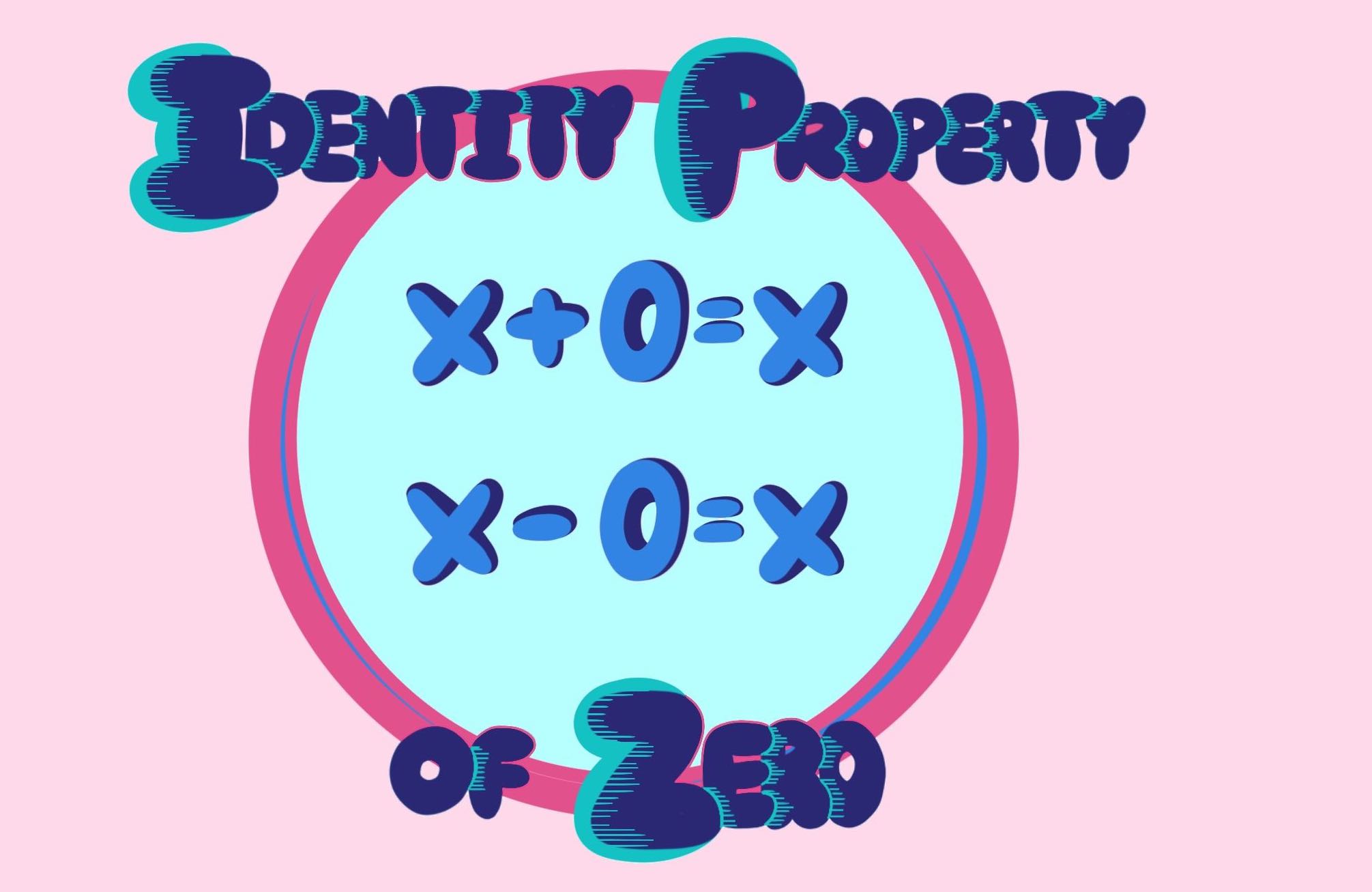
Identity Property of Zero: x+0=x and x-0=x.

Image by Caroline Kulczycky

Think about it: when you add or subtract zero from the number, it retains its identity...it doesn't change! It works for all real numbers (and on variables). On a number line, adding or subtracting zero means we don't move. Not left nor right, a single step.

Examples:

5+0=552−0=52(a+b)+0=a+b\begin{align} 5+0&=5\\ 52-0&=52\\ (a+b)+0&=a+b \end{align}

The real numbers are a set, or a collection of numbers. Each number is called an element. As a result, we call 00 the identity element.

There is also a multiplicative identity. That number is 11. There is a similar rule for multiplying numbers by 11.

Bonus

Interested in mathematical properties? Check out some other cool properties, like the reflexive, symmetric, and transitive properties!

Interactive · 4 questions

Identity Property of Zero

When you add or subtract zero to any number, the result is always that number.

The identity property of 00 states that if you add or subtract 00 from any number, the number will always stay the same. Here are some examples involving whole numbers: 3+0=33 +0 = 3 7−0=77-0 = 7 Therefore, x+0=0+x=xx+0=0+x=x. This is also known as the additive identity property of 00.

We are now going to take a look at some of the types of problems you might encounter about the identity property of zero.

Example 1 \\ 15+0=?15+0=?

Choose one answer

Video

(Video) The Properties of Zero

by MashUp Math

Here's a good video by MashUp Math explaining the different properties involving zero.

Summary\large{\text{Summary}}

This is a fun video to show the interesting properties of the number zero. One of them is the identity property of zero. This states that if 00 is added to any number, the number doesn't change. a+0=a\boxed{a+0=a}

Example 1

5+0=55+0=5

Example 2

−18+0=−18-18+0=-18

Test yourself:

What is a+b+0a+b+0?

Choose one answer

Type a concept, like “slope” or “photosynthesis”.

↑ ↓ to choose · Enter to openSearch explanations and problems
