
Interactive · 5 questions
Introduction
When you hear the word inflation, what do you think of...perhaps this?
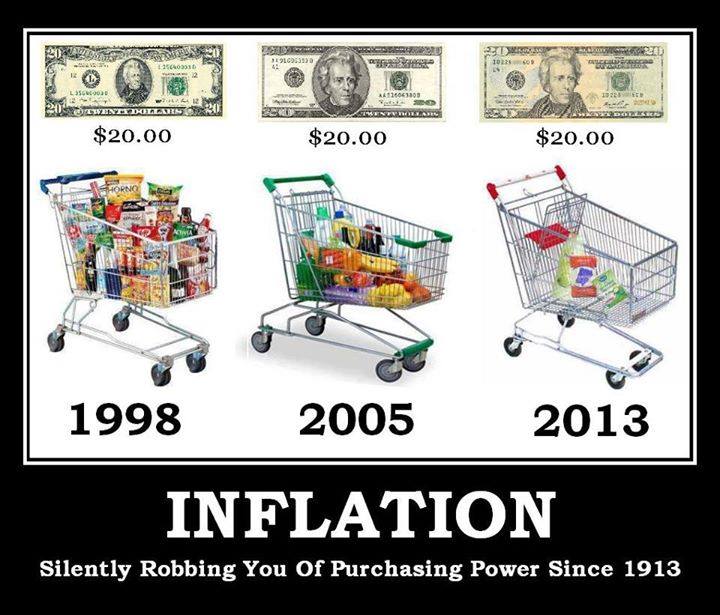
Inflation (Economics)
Well I will admit that this kind of inflation is pretty important (I guess, I mean don't ask me I am a 16 year old math and science nerd not some economist). Or were you thinking this?

Kirby!!!
Cute, but no. The inflation we are discussing today is much larger, and affects EVERYTHING in the universe. So in a sense, it looks more like this:
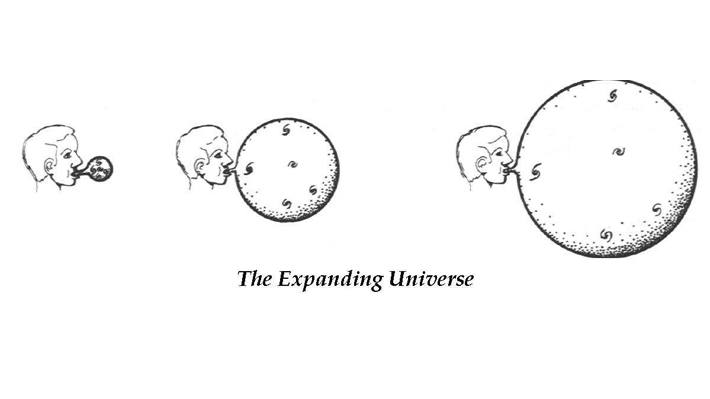
Is that GOD?!
Only...we don't have a dude who is blowing more "space" into the universe. So let's take some time to explore this idea that completely changed the the way that we thought about the creation of the universe.
Ready to Explore?
What is Inflation?
So inflation is basically this idea that tells us that space itself is expanding at an exponential rate. Calculations from people much smarter than myself tells us that this exponential growth was the fastest during the extremely short period of time called the inflationary epoch which started seconds after the Big Bang to somewhere between to seconds after the Big Bang.
A good way to see this is through the timeline below.
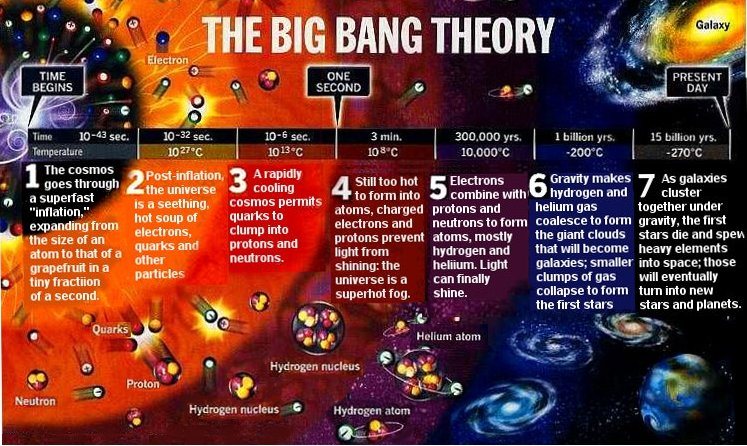
Timeline of the Universe
Inflation is significant because it answers a lot of questions for us with regards to the temperature of the universe in some places, and in general how and why the universe is the universe that we know it as.
But then who came up with this crazy idea? While in general we credit Dr. Alan Guth, in reality this idea started with the most crazy guy in the history of science (or at least physics): Albert Einstein.
Ready to move on?
Scene I: Early(ish) 1900's
Back in the day, physicists loved to play a game of "who drew a better portrait of the universe?" with each other (unfortunately, it's not very well played anymore so it's quite rare to find people who can play with you). Well our amazingly talented In Albert Einstein introduced the cosmological constant to allow a static solution, which was a three-dimensional sphere with a uniform density of matter.
Some time later, a contender came by named Willem de Sitter found a highly symmetric inflating universe, which described a universe with a cosmological constant that is otherwise empty. In this epic (not really) battle between the universes, it was found that Einstein's universe is unstable, and that small fluctuations cause it to collapse or turn into a de Sitter universe. Unfortunately, Einstein never got a chance for a rematch.
Ready to move on?
Scene II: Late 1970's
Along came a guy named Starobinsky (his name even has "star" in it) who noted that quantum corrections to general relativity (proposed by Einstein) will lead to a significant result in understanding the early universe. These generically lead to curvature-squared corrections to the Einstein–Hilbert action and a form of modified gravity.
Note: modified gravity is (simply put) a type of modified gravity theory which generalizes Einstein's general relativity.
Interestingly enough Starobinsky was right, as the solution to Einstein's equations in the presence of curvature squared terms, when the curvatures are large, leads to an effective cosmological constant. Therefore, he proposed that the early universe went through an inflationary de Sitter era.
Ready to move on?
Scene III: 1978-1980
The final obstacle we ran into before coming up with inflation was brought up by Zeldovich in 1978: The monopole problem. Simply put, the monopole problem is a less ambiguous and a more quantitative form of the Horizon Problem
Horizon Problem: *It should be impossible that although different regions of the universe have not "contacted" each other because of the great distances between them, that they have the same temperature and share other physical properties. *(Charles Misner, Sometime in the late 1960's)
Luckily in 1980, Guth realized that false vacuum decay in the early universe solves the problem, which led him to propose a scalar-driven inflation.
Note: Starobinsky's and Guth's scenarios both predicted an initial de Sitter phase.
This is the end of our history lesson (who liked history anyway?).
Let's close up!
To sum up this lesson, we went over the basic idea of what inflation is along with how we got there. Inflation overall is a huge topic in cosmology as it answers a lot of questions of how the universe became the universe as we know it. Of course, inflation also poses a question to us that we've been pondering for quite some time: What is the fate of the universe? That's something I can't answer, but with inflation as the first step, I am sure that we will find out soon enough.