Illustrated · 1 min

Infrared Spectroscopy (IR) is a technique used to determine the functional groups of a molecule. In IR spectroscopy, the molecule is excited by infrared light. Infrared light is strong enough to cause vibrational transitions within the molecule, which can be mapped to functional groups by the energy of light needed. A diagram of the process is shown below.
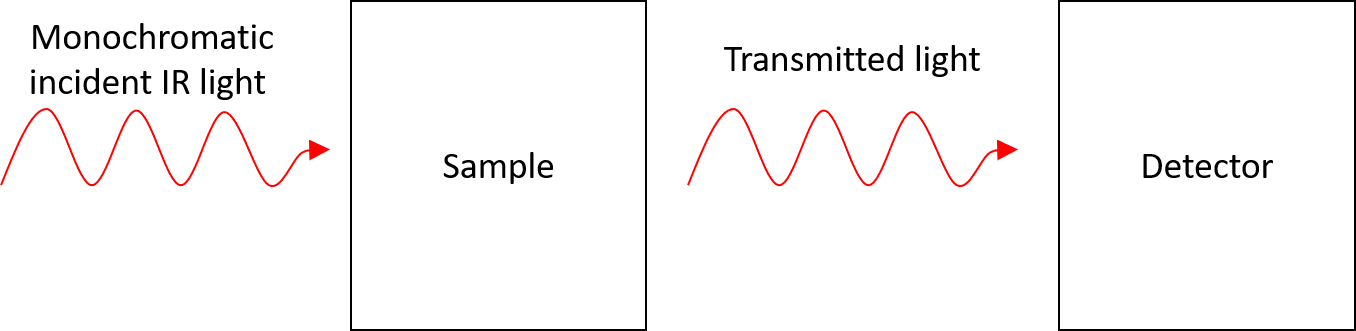
IR spectroscopy typically measures the transmission of light. What this means is that signal is represented by a dip downwards. This is because the molecule absorbs that particular wavelength, thus reducing the transmission. IR spectroscopy also typically measure energy in inverse centimeters (called wavenumbers). This may seem like a strange unit, but it can easily be converted into a more typical energy unit by multiplying by . Consequently, energy increases as wavenumbers increase. This is in contrast to wavelength which decreases as energy increases.
A table of commonly observed wavenumbers and their correlated vibrational mode is shown below.