Illustrated · 1 min

Integers

The set of integers is the list ...,−3,−2,−1,0,1,2,3,......,-3,-2,-1,0,1,2,3,... The integers include the whole numbers (also called the counting numbers) and the natural numbers.

All integers are either positive, negative, or zero. They fall into exactly one of these categories.

We use the symbol Z\mathbb{Z} to refer to the integers.

The integers contain the whole numbers and the natural numbers.

The real numbers include all of the other numbers in the diagram. For example, every integer is a real number. All of the rational numbers are also real, and in fact each integer is rational. Over time, you will see more examples of all the types of numbers. This diagram will become easier to remember as a result.

Integers have some really cool properties, like the reflexive, symmetric, and transitive properties. Check them out!!
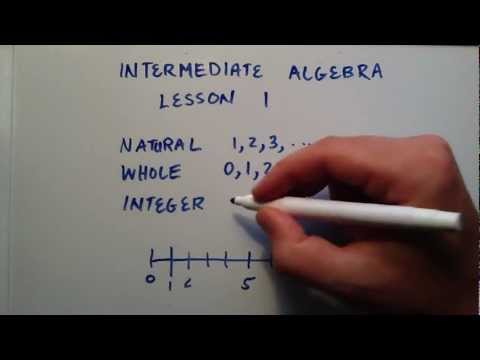

Video

(Video) Natural Numbers, Whole Numbers, and Integers

by Learn Math Tutorials

This video by Learn Math Tutorials goes over the first three types, or sets, of numbers: natural numbers, whole numbers, and integers.

Summary\large{\text{Summary}}

The integers are the numbers we can write without a fractional part. We use the symbol Z\mathbb{Z} to refer to them. Z=...,−2,−1,0,1,2,...\mathbb{Z}=...,-2,-1,0,1,2,...

If we were to make a number line to represent the integers, it would look like:

The integers on a number line.

Made using Desmos

The number line has 00 in the middle and it spans out to the right and left. The left side has the negative integers which go out to negative infinity, −∞-\infty. The right side has the positive integers which go out to infinity, ∞\infty.

Interactive · 6 questions

Integer in a Glance

Integers are numbers that can be obtained by adding a finite number of 11s or subtracting a finite number of 11s. From this definition, both 00 and 11 must be integers.

What other numbers are integers?

Take 33 for example. We know 3=1+1+13 = 1+1+1, so 33 is an integer. 2=1+12 = 1+1 and 5=1+1+1+1+15 = 1+1+1+1+1, so they are both integers. If we change all the "++" signs to "−-" signs in 3=1+1+13 = 1+1+1, we find that −3=−1−1−1-3 = -1-1-1 is also an integer, since it can be obtained by subtracting 11s.

Is −2-2 an integer?

Choose one answer

Type a concept, like “slope” or “photosynthesis”.

↑ ↓ to choose · Enter to openSearch explanations and problems