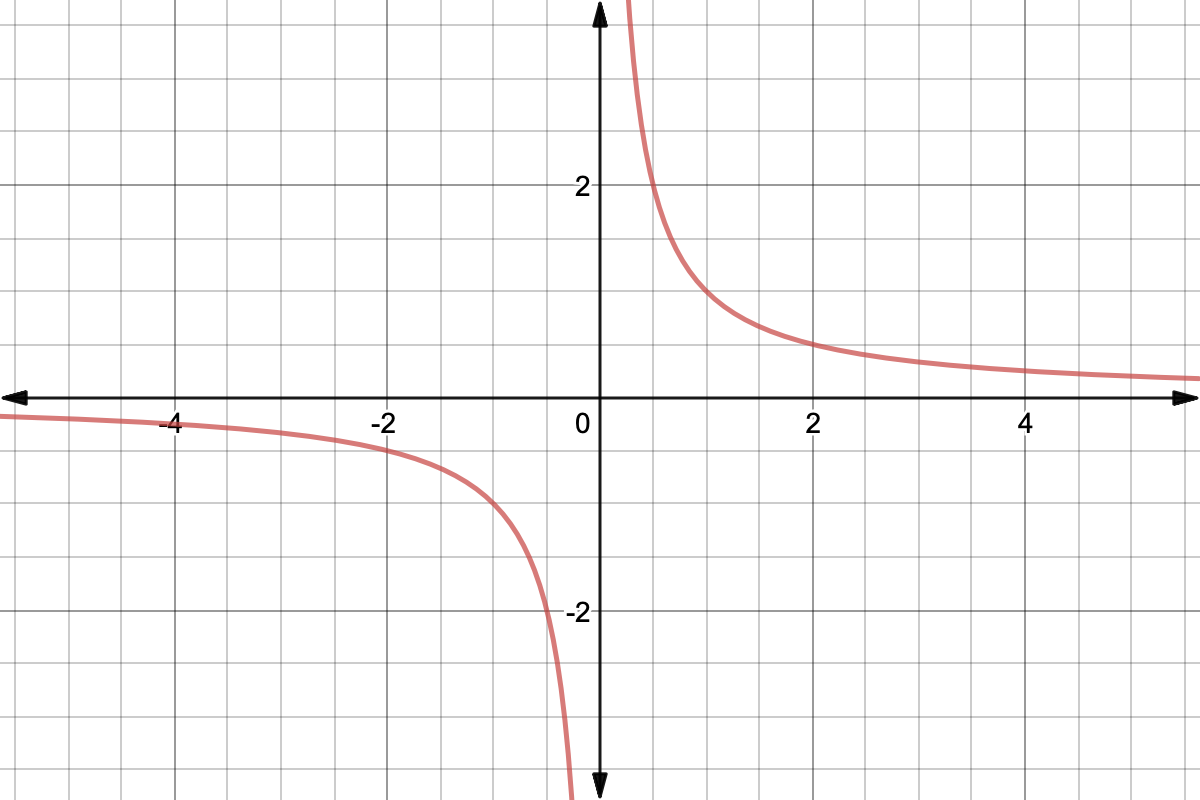
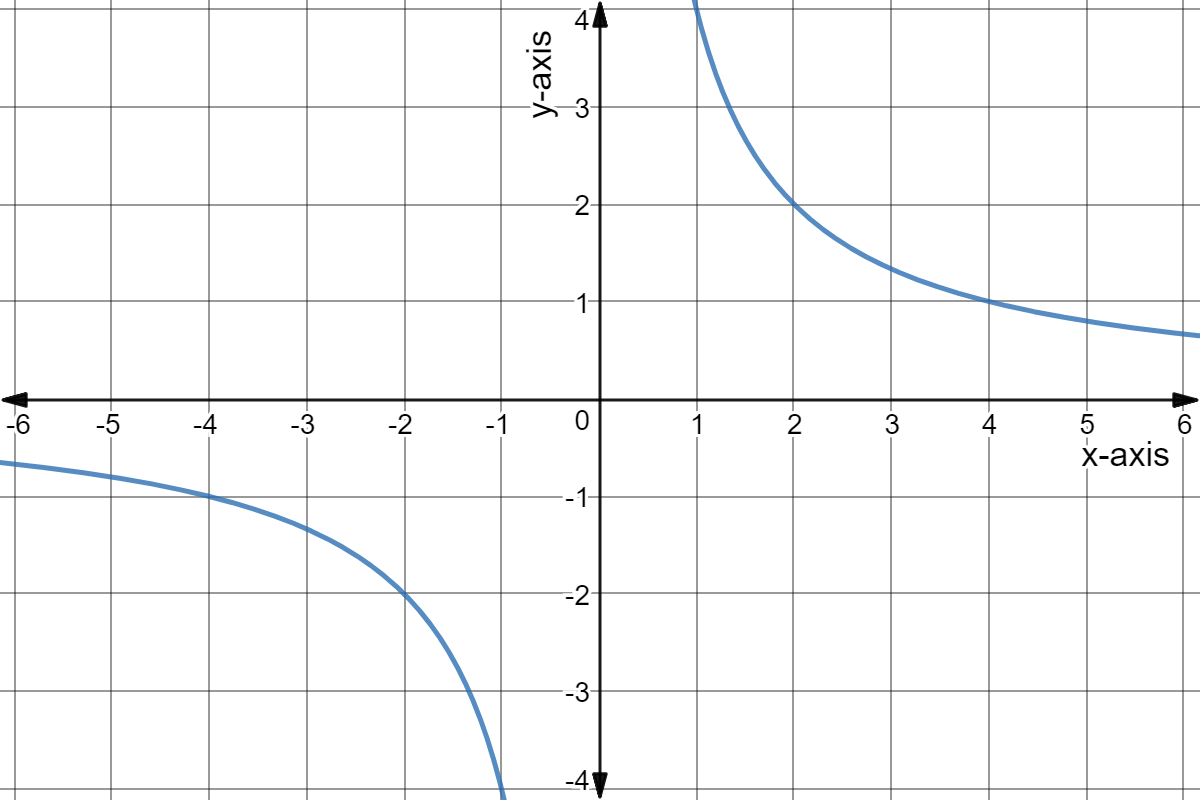
Variables are inversely proportional when their product is always the same. That means that if the product is positive, y will decrease as x increases. If the product is negative, y will increase as x increases (notice that this is the opposite of direct proportionality).
Inversely proportional functions take the form:
y=xk
In this equation, k is the product of x and y. In direct variation) equations, k is the slope, but that is not the case with inversely proportional equations because they do not create a line. Instead they look like this:
Let't try an example problem. We are given the following information. y is inversely proportional to x. When y=2, x=3. What is the value of x when y=5?
First, we set up the problem using the definition of inversely proportional. We know y is inversely proportional to x. This means
y=xk
Now, we know when y=2, x=3. So, we can plug those values in to the equation and simplify.
22×3k=3k=3k×3=6
Now, we want to find x when y=5. So, we set up the the equation using the definition of inversely proportional again, but this time we know k=6.
y=x6
Now, we can plug in 5 for y and solve for x.
y55xx=x6=x6=6=56
Therefore, x=56. Now, you can try one on your own!
So by our proportionality equation, we know that:
t=k(u1)
We also know that when t=10, u=15. In other words:
10=k(151)10=15k
We can use this to find k:
1010(15)150=15k=k=k
Then, we can use k and the value we know for t to figure out u's corresponding value:
202020(x)xxx=(150)x1=x150=150=20150=215=721
Done!