Йони

Interactive · 2 questions

Typically atoms are electrically neutral. Why? They have the same number of protons and electrons. But atoms are capable of gaining and losing electrons. If they do, they form charged particles called ions. There are broadly two types of ions: cations and anions. Cations are positive, they have more protons than electrons. They are formed by the loss of electrons. Anions are negative, they have more electrons than protons. They are formed by the gain of electrons. We can easily determine the charge of an ion by subtracting the number of electrons from the number of protons.

Notation

Ions are written by using the chemical symbol of their parent atom(s) and putting the charge into the superscript. As an example, an oxygen atom that gains 2 electrons is written as O2−O^{2-}. Observe how the magnitude is written first, then the charge. It is also acceptable (albeit uncommon) to write multiple charge symbols in order to indicate magnitude. So our oxygen anion could be written as O−−O^{--}. An important note is that if the magnitude is 1, then a number is omitted. As an example, if a sodium atom loses an electron, then the resulting cation is written as Na+Na^{+}, and is never written as Na1+Na^{1+}.

Polyatomic ions

Sometimes multiple atoms come together to form a larger charged particle called a polyatomic ion. In their charged state, they act in much the same way as normal ions, but they are composed of multiple atoms. However, many polyatomic ions are created by a neutral species gaining or losing a proton.

This means that if we tried to balance the charge by adding or subtracting electrons we would form a radical, a super reactive chemical with unpaired electrons. Some common examples of polyatomic ions are NH4+NH_{4}^{+}, HSO4−HSO_{4}^{-}, and OH−OH^{-}. As a side note, polyatomic ions with oxygen form a special class called oxoanions. They'll be important when we study acids and bases, and neutralization reactions.

Cations are positive‾\underline{\phantom{positive}}

Choose one answer

Video

(Video) Cation vs. Anion: Definition, Explanation, & Examples

by Wayne Breslyn

In this video, Dr, B will teach you about how ions form and how you can easily remember the difference between cations and anions.

He walks you through an example of ionic bonding. To follow along you need to understand valence electrons, how to read the periodic table, and the octet rule.

Finally, he briefly mentions polyatomic ions.

Read · 1 min

We know there are three subatomic particles: protons, neutrons, and electrons. Protons and electrons carry charges. Protons are positive and electrons are negative. For an atom to not have a charge, it must have an equal number of protons and electrons. But what if it doesn't?

An atom with an unequal number of protons and electrons is called an ion. An ion with more electrons has a negative charge. We call them anions. An ion with more protons is positive and called a cation. You can remember this through the phrase "cat-ions are paws-itive." I always love when chemistry can include mention of cats!

Ions are still labeled by the element. So, the number of electrons, not protons, must change for a neutral atom to become an ion. For example, a neutral hydrogen atom has 1 electron and 1 proton. Let's imagine a hydrogen anion (H−H^{-}). It has an extra electron. So, it has 2 electrons and 1 proton.

However, a hydrogen cation (H+^{+}) ion does not get an extra proton. Why? That would make it a helium atom. To be an H atom or ion, it must have 1 proton. So, to have a charge of +1, it must have 1 more proton than electron. Therefore, the hydrogen cation has 1 proton and no electrons.

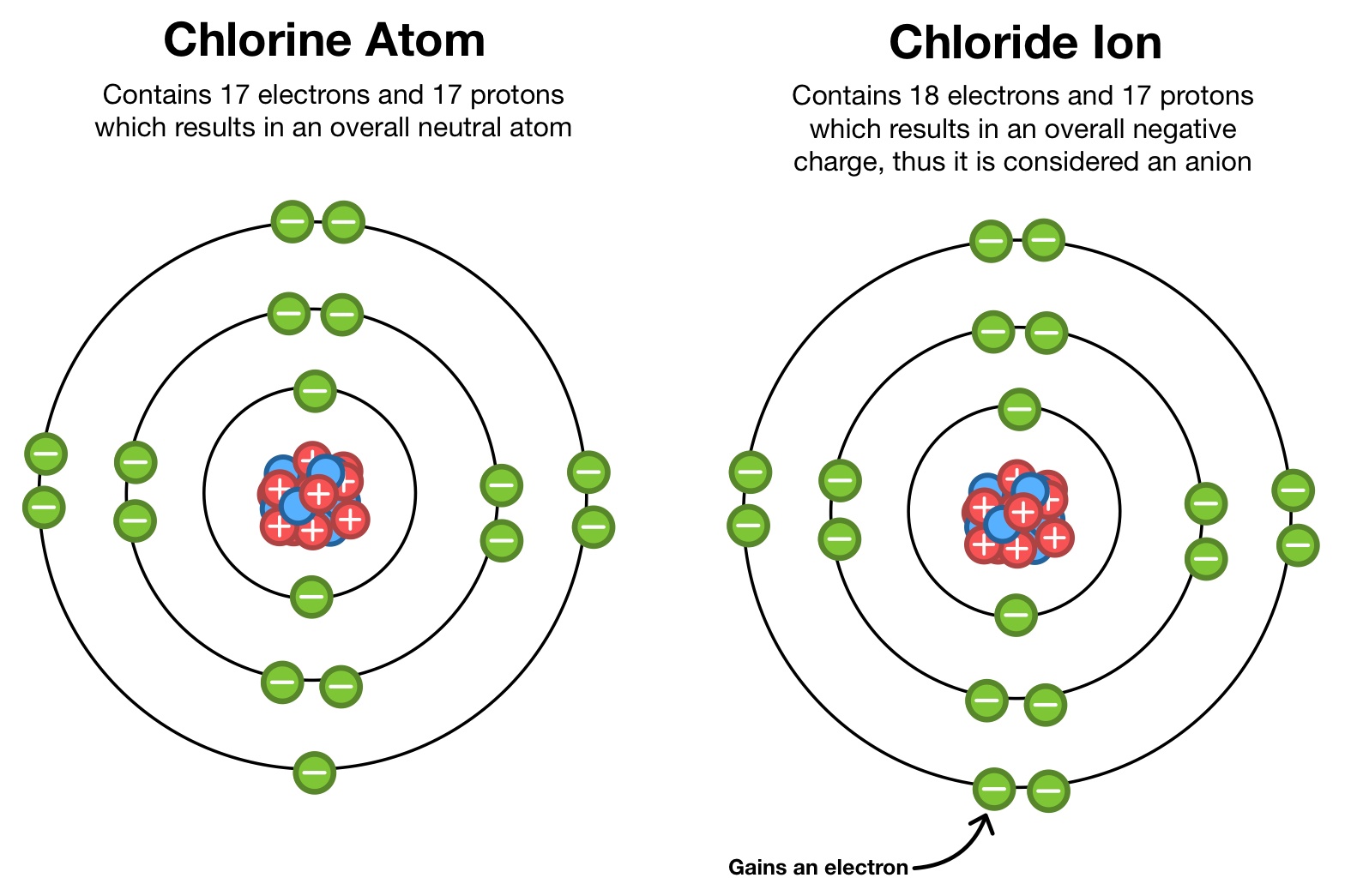
Since ions are charged, they experience attraction and repulsion to each other. Opposites attract. So, cations and anions join together to form ionic bonds. We'll learn about ionic bonds later. Many compounds are made of ions. For example, table salt has the molecular formula NaCl. So, it contains a sodium cation (Na+Na^{+}) and a chlorine anion (Cl−Cl^{-}).

Illustrated · 1 min

###Ions

Image showing what an Ion is: An atom the contains an uneven number of protons and electrons which results in either a positive or negative charge

Image source: Caroline Monahan

Note: The unequal number of protons/electrons is due to the gaining or loss of electrons. If an atom loses an electron, then that atom will have a positive charge (cation). If an atom gains an electron, then that atom will have a negative charge (anion). The atom loses or gains an electron from its outermost orbital. The energy required to remove an electron is called ionization energy.

But remember, the number of protons will always stay the same. So, an ion's mass does not change. It will have the same atomic mass as the neutral element.

Ion Formation Example:

Image showing how when chlorine gained an electron, it caused the atom to have an unequal number of protons and electrons, thus causing it to become an anion

Image source: Caroline Monahan

Ion Nomenclature:

Ions have different names and atoms with unequal charges are named based on if they are an anion or cation. This is important for naming ionic compounds!

Image showing the basic nomenclature for cations and anions

Image source: Caroline Monahan

Note: Polyatomic ions are named slightly differently than simple ions!

Type a concept, like “slope” or “photosynthesis”.

↑ ↓ to choose · Enter to openSearch explanations and problems