Joint Variation
Many algebra problems can be solved by using a direct proportion or an inverse proportion by itself.
However, for some problems we need to combine these two types of proportions.
Joint variation is when a variable varies directly with two or more other variables. In other words, it's just a direct proportion with multiple variables.
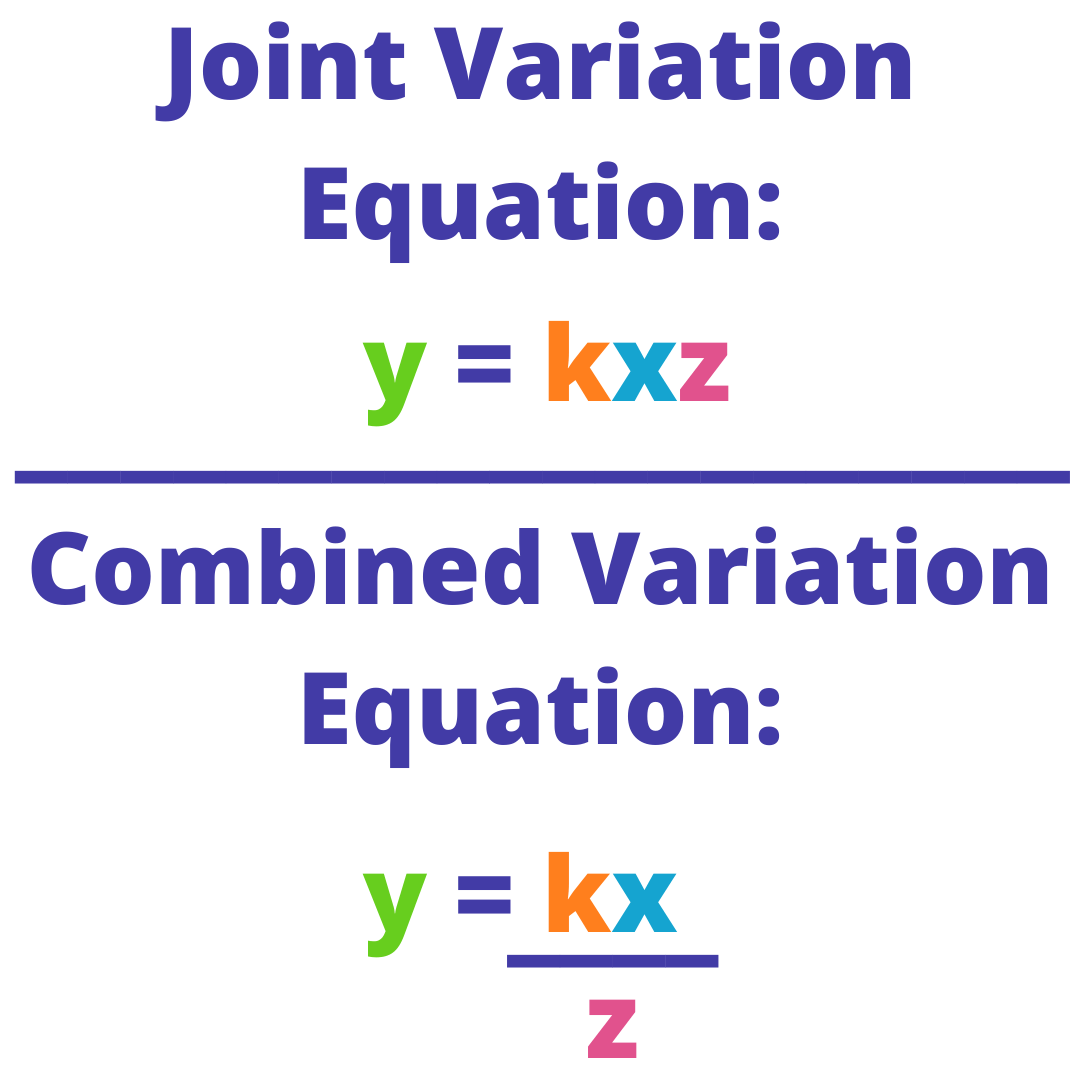
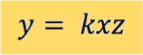
y=kxz
Here, y varies directly with both x and z. Also, k is a positive constant. That means it doesn't change even if x,y, and z do. This constant is called the constant of proportionality.
Doubling the x variable, would also double the y variable . If we double the z, the y will also double. But if we double both x and z, then y gets quadrupled.
The area of a triangle is jointly proportional to the base and height of the triangle.
A=21bh
Here, our constant of proportionality is k=21.
Joint Variation Example
Joint variation problems are similar to direct and inverse proportions. Normally, you'll be given information to use to find k. Then, you use k to find the unknown information.
Suppose the number of days it takes to watch the entirety of a show is jointly proportional to the number of episodes there are and the length of the episodes. It took you 40 days to watch all 73 episodes of "Game of Thrones" which were each an hour long. "The Office" has 201 episodes, each 30 minutes long. How long will it take to watch the series?
Let's use the following variable definitions:
dnl= Number of days it takes to watch the show= Number of episodes in a series= Length of each episode
We're told the variables are jointly proportional, so we can use the equation
d=knl
Now, we use our given information about "Game of Thrones" to solve for k. We know it took 40 days to watch 73 episodes that are each 1 hour long. Because one time is in hours and the other is in minutes, we need to convert one into the other. I'm going to use 60 minutes.
Now, we use our given information about Game of Thrones to solve for k. We know it took 40 days to watch 73 episodes that are 1 hour long. Because one time is in hours and the other is in minutes, we need to convert units. Specifically, both times need to be in the same units. I'm going to use 60 minutes, which is the same as 1 hour. You could convert all the time units to hours if you'd like.
d40404380402192=knl=k(73)(60)=4380k=43804380k=k
Using our newly found k, we can find out how long it will take to watch "The Office." We know there are 201 episodes each 30 minutes long.
dddd=2192nl=2192(201)(30)=21912060≈55
It will take you about 55 days to watch The Office.
Combined Variation
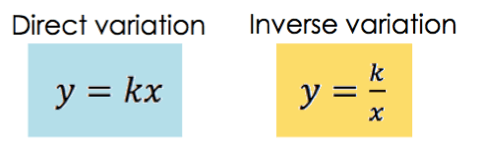
Combined proportionality (or combined variation) is just the combination of direct and inverse proportionality. If a variable has a combined proportionality with two other variables, then it has a direct proportion with one and an inverse proportion with the other.
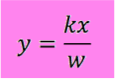
y=zkx
Here, y varies directly with x and inversely with z. Once again k is the constant of proportionality.
Pressure is combined proportionally to force and area. It's directly proportional to force and inversely proportional to area.
P=AF
This formula often appears in physics and chemistry.
The constant of variation is k=1, so it's not written. Remember, multiplying a number by 1 does not change its value, so we don't have to write the k.
Combined Variation Example
The time it takes you to complete a puzzle is directly proportional to the number of pieces and inversely proportional to how many people are working on it. You and your three friends can complete a 1,000 piece puzzle in 2 hours. How long would it take you to complete a 2,500 piece puzzle by yourself?
As always it's a good idea to start by defining variables. This makes it easier to keep track of what you're doing. Let's use the following definitions:
tnp= Time taken to complete the puzzle= Number of people working on the puzzle= Number of pieces in the puzzle
We're told t and p are directly proportional and t and n are inversely proportional. This means the equation relating all the variables is
t=knp
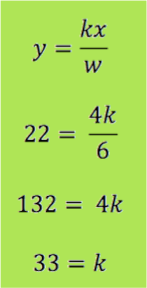
First, we use our given information to find k. We know a 1,000 piece puzzle takes 2 hours to complete if you and three friends work on it. This means n=4 people.
t221251=knp=k41000=250k=k
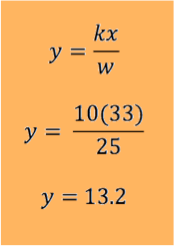
Now that we know k, we can solve the unknown information. We know there are 2,500 pieces and only you working on it: n=1.
ttt=1251np=125112500=20
It'll take you 20 hours to solve the puzzle by yourself. You might want to get some of your friends to help you.
Summary
Here is a graphic summarizing what you need to remember for Joint Variation and Combined Variation: