Interactive · 2 questions

+2 contributors

This explanation is going to be structured somewhat differently from other explanations, it will be structured in the form of an overview of a lab experiment. Its purpose is to test Le Chatelier’s Principle by observing how certain factors affect the equilibrium of a chemical reaction.
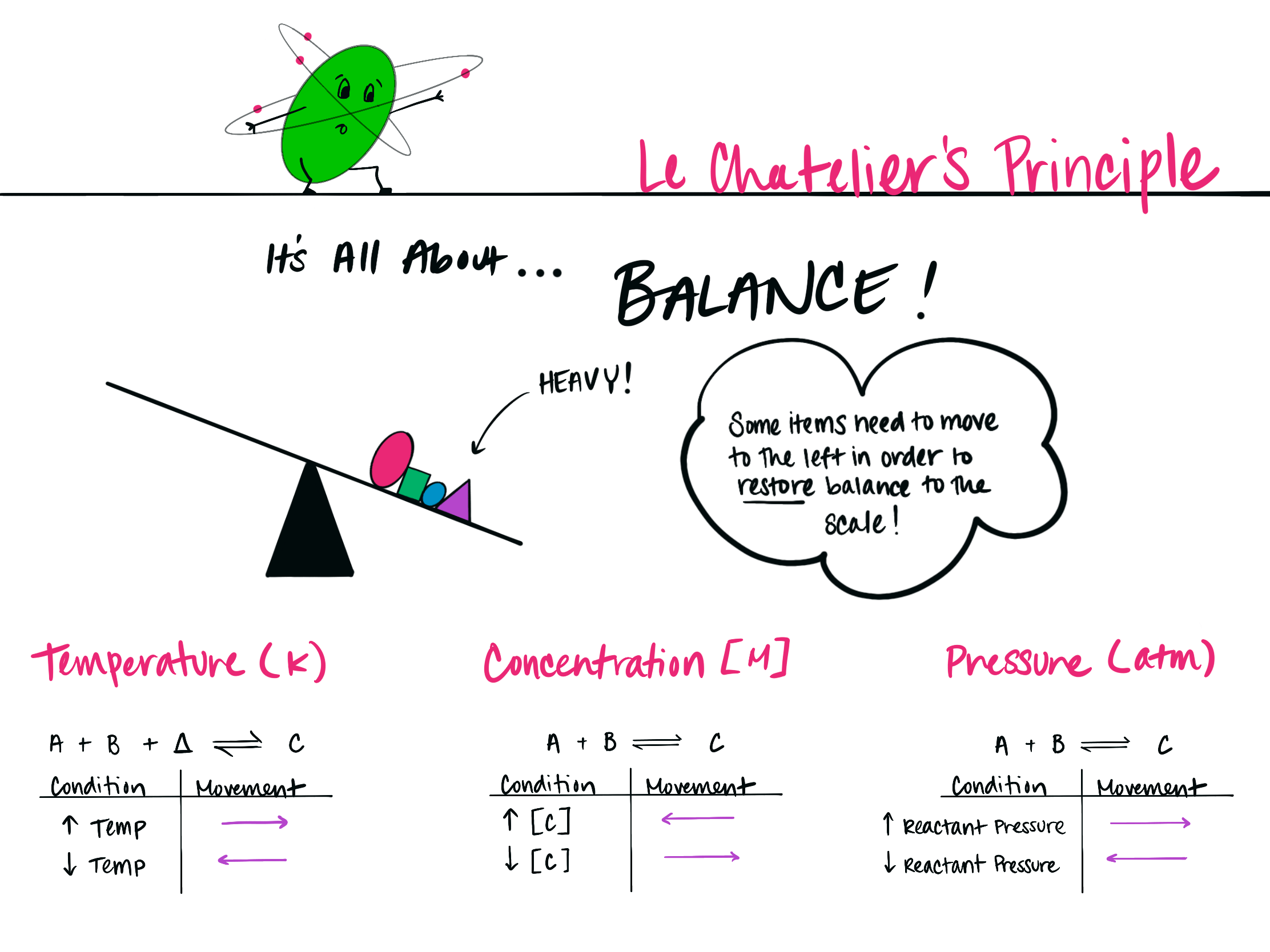
Le Chatelier’s Principle states that a change in either temperature, concentration, or pressure, that describes a reaction at equilibrium produces an equilibrium shift that compensates for the changed variable. Changes in temperature and concentration will be analyzed in this "experiment".
Consider the reaction of the acid-base indicator methyl violet (MV). It can exist in two forms in solution: protonated () and deprotonated ().
The temperature of a reaction, shown below, is manipulated where the hydrate is at equilibrium with .
When heat, denoted as delta (), is added to an endothermic reaction, the equilibrium would shift the direction of the reaction to the right and when cooled, equilibrium would shift to the left.
However, if the reaction is exothermic, heating would move equilibrium toward the left while cooling would shift equilibrium to the right.
Based on how heating and cooling shifts the equilibrium between and , it can be determined through the color change (pink indicating reactants and blue indicating products) whether the reaction is endothermic or exothermic.
If I heated the reaction vessel and the solution turned blue, is the reaction endothermic or exothermic?
Congrats on making it through the overview!