Розтягування фігури

Read · 1 min

Background

Previously, we've seen how to rotate, and reflect a figure using matrices. This next lesson in this series will cover the final matrix transformation, matrix dilation.

Before we continue, it's important that we review how to represent a function with a matrix. We put the ordered pair vertically in the matrix. Say we're given the points, (x,y)(x,y), (a,b)(a,b), and (1,2)(1, 2). We would represent these points in matrix form like so:

[xa1yb2]\begin{bmatrix} x&a&1 \\ y&b&2 \\ \end{bmatrix}

As we can see, the coordinate points are vertically paired in the matrix.

Matrix Dilation

A matrix dilation is when we make a figure bigger or smaller. We've talked about dilations before when we've seen function transformations, specifically vertically or horizontally stretching or compressing a function.

The transformation matrix, specifically the dilation matrix, is given by [k00k]\begin{bmatrix} k& 0 \\ 0&k \end{bmatrix}

If [ab]\begin{bmatrix} a\\ b \end{bmatrix} is a vector, then the matrix transforms [ab]\begin{bmatrix} a\\ b \end{bmatrix} into [kakb]\begin{bmatrix} ka\\ kb \end{bmatrix}, which is the vector multiplied by a constant kk, which is a dilation or a scale factor.

This is useful because we now have another method of transforming functions. Remember that to represent a function with a matrix, we put the ordered pair vertically in the matrix. Say we're given the points, (x,y)(x,y), (a,b)(a,b), and (1,2)(1, 2). We would represent these points in matrix form like so:

[xa1yb2]\begin{bmatrix} x&a&1 \\ y&b&2 \\ \end{bmatrix}

As we can see, the coordinate points are vertically paired in the matrix.
Video

(Video) Matrix Dilations

by statslectures

This video by statslectures talks about how to do matrix dilations.

Summary

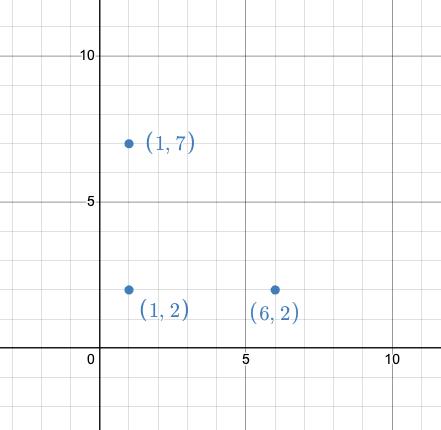
We start off with a triangle with the points, (1,7)(1,7), (1,2)(1,2), and (6,2)(6,2).

Points, (1,7), (1,2), and (6,2)

Made using Desmos

We can organize our coordinates into a vertex matrix: [116722]\begin{bmatrix} 1&1&6 \\ 7&2&2 \\ \end{bmatrix}. We can now use scalar matrix multiplication to dilate the figure. Dilating a figure means we're either enlarging it or reducing it around its center.

If we want to reduce this triangle by half, we multiply by the constant 12\frac12.

[116722]→[0.50.533.511]\begin{bmatrix} 1&1&6 \\ 7&2&2 \\ \end{bmatrix} \rightarrow \begin{bmatrix} 0.5&0.5&3 \\ 3.5&1&1 \\ \end{bmatrix}

Our new points are: (0.5,3.5)(0.5, 3.5), (0.5,1)(0.5, 1), and (3,1)(3,1). Our new triangle looks like:

Points: (0.5, 3.5), (0.5, 1), and (3,1)

Made using Desmos

Illustrated · 1 min

Matrix Dilation of a Figure

Another way we can use matrices to perform function transformations is matrix dilation of a figure!

Matrix Dilation of a Figure
using scalar multiplication

Image source: by Anusha Rahman

Using scalar multiplication, we can multiply each entry in the matrix by the scalar quantity, kk.

Type a concept, like “slope” or “photosynthesis”.

↑ ↓ to choose · Enter to openSearch explanations and problems