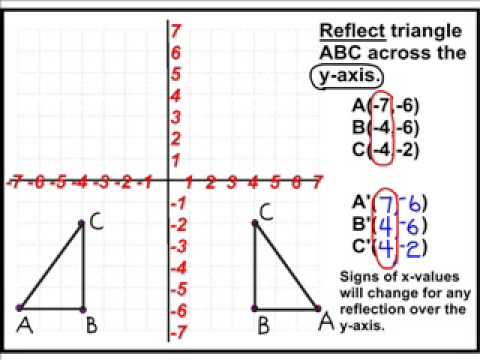
Віддзеркалення графіку многочлена (відбиття відносно осі Oy)

Before this, knowПерегортання графіку многочлена догори ногами (відбиття відносно осі Ox)

Video

(Video) Graph Transformations About the xx- and yy-Axis

by PatrickJMT

The above video by PatrickJMT describes how to reflect about the x-axis and y-axis.

Summary

To reflect a polynomial over the xx-axis, we multiply the entire polynomial by −1-1.

y=−f(x)y=-f(x)

The negative sign in front of the entire polynomial flips the graph about the xx-axis.

Video

(Video) Reflections

by MrMaisonet

In the above video by MrMaisonet it is shown an intuitive example of what is happening with reflections. Triangles are used, but this can be generalized to functions, including polynomials.

Illustrated · 1 min

The previous lesson talked about reflecting polynomial functions over the xx-axis. This lesson will talk about the mirror transformation, or reflecting polynomials about the yy-axis.

Reflecting Polynomials About the yy-Axis

When we are reflecting polynomials about the yy-axis, we are keeping the yy-values the same, but we're negating the xx-values. So the points on the right side of the yy-axis flip to the left side of the yy-axis.

f(x)=f(−x)f(x)=f(-x)

Example

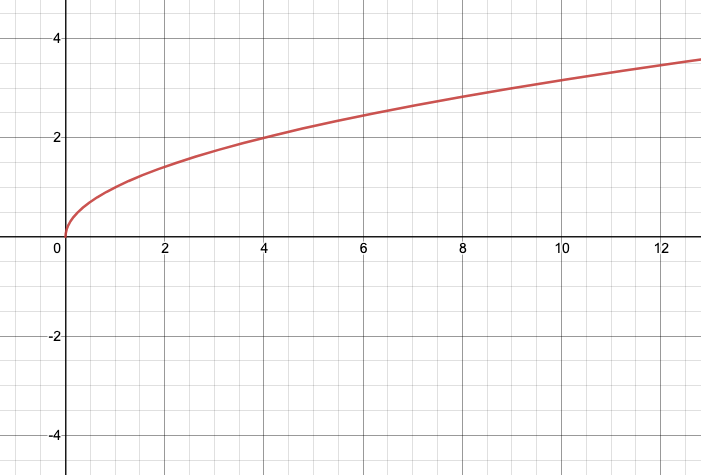
Let's take a look at the square root parent function, y=xy=\sqrt{x}. Here's the graph of the parent function:

Graph of y=\sqrtx

Made using Desmos

If we want to reflect this function over the yy-axis, we want to negate the xx values.

(0,0)→(0,0)(1,1)→(−1,1)(4,2)→(−4,2)(9,3)→(−9,3)\begin{align} (0,0) \rightarrow (0,0) \\ (1,1) \rightarrow (-1,1) \\ (4,2) \rightarrow (-4,2) \\ (9,3) \rightarrow (-9,3) \\ \end{align}
Graph of y=sqrt(-x)

Made using Desmos

As we can see from the second graph, the shape of the function has stayed the same. Even the yy values of the function have stayed the same. The only things that changed are the xx values!

Illustrated · 1 min

Reflecting Polynomials Over the yy-Axis

When we reflect a polynomial over the y-axis, we flip it across the vertical line where x=0x=0. This means that every point on the graph of the polynomial moves to the opposite side of the y-axis. For example, if a point on the graph is at (2,3)(2,3), after the reflection, it would move to (−2,3)(-2,3).

Reflect Polynomials About the y-Axis
Polynomials can be reflected over the y-axis!


In this example, we see the polynomial y=x3 reflected over the y-axis.


The new polynomial is: y=(-x)3

Made using Desmos

They key idea is that reflection over the yy-axis changes the signs of the odd powers of xx, but it keeps the signs of the even powers the same. So, in the equation y=x2+3x−4y=x^2 + 3x-4, the x2x^2 stays positive because 22 is an even number, but the 3x3x changes to −3x-3x because 11 is an odd number.

If the polynomial has only even powers of xx like y=x2+4x4y=x^2+4x^4, reflecting it over the yy-axis will not change the graph at all. This is because the even powers of xx stay the same when we replace xx with −x-x.

Reflecting polynomials over the y-axis helps us understand how the graph of a polynomial behaves when flipped. By practicing with different polynomials, you’ll become more comfortable with recognizing these changes!

In the next lesson, you will learn how to combine polynomial transformations.

Type a concept, like “slope” or “photosynthesis”.

↑ ↓ to choose · Enter to openSearch explanations and problems