Interactive · 1 question
What is molality?
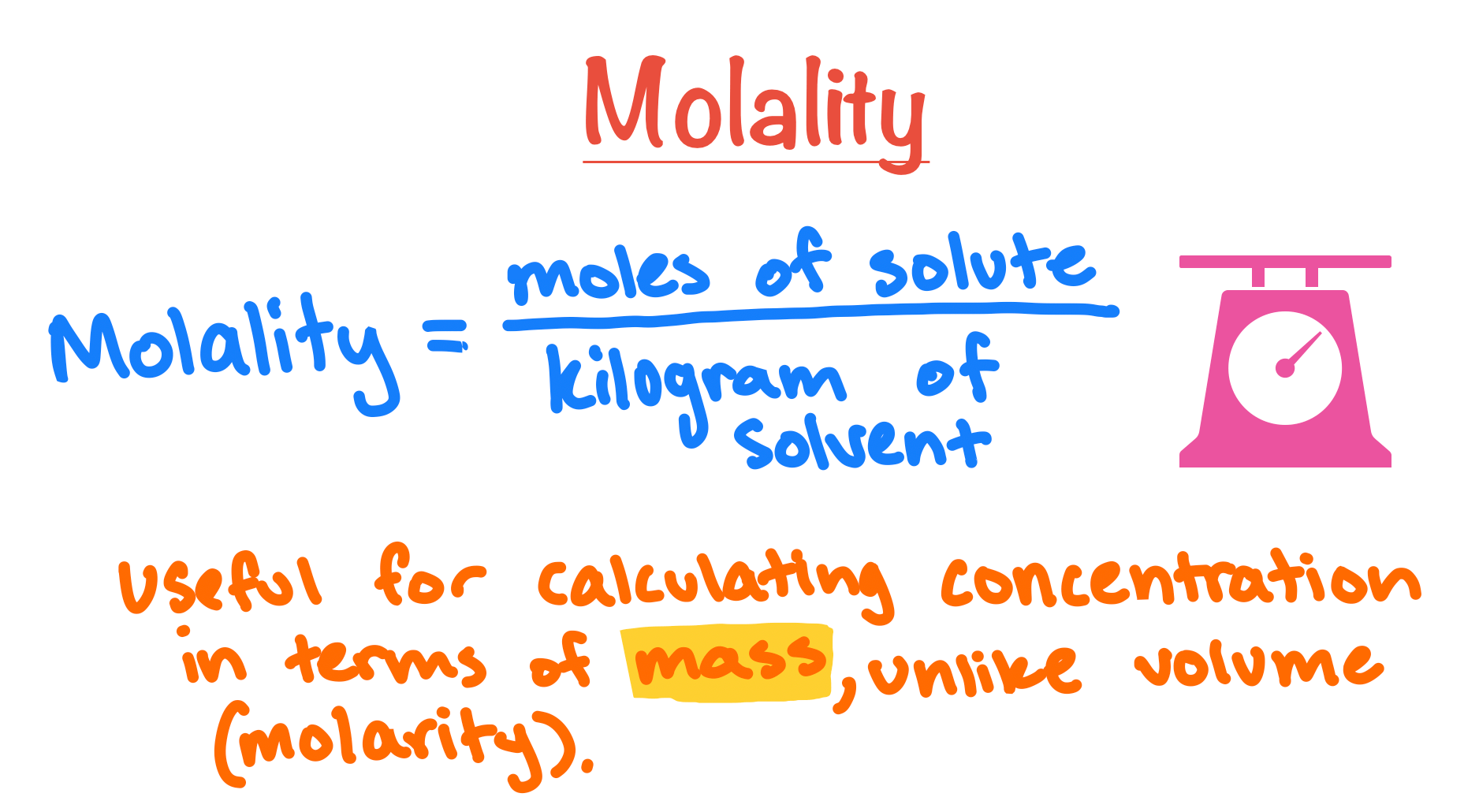
Molality is another way of communicating the concentration of solute in a solvent. Therefore, it is also really similar to molarity! Molality is the mole amount of solute in a mass of solvent. Remember though, the SI unit for mass is kg. Molality is represented by a lower-case “m” instead of the upper-case “M” denoting molarity.
The equation for molality is shown below:
But why is molality important?
Besides saying a lot of other equations use it, sometimes utilizing mass instead of volume can help us make a more accurate determination of concentration, especially when determining values for colligative properties like freezing point depression and boiling point elevation. Molality depends on temperature, but this can lead to errors in calculations because liquids will expand at increasing temperatures and contact at lower temperatures. This variation can affect our concentration, and therefore sometimes it is more useful for us to evaluate concentration independently of temperature.
References: 1
So, if we have 2 g of NaCl dissolved in 100 g of water, what is the molality of the solution?