Read · 4 min
Many chemical reactions have multiple steps. In organic chemistry, I studied some that had ten! Even worse, I had to draw the whole mechanism!
We studied reaction mechanisms. Each step in a reaction mechanism is an elementary reaction. They occur in a single collision. Because they are a single step, they don't have an intermediate. The slowest step was the rate-determining step. It controlled the rate law for the whole reaction!
What Causes Elementary Reactions?
How can a reaction be a single step? Consider collision theory. For any chemical reaction, the molecules must collide. But, they must collide with the proper orientation and energy. The required energy is the activation energy.
Think about a reaction mechanism. It tells you in what order the molecules collide. First, the molecules collide to form the intermediate. Next, the intermediate's collisions create the products. Some reactions are more than two steps. So, you generate many intermediates. I said that I'd studied ten-step reactions. A ten-step process would have eight!
Why does a chemical reaction not stop at the intermediates? Each elementary step is complete. But, chemical systems want their lowest energy. Most reactions are exothermic. They give off heat. So, they achieve a more stable state. A reaction's intermediates are not the lowest energy. So, they spontaneously undergo subsequent reactions. But remember, thermodynamics and kinetics differ. A process might be spontaneous but slow.
Consider the energy diagram. The intermediates have less energy than the reactants. But, they have more than the products. So, the intermediate point is not the most stable. Every elementary reaction has an activation energy. That's the humps on the energy diagram. Remember, activation energy and reaction rate are connected. The Arrhenius equation correlated activation energy and the rate constant. So, if an elementary reaction has high activation energy, it will be slow. If it has low activation energy, it will be fast.
Elementary Reactions and Molecularity
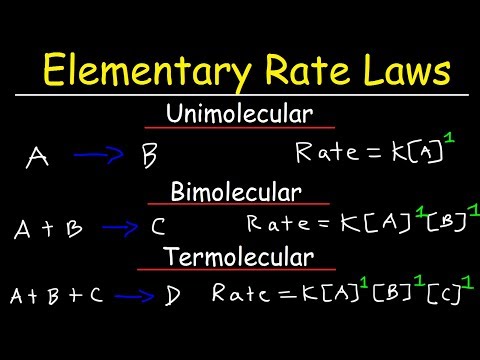
Each elementary reaction has a rate law. They are easy to determine. Just balance the equation! The equation's coefficients are the rate law's exponents. But, they don't have a reaction order. Instead, they have a molecularity. Molecularity is the number of molecules that collide in the rate-determining step. To find it, add the exponents.
Aren't rate laws found experimentally? Yes, for the overall reaction. Most often, chemists discover the rate law. Next, they propose a mechanism. The rate law may depend on multiple steps. The rate law could have parts from every elementary reaction. That's why its reaction order does not equal its coefficients. But, elementary reactions are a single step. So, its rate law will not depend on any intermediates. Without intermediates, the rate law corresponds to the number of colliding reactants.
Unimolecular Reactions
Sometimes a reaction's molecularity is one. One reactant generates the products. We call it unimolecular. The equation would be . Its rate would be . Most often, unimolecular reactions are decomposition. For example, dinitrogen tetroxide gas dissociates into nitrogen dioxide. The equation is . For unimolecular dissociation, there is no collision. Instead, the molecules have too much vibrational energy. They rip apart.
Do you know organic chemistry? If not, ignore this. If so, another example is isomerization. For example, cyclopropane isomerizes into propane.
Bimolecular Reactions
The most common elementary reactions have a molecularity of two. We call them bimolecular. In bimolecular reactions, two reactants form the products. The reactants may be the same molecule. Such as, . Or the reactant could be different. As in, . Bimolecular reactions can be any reaction type. But, they must be elementary. Below I've listed some examples.
Decomposition of hydrogen peroxide:
.
Single-replacement reaction between carbon monoxide and nitrate radical:
.
Termolecular Reactions
The highest molecularity is three, named termolecular. Three reactants collide to form the products. So, there are three possible combinations. The first possibility is the collision of three of the same molecule. Another is two of the same and one different. Finally, there is the possibility of three unique molecules.
Termolecular reactions are rare. Why? Think about collision theory. You have to have three molecules collide. They need the exact orientation and energy. The most common termolecular reaction is the depletion of ozone. In the atmosphere, pollutants absorb the sun's UV radiation, creating radicals. Radicals have an unpaired electron. So they don't obey the octet rule and are very reactive. Pollutant radicals react with ozone. The result is ozone depletion.