Interactive · 1 question

A Negative Number Divided By a Negative Number

When you are dividing a negative number by a negative number, the quotient will be a positive number.

Negative Number divided by a Negative Number: Example: -15 ÷ -3. Step One: Determine the sign (negative ÷ negative = positive) Step Two: Pretend the numbers are positive and divide (15 ÷ 3 = 5) Step Three: Solution! (positive 5 = 5)

Image by Caroline Kulczycky

Let's do another example.

What is (−34)÷(−17)?(-34) \div (-17)?

Choose one answer

Interactive · 1 question

When dividing one negative integer by another, there is one central idea: the negative signs cancel out. This is special for this particular case. A positive number divided by a negative number is actually negative. So, you can't divide any two numbers and expect to get a positive result. Positive and negative numbers have different behaviors in general.

One way to visualize this on a number line is to interpret the minus sign as movement to the left and the (implied) plus sign as movement to the right.

A number line from -5 to 5 with a minus sign above the negative numbers and a plus sign above the positive numbers.

Dividing positive integers: a refresher

Let's say we want to divide 44 by 22. We can mark both of these numbers on the number line:

A number line with a pink arrow pointing to 2 and a green arrow pointing to 4.

Then, we can answer our question by seeing how many jumps of size 22 we need to get to 44.

It takes two jumps of size 2 to get to 4.

This image has two jumps of size 22 (represented by the purple arrows facing right) to get to 44; thus, 4÷2=2\color{#29A603}{4} \div \color{#8925AE}{2} = \boxed{2}. Positive numbers divided by positive numbers give more positives.

Negative Integer Division

Let's try dividing −4-4 by −2-2. We can start with the same setup by marking −2-2 and −4-4 on the number line. The −4-4 will be to the left of −2-2.

A number line with a pink arrow pointing to -2 and a green arrow pointing to -4.

And now we figure out how many jumps of size −2-2 (or, jumps of size 22 to the left) it takes to get to −4-4.

It takes two jumps of size -2 to get to -4.

This image has two jumps of size −2-2 (represented by the purple arrows facing left) to get to −4-4; thus, −4÷−2=2\color{#29A603}{-4} \div \color{#8925AE}{-2}=\boxed{2}.

So we get a positive number again! Visually, we see that the arrows for 4÷24\div 2 and −4÷−2-4\div -2 are simply flipped across 00; this goes along with the idea that the minus signs of −4-4 and −2-2 cancel out.

Evaluate: −30÷−5-30\div -5

Choose one answer

Video

(Video) Dividing Integers

by mathman1024

Here is a video by mathman1024 that goes over dividing positive integers, dividing negative integers, and dividing a negative and a positive integer.

Summary\large{\text{Summary}}

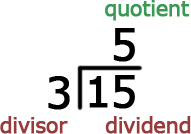
The 3 on the outside is the divisor. The 15 inside is the dividend. The 5 on top is the quotient.

Division will normally be written one of two ways: 15÷3=5dividend→divisor→153=5←quotient\begin{align} 15\div3&=5\\ \\ {\text{dividend}\rightarrow\atop \text{divisor}\rightarrow }\frac{15}{3}&=5\leftarrow \text{quotient} \end{align}

Division follows the sign rules given by multiplication. ++=+−−=++−=−−+=−\begin{align} \frac{+}{+} &= +\\ \\ \frac{-}{-}&=+\\ \\ \frac{+}{-}&=-\\ \\ \frac{-}{+}&=-\end{align} Dividing two numbers with the same sign will give a positive answer, while dividing two numbers with different signs will give a negative answer.

His example for the case of dividing two negative numbers is (−56)÷(−7)(-56)\div (-7). We know that the answer will be positive because both the divisor and dividend are negative. We are trying to find how many groups of 77 go into 5656.

(−56)÷(−7)=8(-56) \div (-7) = 8

Try one for yourself:

What is −45÷−9-45 \div -9?

Choose one answer

Type a concept, like “slope” or “photosynthesis”.

↑ ↓ to choose · Enter to openSearch explanations and problems