Порядок операцій

Interactive · 7 questions

Evaluating Expressions with Two Operations

There are four major mathematical operations:

Addition: +
Subtraction: -
Multiplication: x
Division: /

Image Source: Hannah Bonnville

Once you've gotten yourself to algebra, it's pretty rare that a math problem involves only one of these operations at a time. In fact, it's not uncommon to see all four of them together. Fun all around, right?

There's a particular order in which these operations are performed. This is called the Order of Operations, more affectionally known as PEMDAS (you'll see why, below).

Order of Operations: use PEMDAS to simplify expressions! PEMDAS = Parentheses, Exponents, Multiplication/Division, Addition/Subtraction

Image Source: Caroline Kulczycky

This means that, if there are parentheses in the expression, they need to be handled first. Then, work with exponents. Next, multiply and divide (in whichever order they are written). Last, add and subtract (in whichever order they are written). Then you have the correct answer!

Sadly, if you do these operations out of order, you'll probably get the wrong answer.

(24−17)×3(24-17)\times 3

Which operation should we deal with first in the expression above?

Choose one answer

Spot the idea in disguise

In a contest problem, this idea hides inside a situation you have not seen before. Learning to spot it is the real skill. These are real problems from the AMC 8 and AMC 12, the national math competitions for middle and high school students, each with a worked solution on LIVE by Po-Shen Loh.

Video · + 1 min read

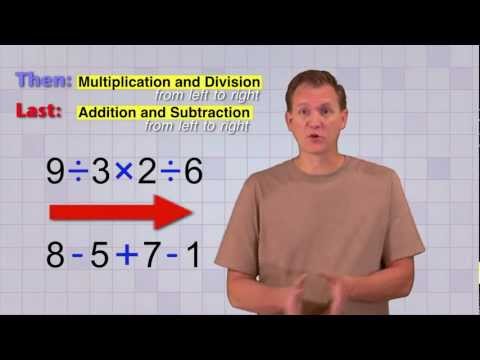
(Video) Order of Operations

by Math Antics

This video by mathantics explains the acronym PEMDAS.

Summary\large{\text{Summary}}

Order of operations is the order in which simplify mathematical expressions. Operations are just addition, subtraction, multiplication, etc.

A common rule to follow is PEMDAS. Parenthesis, Exponents, Multiplication and Division, and Addition and Subtraction.

When doing multiplication and division you move from left to right doing whichever operation comes first. The same goes for when doing addition and subtraction...left to right again please.

Example

Use PEMDAS to solve (5−3)2+8÷2×3−7+1(5-3)^2+8\div2\times3-7+1.

This looks like a huge headache at first glance but we can use PEMDAS to go one step at a time. The first step is parentheses. Simplify everything inside the parentheses. (5−3)2+8÷2×3−7+1=(2)2+8÷2×3−7+1\begin{align} &({\color{#8925AE}{5-3}})^2+8\div2\times3-7+1\\ &=({\color{#8925AE}{2}})^2+8\div2\times3-7+1 \end{align} Next up is exponents.

=22+8÷2×3−7+1=4+8÷2×3−7+1\begin{align} &={\color{#8925AE}{2^2}}+8\div2\times3-7+1\\ &={\color{#8925AE}{4}}+8\div2\times3-7+1 \end{align}

For multiplication and division, we move left to right and do whichever we see first. In our example, we'll divide first and then multiply.

=4+8÷2×3−7+1=4+4×3−7+1=4+4×3−7+1=4+12−7+1\begin{align} &=4+{\color{#8925AE}{8\div2}}\times3-7+1\\ &=4+{\color{#8925AE}{4}}\times3-7+1\\ &=4+{\color{#29A603}{4\times3}}-7+1\\ &=4+{\color{#29A603}{12}}-7+1\\ \end{align}

We can finally add or subtract. We also move left to right in our equation and do whichever comes first. In our example, we'll do addition, then subtraction, then addition again.

=4+12−7+1=16−7+1=16−7+1=9+1=9+1=10\begin{align} &={\color{#8925AE}{4+12}}-7+1\\ &={\color{#8925AE}{16}}-7+1\\ &={\color{#29A603}{16-7}}+1\\ &={\color{#29A603}{9}}+1\\ &={\color{darkblue}{9+1}}\\ &={\color{darkblue}{10}}\\ \end{align}

Test Yourself: What is −9−4÷2×3+(6−32)-9-4\div2\times3+(6-3^2)?

Choose one answer

Read · 2 min

What is "Order of Operations"?

Let's first talk about what an "operation" is. An operation in math is any action that involves adding, subtracting, multiplying, dividing, raising to a power, taking a square root, etcetera. If you see it in an equation, and it's not a number or variable, it's probably an operation.

Now, when we see an expression, such as (3+9)×2−10÷5(3 + 9) \times 2 - 10 \div 5, how do we know what to do first? Do we read it left to right? Right to left? Should we pay attention to what is in the parentheses?

The math wizards of the world sat down at a meeting to discuss how to solve problems like this. They then made the "Order of Operations", that they engraved into a stone tablet, which stated that math problems should be solved in this order:

  • Parentheses
  • Exponents
  • Multiplication/Division
  • Addition/Subtraction

Alright, this is a lot to remember, so we can create an acronym to remember it!

P.E.M.D.A.S (Parentheses, Exponents, Multiplication, Division, Addition, Subtraction) will help you remember in what order to perform the operations. You can use the phrase Please Excuse My Dear Aunt Sally to help you memorize. Let's look at an example.

Example

What is 4+(3×2)−2+10÷54 + (3 \times 2) - 2 + 10 \div 5?

How do we start this? Let's think back to P.E.M.D.A.S. The PP is for parentheses, so let's look at what is in our parentheses. We have (3×2)(3 \times 2). We perform this operation first, which we know equals 66, so our equation will now become: 4+6−2+10÷54 {\color{#8925AE}{+ 6}} - 2 + 10 \div 5

What next? Well, we don't have any exponents, so we will skip the EE. We will move on to M.D.M.D., which stands for multiplication and division. We notice that we have division in our equation. Therefore, we will perform that operation next. We will do 10÷510\div 5, which we know to be 22. Our equation will now become: 4+6−2+24 + 6 - 2 \color{#8925AE}{+ 2}

Now that we have our equation containing only addition and subtraction! We can now perform the operations from left to right, since we can do addition and subtraction in whatever order they appear. So now, we will do: 4+6−2+2{\color{#8925AE}{4 + 6}} - 2 + 2 10−2+210 - 2 + 2 10−2+2{ \color{#8925AE}{10 - 2}} + 2 8+28 + 2 =10= 10

And there we have it! Just follow the P.E.M.D.A.S., and you'll always be successful! Let's look at an example containing exponents.

5×3+23−6÷3+(9−6)5 \times 3 + 2^3 - 6 \div 3 + (9 - 6)

We still have a pair of parentheses in this equation, so we will do this first: 5×3+23−6÷3+(9−6)5 \times 3 + 2^3 - 6 \div 3 + {\color{#8925AE}{(9 - 6)}} 5×3+23−6÷3+35 \times 3 + 2^3 - 6 \div 3 + 3

Now, we will look for our EE, exponents. We notice 232^3 in our equation. Perfect! So now we will perform 232^3, which is 2×2×22 \times 2 \times 2, equal to 88. So now we will have: 5×3+8−6÷3+35 \times 3 + {\color{#8925AE}{8}} - 6 \div 3 + 3

Our next move is to look for multiplication and division, M.D. in our equation. We have 5×35 \times 3 and 6÷36 \div 3. We will do 5×35 \times 3 first, since it comes first in the equation. We know that 5×3=155 \times 3 = 15, so we can change our equation to: 15+8−6÷3+3{\color{#8925AE}{15}} + 8 - 6 \div 3 + 3

Now, we can do 6÷36\div 3, which equals 22, so our equation is: 15+8−2+315 + 8 - {\color{#8925AE}{2}} + 3

Great! Now we have our equation containing only addition and subtraction, so we can just perform the operations from left to right! 15+8−2+315 + 8 - 2 + 3 15+8−2+3{\color{#8925AE}{15 + 8}} - 2 + 3 23−2+3{\color{#8925AE}{23 - 2}} + 3 =21+3= {\color{#8925AE}{21}} + 3 =24= \boxed{24} and there you have it!

Type a concept, like “slope” or “photosynthesis”.

↑ ↓ to choose · Enter to openSearch explanations and problems