We've been studying chemical bonding. The goal of any chemical bond is to complete an atom's octet. But, there are two ways to do that. They can transfer electrons or share electrons.
When the electrons transfer, we create ions. The ion's electron configuration is more stable. Why? They've achieved their noble gas configuration. Moreso, the opposite charges get attracted to one another. The energy lessens, further increasing stability. Now, we have an ionic bond!
The other way to complete an octet is to share electrons. The electron pairs contribute to both valence shells. So, they achieve their full octet. Again, having a full octet lowers the overall energy. What's the result? Increased stability and a covalent bond!
What Makes it Polar or Nonpolar?
There are two types of covalent bonds, polar and nonpolar. A nonpolar bond is easy. The electrons are shared evenly, and the bond is neutral. In contrast, a polar bond has two oppositely charged sides or poles. It's like a magnet. What causes the charges? The electrons get unequally shared between the atoms. The unequal sharing happens when the two elements have a considerable electronegativity difference. The more electronegative element will pull the electrons towards it. So, the electron density is uneven. What would we see if we looked at the electron cloud diagram? We'd see that the electrons would spend more time with the electronegative element. So, there would be a lot of dots around it. But, there would be fewer dots around the less electronegative element. What's the result? The atoms have a partial charge or dipole.
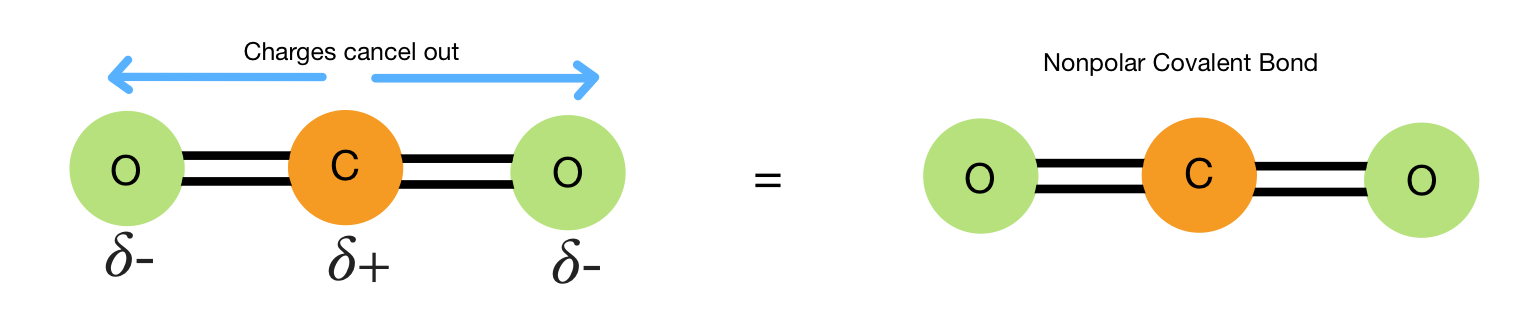
We can also talk about a molecule's polarity. For molecules, we look at both bond polarity and molecular geometry. For a molecule to be polar, it must have polar bonds. But, not all molecules with polar bonds are polar. For example, consider carbon dioxide. It has two carbon-oxygen double bonds that are polar. The electrons in both bonds get pulled toward the oxygen. But it's a linear molecule. Both ends have partial negative charges. But, to be polar, it has to have oppositely charged poles. It doesn't have that. The two polar bonds cancel out. What's the result? The molecular geometry makes it nonpolar!
Intermolecular Forces
Why do we care about polar and nonpolar bonds? They determine the types of Van der Waal's forces. Nonpolar molecules only experience dispersion forces. But, polar molecules can undergo dipole-dipole and dipole-ion interactions.
A dipole-dipole attraction occurs when a molecule's positive pole attracts the negative pole of another. The most robust dipole-dipole interaction is a hydrogen bond. Hydrogen bonds occur when hydrogen bonds to nitrogen, oxygen, or fluorine. Why these elements? They are very electronegative! So, the electron distribution is especially uneven. Dipole-dipole forces are responsible for a substance's physical properties. They are more likely to be solids or liquids at room temperature. They often have higher melting and vaporization points. Why? Because it takes energy to overcome the dipole-dipole interaction.
Polar molecules can also interact with ions. But, the interaction is a little different. The ion has a full ionic charge. Polar molecules only have partial dipoles. So, it takes many polar molecules to stabilize an ion. They surround the ion, forming a shell. The ion's charge gets stabilized. That's why polar molecules are excellent solvents for ionic compounds. But, the other end of the dipole is pointing outward. So, we need more polar molecules to stabilize themselves. The charge dissipates the further we are from the ion. So, overall we need a lot of polar molecules to stabilize one ion. That's one of the reasons we hit a saturation concentration. We can't dissolve more ions because all our solvent molecules are currently engaged.
Water, the Essential Polar Molecule
Water is the quintessential polar molecule. You should become very familiar with it. Let's start with the basics! It has two oxygen-hydrogen bonds and two lone electron pairs. That means it has a bent VSEPR geometry. But, oxygen is a very electronegative atom. Remember, we intentionally defined hydrogen as the middle of the scale. So, water is a polar molecule that undergoes hydrogen bonding.
Water's polarity explains its physical and chemical properties. For example, water is an unbelievable solvent. We call it the universal solvent. It can absorb massive amounts of heat. Water's heat capacity is 4.18g×KJ. For comparison, many metals have a heat capacity below 1.0g×KJ. It also has very high surface tension. Water's surface tension is why bugs can sit on top of lakes and ponds! Finally, we find it in all three phases of matter at earth's temperatures and pressures. The coolest thing is ice. It's less dense than liquid water. So, it floats on top of water. In the winter, ice forms a protective layer over our lakes and oceans. Life can continue below the surface because it's insulated. If water's density didn't change, freezing would destroy any water-based ecosystem.