Interactive · 1 question

Kilograms to Pounds

Here's a prehistoric example to get things started.

We find out that 22,500 kilograms (kg)22,500\text{ kilograms (kg)} is equal to the mass of a T-rex, on average. You like to measure weight using pounds (lbs). You decide to ask your math teacher how many pounds the T-rex weighs, but she gives you the unit rate for kg to lbs.

1 kilogram≈2.2 pounds1\text{ kilogram}\approx 2.2\text{ pounds}

She expects you to convert kg to lbs yourself. Typical.

The conversion rate

1 kilogram≈2.2 pounds1\text{ kilogram}\approx 2.2\text{ pounds}

means 1 kilogram1\text{ kilogram} and 2.2 pounds2.2\text{ pounds} are defined as being equal.

Example: Converting Kg to Lb

Let's set up a conversion table to help us. We know the T-rex weighs 22,500 kg22{,}500\text{ kg}. 22,500 kg\begin{array}{c|c|c} 22{,}500\text{ kg}\\ \hline \end{array} We also know that 2.2 lbs2.2\text{ lbs} is approximately 1 kg1\text{ kg}. 22,500 kg2.2 lbs1 kg\begin{array}{c|c|c} 22{,}500\text{ kg}&2.2\text{ lbs}\\ \hline &1\text{ kg} \end{array} Since kilograms are above and below the fraction bar, we can cancel them out. 22,500 kg2.2 lbs1 kg\begin{array}{c|c|c} 22{,}500\cancel{\text{ kg}}&2.2\text{ lbs}\\ \hline &1\cancel{\text{ kg}} \end{array} This tells us that a T-rex weighs 22,500⋅2.2 lbs22{,}500\cdot2.2\text{ lbs}. 22,500⋅2.2=49,500 lbs22{,}500\cdot2.2=\boxed{49{,}500\text{ lbs}}

1 kilogram = 2.2 pounds

Image source: By OpenClipart-Vectors CC0, via pixabay.com

The example above walked you through using conversion tables to change kg to lbs. Now try reversing the conversion in the example below.

Practice: Converting Lb to Kg

Convert 500 pounds500\text{ pounds} to kilograms\text{kilograms}.

Choose one answer

Video

(Video) Converting Pounds to Kilograms

by T Wood

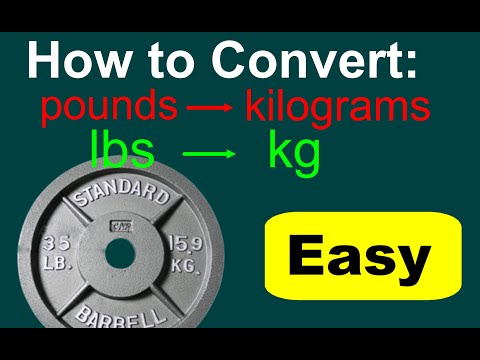
The above video by T Wood shows how to convert from pounds to kilograms. Throughout we abbreviate kilograms with the symbol kg. We also abbreviate pounds with the symbol lb.

Summary\large{\text{Summary}}

We need to keep in mind the unit rate to convert from kilograms to pounds (kg to lbs): 1 kg=2.205 lbs\boxed{1\text{ kg}=2.205\text{ lbs}}

Suppose you wanted to convert 2525 lbs to kg. We can do this by setting up a conversion table. For this problem, divide by the decimal 2.2052.205 and cancel out the pound units: 25 lbs1 kg2.205 lbs\begin{array}{c|c} 25\text{ lbs}&1\text{ kg}\\ \hline &2.205\text{ lbs} \end{array} 25 lbs1 kg2.205 lbs≈11.38 kg\begin{array}{c|c} 25\cancel{\text{ lbs}}&1\text{ kg}\\ \hline &2.205\cancel{\text{ lbs}} \end{array}\approx \boxed{11.38}\text{ kg}

Read · 1 min

Your friend, who's on vacation in the United Kingdom at the moment, emails you about a large fish he caught. He tells you that when he weighed it using the scale in their house, it was 22.4 kilograms(kg)22.4 \text{ kilograms} (kg)! However, he has no idea exactly how heavy it is, since he's not from the United States and isn't used to measuring things in pounds (lbs). Perhaps this is because kilograms are the base unit of mass! How do you figure out how much the fish weighs in pounds? We convert kg to pounds. But how? Let's find out.

To find the fish's weight (or mass) in pounds, we convert its weight from kilograms to pounds by using the unit rate lb=2.2⋅kg\text{lb}=2.2 \cdot \text{kg} where lb\text{lb} is the number of pounds and km\text{km} is the number of kilograms.

This gives us an approximate measure of how much the fish weighs, which is around 2.2⋅22.4=49.282.2\cdot22.4=\boxed{49.28} pounds. That's one heavy fish!

Now let's say your friend told you it weighed 22.422.4 pounds instead, and he wanted to tell another friend, who lives in England, how much it weighed in kilograms. We can apply a similar formula to convert pounds to kilograms. kg=0.45⋅lb\text{kg}=0.45 \cdot \text{lb} where lb\text{lb} is the number of pounds and kg\text{kg} is the number of kilograms.

In kilograms, the fish weighs around 0.45⋅22.4=10.08 kilograms0.45\cdot22.4=\boxed{10.08} \text{ kilograms}. If you're interested, you can also convert between kilograms and grams.

Type a concept, like “slope” or “photosynthesis”.

↑ ↓ to choose · Enter to openSearch explanations and problems