Неперервні та розривні функції

Illustrated · 1 min

There are formal ways to discuss and define continuous functions, but here is a "lazy" definition of continuous: Continuous functions are ones which you could, in principle, draw without lifting your pen or pencil off the paper. These functions don't have any holes or jumps.

An example is y=x2:y=x^2:

Graph of the function y=x^2

Created using Desmos

Notice that, to draw y=x2,y=x^2, you don't have to lift your pencil off the paper −- the curve is unbroken.

A discontinuous function is any function that isn't continuous. A good example is y=1x:y=\dfrac{1}{x}:
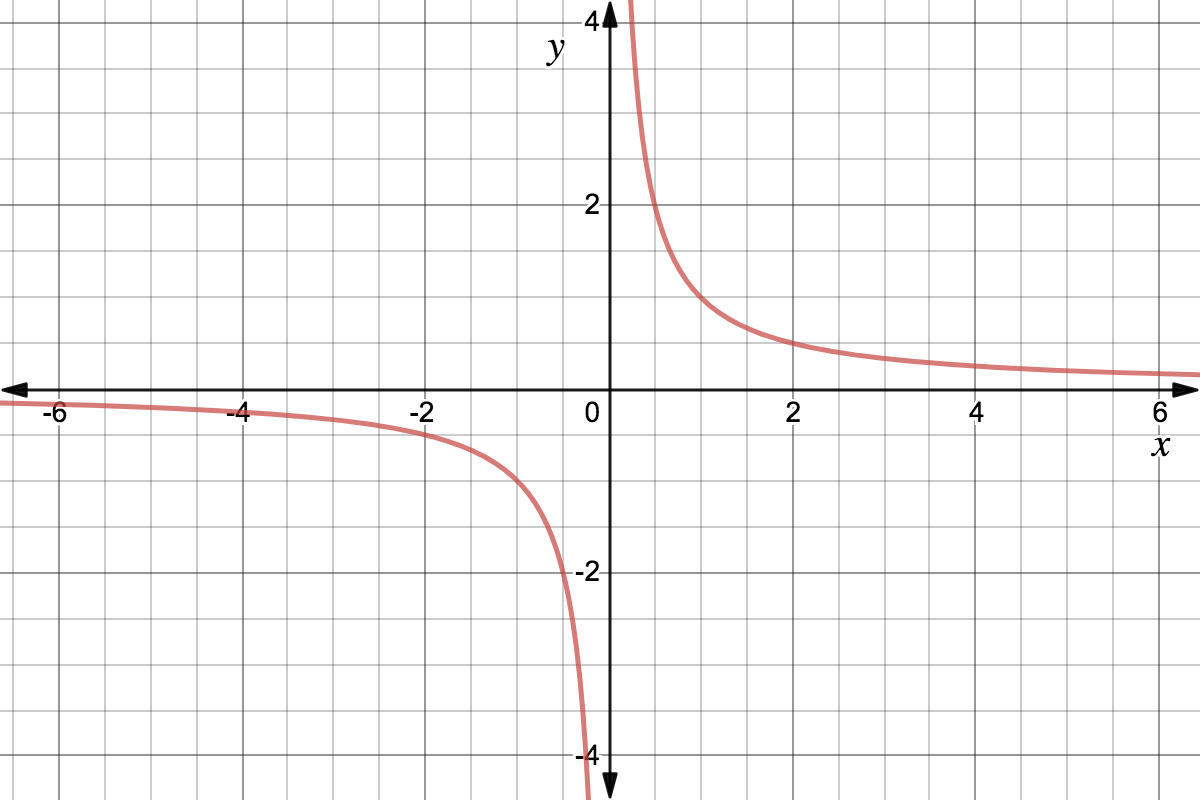
Graph of the function y=1/x

Created using Desmos

Notice that, to draw y=1x,y=\dfrac{1}{x}, you have to draw two curves, and you have to lift your pencil off of your paper to do that! Thus, this function is not continuous.

Video

(Video) Where is a Function Continuous?

by MySecretMathTutor

Here's a video by MySecretMathTutor explaining the difference between continuous and discontinuous graphs.

Read · 1 min

The common "draw without lifting a pencil" definition only applies to functions on certain domains, typically an open, closed, or clopen interval of real numbers for functions from real numbers to real numbers. This definition is very incomplete. It ignores all other domains. It also only applies to functions that can be graphed, which ignores functions from integers to bananas.

Read · 1 min

An increasing or decreasing function that is defined on an interval and does not skip any intermediate values is continuous. This property can be taken as the definition of continuity for increasing and decreasing functions.

Type a concept, like “slope” or “photosynthesis”.

↑ ↓ to choose · Enter to openSearch explanations and problems
