Правило добутку

Interactive · 10 questions

Suppose we have a function we don't know how to take the derivative of, but the function is the product of two functions we do know how to take the derivative of, like this:

h(x)=(x2+3x+6)(x8+x)h(x) = (x^{2} + 3x + 6)(x^{8} + x)

It would be nice to have a formula for the derivative of f(x)f(x) in terms of the derivatives of the two functions on the right. Let's call these functions f(x)=x2+3x+6f(x) = x^{2} + 3x + 6 and g(x)=x8+xg(x) = x^{8} + x.

To do this, imagine a rectangle with sides f(x)f(x) and g(x)g(x), and suppose xx represents time. Then h(x)h(x) is the area of the rectangle at time xx:

Now suppose a small amount of time, Δx\Delta x, passes. The values of the two functions will also change by small amounts, Δf\Delta f and Δg\Delta g, and the rectangle's dimensions will change:

We want the derivative of h(x)h(x), so let's find Δh(x)\Delta h(x), the difference between the area of the red rectangle and the area of the blue rectangle.

What strategy should we use to find this difference of areas?

Choose one answer

Read · 1 min

I often like limiting cases when I derive equations. What we want to know is a way to take the derivative of the product of two functions

ddx(f(x)g(x))\frac{d}{dx} (f(x) g(x))

in terms of f′(x)f'(x) and g′(x)g'(x). Well, if we got lucky and f(x)=f0f(x) = f_0 was a constant this would be easier.

ddx(f0g(x))=f0g′(x)\frac{d}{dx} (f_0 g(x)) = f_0 g'(x)

Similarly, if g(x)=g0g(x)=g_0 was a constant function, we would have gotten g0f′(x)g_0 f'(x) for the derivative. These cases will let us know when we get the right answer.

What if we estimate f(x)≈f0+Δx  f′f(x) \approx f_0 + \Delta x\;f' and g(x)=g0+Δx  g′g(x) = g_0 + \Delta x\;g'. Then,

ddx(f(x)g(x))=f0g′(x)=ddx[(f0+Δx  f′)(g0+Δx  g′)]≈ddx(f0g0+Δx  (f0g′+f′g0))≈f(x)g′(x)+f′(x)g(x)\frac{d}{dx} (f(x) g(x))= f_0 g'(x)\\ = \frac{d}{dx} \left[(f_0+ \Delta x \;f') (g_0+ \Delta x \;g') \right]\\ \approx \frac{d}{dx} \left( f_0 g_0 + \Delta x\;(f_0 g' + f' g_0) \right) \\ \approx f(x) g'(x) + f'(x) g(x)

Read · 1 min

The derivative of product of functions f(x)f(x) and g(x)g(x) is equal to the product of f(x)f(x) and the derivative of g(x)g(x) plus the product of the derivative of f(x)f(x) and g(x)g(x). (f(x)⋅g(x))′=f(x)⋅g(x)′+f(x)′⋅g(x)\begin{equation} (f(x) \cdot g(x))'=f(x)\cdot g(x)'+f(x)'\cdot g(x) \end{equation}

Interactive · 7 questions

This is an intuitive explanation of the product rule using a physical example...

Imagine you're tiling a floor with little square tiles that have side length ss. You have a tiled patch that is 5 tiles long and 3 tiles wide. The length of the patch (L)(L) and width of the patch (W)(W) can be expressed as functions of ss.

What are these functions?

Choose one answer

Interactive · 2 questions

(This explanation uses little-o notation.)

Suppose functions f(x)f(x), g(x)g(x) are differentiable at aa. What can we say about (f(x)g(x))′∣x=a(f(x)g(x))' |_{x=a}, the derivative of f(x)g(x)f(x)g(x) evaluated at x=ax=a?

Perhaps we can get an expression in terms of f(a),f′(a),g(a),g′(a)f(a),f'(a),g(a),g'(a).

Is this derivative just f′(a)g′(a)f'(a) g'(a)?

Choose one answer

Read · 1 min

Although the Product Rule is most commonly seen for the expansion of a two-factor product, if there are more than two factors, the Product Rule can be extended for these more complicated expressions.

(f(x)g(x)h(x))′=([f(x)g(x)]⋅[h(x)])′(f(x)g(x)h(x))' = ([f(x)g(x)]\cdot[h(x)])'

The Product Rule can be used where the factors are f(x)g(x)f(x)g(x) and h(x)h(x):

(f(x)g(x))′h(x)+(f(x)g(x))h′(x)=h(x)(f′(x)g(x)+f(x)g′(x))+f(x)g(x)h′(x)=f′(x)g(x)h(x)+f(x)g′(x)h(x)+f(x)g(x)h′(x)\begin{align*}&(f(x)g(x))'h(x) + (f(x)g(x))h'(x) \\&= h(x)(f'(x)g(x) + f(x)g'(x)) + f(x)g(x)h'(x) \\&= f'(x)g(x)h(x) + f(x)g'(x)h(x) + f(x)g(x)h'(x) \end{align*}

Interactive · 4 questions

(This will possibly need some knowledge of combinatorics, induction, and binomial coefficients. This is very optional, and for the very interested reader. :) )

In this post we will generalize the Product-Rule, showing something called the General Leibniz Rule.

Define f(n)(x)f^{(n)}(x) to be the result when you differentiate f(x)f(x) nn times. For example, if f(x)=x5,f(3)(x)=60x2f(x) = x^5, f^{(3)}(x) = 60x^2. From now on, I will drop the (x)(x) for simplicity, so f(x)≡ff(x) \equiv f. Define fg(x)=f(x)g(x)fg(x) = f(x)g(x). The product rule says that (fg)(1)=f(1)g+fg(1)(fg)^{(1)} = f^{(1)}g + fg^{(1)}.

Compute (fg)(2)(fg)^{(2)}. What do you get?

Choose one answer

Read · 1 min

The derivative of a product of two functions is equal to the sum of the first function times the derivative of the second function plus the derivative of the first function times the second function.

(f(x)g(x))′(f(x)g(x))' = f(x)g(x)′f(x)g(x)' + f(x)′g(x)f(x)'g(x)

Read · 1 min

PROOF OF PRODUCT RULE:

ddx[f(x)g(x)]=lim⁡f(x+a)g(x+a)−f(x)g(x)a=lim⁡f(x+a)g(x+a)−f(x)g(x+a)+f(x)g(x+a)−f(x)g(x)a=lim⁡g(x+a)(f(x+a)−f(x))a+lim⁡f(x)(g(x+a)−g(x))a=f′(x)g(x)+f(x)g′(x).\frac{d}{dx} [f(x)g(x)] = \lim \frac{f(x+a)g(x+a) - f(x)g(x)}{a} \\= \lim \frac{f(x+a)g(x+a)-f(x)g(x+a) + f(x)g(x+a) - f(x)g(x)}{a} \\= \lim \frac{g(x+a)(f(x+a) - f(x))}{a} + \lim \frac{f(x)(g(x+a) - g(x))}{a} \\= f'(x)g(x) + f(x)g'(x).

Illustrated · 1 min

One might think that the derivative of a product is the product of the derivatives in question. However, this is wrong. An example of this is:

Let f(x)=xf(x)=x and f(g)=x2f(g)=x^2

f′(x)=1f'(x)=1 and f′(g)=2xf'(g)=2x

but (fg)(x)=x3(fg)(x)=x^3 so (fg)′(x)=3x2(fg)'(x)=3x^2

Thus (fg)′(fg)' does not equal f′g′f'g' because f′g′=2xf'g'=2x not 3x23x^2

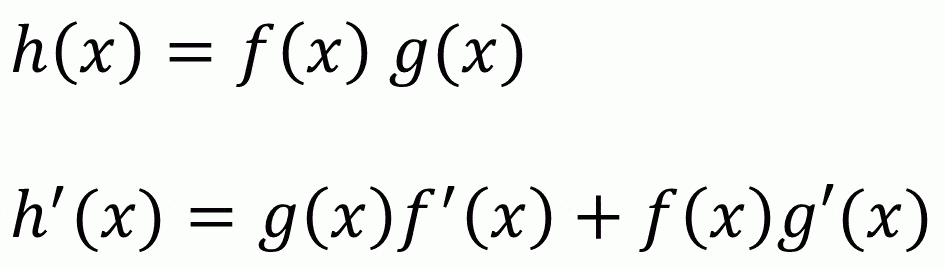
So how does one actually solve this properly? You use the product rule. The product rule is viewed as such:

So lets reason the problem properly now that we know what to do.

h(x)=f(x)∗g(x)h(x)=f(x) * g(x) where f(x)=xf(x)=x and g(x)=x2g(x) = x^2

so lets find h′(x)h'(x)...

h′(x)=2x(x)+1(x2)h'(x)= 2x(x) + 1(x^2) h′(x)=2x2+x2h'(x)= 2x^2 + x^2 h′(x)=3x2h'(x)=3x^2

and there we have the previous, correct, answer. This is how one does the product rule but remember to always make sure you are getting the proper derivatives from both f(x) and g(x) within the formula.

Interactive · 3 questions

We know how to find the derivative of functions f(x)f(x) and g(x)g(x). The derivatives are f′(x)f'(x) and g′(x)g'(x) respectively.

But what about the derivative of function h(x)h(x) which is composed of functions f(x)f(x) and g(x)g(x)?

(f(x)∗g(x))′(f(x)*g(x))'

Is it f′(x)∗g′(x)f'(x)*g'(x)?

Choose one answer

Read · 1 min

Here are some extra practice problems, have fun solving them!

Video · + 1 min read

(Videos) Using Chain, Product, and Quotient Rules to Find Derivatives

by PatrickJMT

Here's a video by patrickJMT showing you how to use the chain, product, and quotient rules to find the derivatives of functions.

Recall the chain, product, and quotient rules: [f(g(x))]′=f′(g(x))⋅g′(x)[f(x)g(x)]′=f′(x)g(x)+g′(x)f(x)[f(x)g(x)]′=f′(x)g(x)−g′(x)f(x)[g(x)]2\begin{align} [f(g(x))]'&=f'(g(x))\cdot g'(x)\\ [f(x)g(x)]'&=f'(x)g(x)+g'(x)f(x)\\ \bigg[\frac{f(x)}{g(x)}\bigg]'&=\frac{f'(x)g(x)-g'(x)f(x)}{[g(x)]^2} \end{align}

The first problem he finds the derivative of is: f(x)=(2x13−6x53)3⋅(4x2−5x)13f(x)=(2x^{\frac13}-6x^{\frac53})^3\cdot(4x^2-5x)^{\frac13}

I like to calculate each pieces derivative separately and then plug them into the formula after. It helps me keep things organized.

So I'll start by finding the derivative of the first part. f1(x)=(2x13−6x53)3f_1(x)=(2x^{\frac13}-6x^{\frac53})^3 Here's where we use the chain rule. Take the derivative of the outside and then multiply it by the derivative of the inside. f1′(x)=3(2x13−6x53)3−1⋅(2x13−6x53)′=3(2x13−6x53)2⋅[2(13x13−1)−6(53x53−1)]=3(2x13−6x53)2⋅(23x−2310x23)\begin{align} f_1'(x)&=\color{red}{3}(2x^{\frac13}-6x^{\frac53})^{\color{red}{3-1}}\color{red}{\cdot(2x^{\frac13}-6x^{\frac53})'}\\ &=3(2x^{\frac13}-6x^{\frac53})^2\cdot[2(\color{red}{\frac13}x^{\color{red}{\frac13-1}})-6(\color{red}{\frac53}x^{\color{red}{\frac53-1}})]\\ &=\boxed{3(2x^{\frac13}-6x^{\frac53})^2\cdot\bigg(\frac23x^{-\frac23}10x^{\frac23}\bigg)} \end{align}

Now let's find the derivative of the second part. f2(x)=(4x2−5x)13f_2(x)=(4x^2-5x)^{\frac13} Again, we need to use the chain rule. f2′(x)=13(4x2−5x)13−1⋅(4x2−5x)′=13(4x2−5x)−23⋅[4(2x2−1)−5(1x1−1)]=13(4x2−5x)−23⋅(8x−5)\begin{align} f_2'(x)&=\color{red}{\frac13}(4x^2-5x)^{\color{red}{\frac13-1}}\color{red}{\cdot(4x^2-5x)'}\\ &=\frac13(4x^2-5x)^{-\frac23}\cdot[4(\color{red}{2}x^{\color{red}{2-1}})-5(\color{red}{1}x^{\color{red}{1-1}})]\\ &=\boxed{\frac13(4x^2-5x)^{-\frac23}\cdot(8x-5)} \end{align}

Now that we have all the pieces we can plug them into our product rule for derivatives formula. f′(x)=f1′(x)⋅f2(x)+f2′(x)⋅f1(x)=3(2x13−6x53)2⋅(23x−2310x23)⋅(4x2−5x)13+     +13(4x2−5x)−23⋅(8x−5)⋅(2x13−6x53)3=3(2x13−6x53)2⋅(23x−2310x23)⋅(4x2−5x)13+     +(8x−5)(2x13−6x53)33(4x2−5x)23\begin{align} f'(x)&=f_1'(x)\cdot f_2(x)+f_2'(x)\cdot f_1(x)\\ &=3(2x^{\frac13}-6x^{\frac53})^2\cdot\bigg(\frac23x^{-\frac23}10x^{\frac23}\bigg)\cdot(4x^2-5x)^{\frac13}+\\ &\ \ \ \ \ +\frac13(4x^2-5x)^{-\frac23}\cdot(8x-5)\cdot(2x^{\frac13}-6x^{\frac53})^3\\ &=3(2x^{\frac13}-6x^{\frac53})^2\cdot\bigg(\frac23x^{-\frac23}10x^{\frac23}\bigg)\cdot(4x^2-5x)^{\frac13}+\\ &\ \ \ \ \ +\frac{(8x-5)(2x^{\frac13}-6x^{\frac53})^3}{3(4x^2-5x)^{\frac23}} \end{align}

Here's another example of solving a derivative using the chain and quotient rules.

The problem he looks at is: g(x)=(2x3−5x)4(4x+1)5g(x)=\frac{(2x^3-5x)^4}{(4x+1)^5}

I like to calculate each pieces derivative separately and then plug them into the formula after. It helps me keep things organized.

Let's start with the top piece's derivative. g1(x)=(2x3−5x)4g_1(x)=(2x^3-5x)^4 Here we have to take the derivative outside the parentheses and then multiply on the derivative of inside the parentheses. g1′(x)=4(2x3−5x)4−1⋅(2x3−5x)′=4(2x3−5x)3⋅(2(3x3−1)−5(1x1−1))=4(2x3−5x)3⋅(6x2−5)\begin{align} g_1'(x)&=\color{red}{4}(2x^3-5x)^{\color{red}{4-1}}\color{red}{\cdot(2x^3-5x)'}\\ &=4(2x^3-5x)^3\cdot(2(\color{red}{3}x^{\color{red}{3-1}})-5(\color{red}{1}x^{\color{red}{1-1}}))\\ &=\boxed{4(2x^3-5x)^3\cdot(6x^2-5)} \end{align}

Now let's derive the bottom piece. g2(x)=(4x+1)5g_2(x)=(4x+1)^5 Again, we use the chain rule to find this derivative. g2′(x)=5(4x+1)5−1⋅(4x+1)=5(4x+1)4⋅(4(1x1−1)+0)=5(4x+1)4⋅(4)=20(4x+1)4\begin{align} g_2'(x)&=\color{red}{5}(4x+1)^{\color{red}{5-1}}\color{red}{\cdot(4x+1)}\\ &=5(4x+1)^4\cdot(4(\color{red}{1}x^{\color{red}{1-1}})+\color{red}{0})\\ &=5(4x+1)^4\cdot(4)\\ &=\boxed{20(4x+1)^4} \end{align}

So now we can plug these into our quotient rule derivative formula. g′(x)=g1′(x)⋅g2(x)−g2′(x)⋅g1(x)(g2(x))2=4(2x3−5x)3⋅(6x2−5)⋅(4x+1)5−20(4x+1)4⋅(2x3−5x)4[(4x+1)5]2=4(2x3−5x)3⋅(6x2−5)⋅(4x+1)5−20(4x+1)4⋅(2x3−5x)4(4x+1)10=4(4x+1)4(2x3−5x)3[(6x2−5)⋅(4x+1)−5(2x3−5x)](4x+1)10=4(2x3−5x)3[(6x2−5)⋅(4x+1)−5(2x3−5x)](4x+1)6=4(2x3−5x)3[24x3−20x+6x2−5−10x3+25x](4x+1)6=4(2x3−5x)3[14x3+6x2+5x−5](4x+1)6\begin{align} g'(x)&=\frac{g_1'(x)\cdot g_2(x)-g_2'(x)\cdot g_1(x)}{(g_2(x))^2}\\ &=\frac{4(2x^3-5x)^3\cdot(6x^2-5)\cdot(4x+1)^5-20(4x+1)^4\cdot(2x^3-5x)^4}{[(4x+1)^5]^2}\\ &=\frac{4(2x^3-5x)^3\cdot(6x^2-5)\cdot(4x+1)^5-20(4x+1)^4\cdot(2x^3-5x)^4}{(4x+1)^{10}}\\ &=\frac{4(4x+1)^4(2x^3-5x)^3[(6x^2-5)\cdot(4x+1)-5(2x^3-5x)]}{(4x+1)^{10}}\\ &=\frac{4(2x^3-5x)^3[(6x^2-5)\cdot(4x+1)-5(2x^3-5x)]}{(4x+1)^{6}}\\ &=\frac{4(2x^3-5x)^3[24x^3-20x+6x^2-5-10x^3+25x]}{(4x+1)^{6}}\\ &=\boxed{\frac{4(2x^3-5x)^3[14x^3+6x^2+5x-5]}{(4x+1)^{6}}} \end{align}

Here's a third video where he works through another derivative problem involving chain rule.

The problem he looks at this time is: h(x)=(x+1)2x−(2x3+1)2−5xh(x)=\frac{(x+1)^2}{x}-\bigg(\frac{2}{x^3+1}\bigg)^2-5x He first simplifies this problem before taking the derivative in order to make it easier. =x2+2x+1x−4(x3+1)2−5x=x+2+x−1−4(x3+1)−2−5x\begin{align} &=\frac{x^2+2x+1}{x}-\frac{4}{(x^3+1)^2}-5x\\ &=x+2+x^{-1}-4(x^3+1)^{-2}-5x \end{align} Now we can take the derivative. h′(x)=1+0+(−1x−2)−4[−2(x3+1)−3]⋅(3x2)−5=1−x−2+8(x3+1)−3(3x2)−5=−4−1x2+24x2(x3+1)3\begin{align} h'(x)&=1+0+(-1x^{-2})-4[-2(x^3+1)^{-3}]\cdot(3x^2)-5\\ &=1-x^{-2}+8(x^3+1)^{-3}(3x^2)-5\\ &=\boxed{-4-\frac{1}{x^2}+\frac{24x^2}{(x^3+1)^3}} \end{align}

Illustrated · 1 min

(Video) The Product Rule for Derivatives

by PatrickJMT

Here's a video by patrickJMT showing you how to use the product rule to find a derivative of a function.

The product rule tells us that we need to take the derivative of the first part, multiply it by the second part, and then add on the derivative of the second part multiplied by the first part. In other words: [f(x)g(x)]′=f′(x)⋅g(x)+g′(x)⋅f(x)[f(x)g(x)]'=f'(x)\cdot g(x)+g'(x)\cdot f(x)

The first problem he goes over is very simple. h(x)=(x2)(x3+4)h(x)=(x^2)(x^3+4) Note that you could distribute this and then take the derivative. This would be easier to do than using the product rule. But since this lesson is on the product rule, we need to use it to illustrate how it works. h′(x)=(x2)′(x3+4)+(x3+4)′(x2)=(2x)(x3+4)+(3x2)(x2)=2x4+8x+3x4=5x4+8x\begin{align} h'(x)&=\color{red}{(x^2)'}(x^3+4)+\color{red}{(x^3+4)'}(x^2)\\ &=(2x)(x^3+4)+(3x^2)(x^2)\\ &=2x^4+8x+3x^4\\ &=\boxed{5x^4+8x} \end{align}

The second problem involves trig functions. If you haven't learned the derivatives of trig functions yet, you can learn them here! y=(sin⁡x)(x4+x)y′=(sin⁡x)′(x4+x)+(sin⁡x)(x4+x)′=(cos⁡x)(x4+x)+(sin⁡x)(4x3+1)\begin{align} y&=(\sin x)(x^4+x)\\ y'&=\color{red}{(\sin x)'}(x^4+x)+(\sin x)\color{red}{(x^4+x)'}\\ &=\boxed{(\cos x)(x^4+x)+(\sin x)(4x^3+1)} \end{align}

The third problem is more tricky. There are now three terms. y=(sin⁡x)(cos⁡x)(x2+1)y=(\sin x)(\cos x)(x^2+1) The trick for solving these is to group two terms together. y=[(sin⁡x)(cos⁡x)](x2+1)y=\color{red}{[}(\sin x)(\cos x)\color{red}{]}(x^2+1) Here, the [(sin⁡x)(cos⁡x)][(\sin x)(\cos x)] is our f(x)f(x) and the (x2+1)(x^2+1) is our g(x)g(x). y′=[(sin⁡x)(cos⁡x)]′(x2+1)+[(sin⁡x)(cos⁡x)](x2+1)′y'=\color{red}{[(\sin x)(\cos x)]'}(x^2+1)+[(\sin x)(\cos x)]\color{red}{(x^2+1)'} But now when we go to take the derivative of [(sin⁡x)(cos⁡x)][(\sin x)(\cos x)] we have to apply the product rule again. y′=[(sin⁡x)′(cos⁡x)+(sin⁡x)(cos⁡x)′](x2+1)+[(sin⁡x)(cos⁡x)](x2+1)′=[(cos⁡x)(cos⁡x)+(sin⁡x)(−sin⁡x)](x2+1)+[(sin⁡x)(cos⁡x)](2x)=[(cos⁡2x)−(sin⁡2x)](x2+1)+[(sin⁡x)(cos⁡x)](2x)\begin{align} y'&=[\color{red}{(\sin x)'}(\cos x)+(\sin x)\color{red}{(\cos x)'}](x^2+1)+[(\sin x)(\cos x)]\color{red}{(x^2+1)'}\\ &=[(\cos x)(\cos x)+(\sin x)(-\sin x)](x^2+1)+[(\sin x)(\cos x)](2x)\\ &=\boxed{[(\cos^2 x)-(\sin^2 x)](x^2+1)+[(\sin x)(\cos x)](2x)} \end{align}

Video

(Video) Proof of the Product Rule

by PatrickJMT

Curious as to how we came up with the product rule? Luckily, patrickJMT has a video just for you! Here he uses the definition of derivatives to show you how it becomes the product rule.

Recall the product rule and definition for a derivative. [f(x)g(x)]′=f′(x)⋅g(x)+f(x)⋅g′(x)f′(x)=lim⁡h→0f(x+h)−f(x)h[f(x)g(x)]'=f'(x)\cdot g(x)+f(x)\cdot g'(x)\\ f'(x)=\lim_{h\rightarrow0}\frac{f(x+h)-f(x)}{h}

First, let's define F(x)F(x) to be the product of f(x)f(x) and g(x)g(x). F(x)=f(x)⋅g(x)F(x)=f(x)\cdot g(x) Now let's plug F(x)F(x) into the definition of a derivative. F′(x)=lim⁡h→0F(x+h)−F(x)h=lim⁡h→0f(x+h)g(x+h)−f(x)g(x)h\begin{align} F'(x)&=\lim_{h\rightarrow0}\frac{F(x+h)-F(x)}{h}\\ &=\lim_{h\rightarrow0}\frac{f(x+h)g(x+h)-f(x)g(x)}{h} \end{align} So now we want to subtract and add the term f(x+h)g(x)f(x+h)g(x) into the numerator. =lim⁡h→0f(x+h)g(x+h)−f(x+h)g(x)+f(x+h)g(x)−f(x)g(x)h=\lim_{h\rightarrow0}\frac{f(x+h)g(x+h)\color{red}{-f(x+h)g(x)+f(x+h)g(x)}-f(x)g(x)}{h} Now we want to split this up into two terms. =lim⁡h→0f(x+h)g(x+h)−f(x+h)g(x)h+lim⁡h→0f(x+h)g(x)−f(x)g(x)h=lim⁡h→0f(x+h)g(x+h)−g(x)h+lim⁡h→0g(x)f(x+h)−f(x)h=f(x)lim⁡h→0g(x+h)−g(x)h+g(x)lim⁡h→0f(x+h)−f(x)h=f(x)g′(x)+g(x)f′(x)□\begin{align} &=\lim_{h\rightarrow0}\frac{f(x+h)g(x+h)-f(x+h)g(x)}{h}+\lim_{h\rightarrow0}\frac{f(x+h)g(x)-f(x)g(x)}{h}\\ &=\lim_{h\rightarrow0}f(x+h)\frac{g(x+h)-g(x)}{h}+\lim_{h\rightarrow0}g(x)\frac{f(x+h)-f(x)}{h}\\ &=f(x)\lim_{h\rightarrow0}\frac{g(x+h)-g(x)}{h}+g(x)\lim_{h\rightarrow0}\frac{f(x+h)-f(x)}{h}\\ &=f(x)g'(x)+g(x)f'(x)_{\square} \end{align}

Video

(Videos) Using Chain, Product, and Quotient Rule to Find Derivatives

by PatrickJMT

Here's a video by patrickJMT showing you how to find the derivative of functions where you need to use multiple rules.

Recall the chain, product and quotient rules. [f( g(x) )]′=f′( g(x) )⋅g′(x)[f(x)g(x)]=f′(x)g(x)+f(x)g′(x)[f(x)g(x)]′=f′(x)g(x)−f(x)g′(x)[g(x)]2[f(\ g(x)\ )]'=f'(\ g(x)\ )\cdot g'(x)\\ [f(x)g(x)]=f'(x)g(x)+f(x)g'(x)\\ \bigg[\frac{f(x)}{g(x)}\bigg]'=\frac{f'(x)g(x)-f(x)g'(x)}{[g(x)]^2}

The first function he looks at is: f(x)=x4(5x−1)3f(x)=x^4(5x-1)^3 We have a chain rule inside a product rule for this one. f′(x)=(x4)′(5x−1)3+(x4)[(5x−1)3]′=4x3(5x−1)3+(x4)[3(5x−1)2⋅(5x−1)′]=4x3(5x−1)3+(x4)[3(5x−1)2(5)]=4x3(5x−1)3+15x4(5x−1)2=x3(5x−1)2[4(5x−1)+15x]=x3(5x−1)2[20x−4+15x]=x3(5x−1)2[35x−4]\begin{align} f'(x)&=\color{red}{(x^4)'}(5x-1)^3+(x^4)\color{red}{[(5x-1)^3]'}\\ &=4x^3(5x-1)^3+(x^4)[3(5x-1)^2\cdot\color{red}{(5x-1)'}]\\ &=4x^3(5x-1)^3+(x^4)[3(5x-1)^2(5)]\\ &=4x^3(5x-1)^3+15x^4(5x-1)^2\\ &=x^3(5x-1)^2[4(5x-1)+15x]\\ &=x^3(5x-1)^2[20x-4+15x]\\ &=\boxed{x^3(5x-1)^2[35x-4]} \end{align}

Here's another example of finding a derivative when you have to use both the product rule and the chain rule.

The problem he looks at is: h(x)=x2x3+1h(x)=x^2\sqrt{x^3+1} Let's rewrite this so there's no square root symbol. h(x)=x2(x3+1)12h(x)=x^2(x^3+1)^{\frac12} So as you might be able to see, we have a chain rule inside a product rule again. h′(x)=(x2)′(x3+1)12+(x2)[(x3+1)12]′=(2x)(x3+1)12+(x2)[12(x3+1)−12(x3+1)′]=2x(x3+1)12+x2[12(x3+1)−12(3x2)]=2x(x3+1)12+32x4(x3+1)−12=x(x3+1)−12[2(x3+1)+32x3]=x[2(x3+1)+32x3](x3+1)12=x[2x3+2+32x3](x3+1)12=x(72x3+2)x3+1\begin{align} h'(x)&=\color{red}{(x^2)'}(x^3+1)^{\frac12}+(x^2)\color{red}{[(x^3+1)^{\frac12}]'}\\ &=(2x)(x^3+1)^{\frac12}+(x^2)[\frac12(x^3+1)^{-\frac12}\color{red}{(x^3+1)'}]\\ &=2x(x^3+1)^{\frac12}+x^2[\frac12(x^3+1)^{-\frac12}(3x^2)]\\ &=2x(x^3+1)^{\frac12}+\frac32x^4(x^3+1)^{-\frac12}\\ &=x(x^3+1)^{-\frac12}[2(x^3+1)+\frac32x^3]\\ &=\frac{x[2(x^3+1)+\frac32x^3]}{(x^3+1)^{\frac12}}\\ &=\frac{x[2x^3+2+\frac32x^3]}{(x^3+1)^{\frac12}}\\ &=\boxed{\frac{x(\frac72x^3+2)}{\sqrt{x^3+1}}} \end{align}

Here's one final example where we need to use both the quotient and chain rule. The problem he looks at is: y=(x+3)4x2+5y=\frac{(x+3)^4}{\sqrt{x^2+5}} As always, rewrite the function to remove the square root symbol. y=(x+3)4(x2+5)12y=\frac{(x+3)^4}{(x^2+5)^{\frac12}} So here we have two chain rules inside a quotient rule. y′=[(x+3)4]′(x2+5)12−(x+3)4[(x2+5)12]′[(x2+5)12]2=[4(x+3)3(x+3)′](x2+5)12−(x+3)4[12(x2+5)−12(x2+5)′]x2+5=[4(x+3)3(1)](x2+5)12−(x+3)4[12(x2+5)−12(2x)]x2+5=4(x+3)3(x2+5)12−x(x+3)4(x2+5)−12x2+5=(x+3)3[4(x2+5)−x(x+3)]x2+5=(x+3)3(4x2+20−x2−3x)(x2+5)(x2+5)12=(x+3)3(3x2−3x+20)(x2+5)32\begin{align} y'&=\frac{\color{red}{[(x+3)^4]'}(x^2+5)^{\frac12}-(x+3)^4\color{red}{[(x^2+5)^{\frac12}]'}}{[(x^2+5)^{\frac12}]^2}\\ &=\frac{[4(x+3)^3\color{red}{(x+3)'}](x^2+5)^{\frac12}-(x+3)^4[\frac12(x^2+5)^{-\frac12}\color{red}{(x^2+5)'}]}{x^2+5}\\ &=\frac{[4(x+3)^3(1)](x^2+5)^{\frac12}-(x+3)^4[\frac12(x^2+5)^{-\frac12}(2x)]}{x^2+5}\\ &=\frac{4(x+3)^3(x^2+5)^{\frac12}-x(x+3)^4(x^2+5)^{-\frac12}}{x^2+5}\\ &=\frac{(x+3)^3[4(x^2+5)-x(x+3)]}{x^2+5}\\ &=\frac{(x+3)^3(4x^2+20-x^2-3x)}{(x^2+5)(x^2+5)^{\frac12}}\\ &=\boxed{\frac{(x+3)^3(3x^2-3x+20)}{(x^2+5)^{\frac32}}}\\ \end{align}

Video

(Video) Complicated Derivative Examples

by PatrickJMT

Here's a video by patrickJMT going over some derivative problems that have a mix of different rules.

The first problem he looks at has a power rule, a chain rule, and a trig rule. y=1+tan⁡x43y=\sqrt[3]{1+\tan x^4} Rewrite this in order to remove the radical symbol. y=(1+tan⁡x4)13y=(1+\tan x^4)^{\frac13} Now we can start to derive. y′=13(1+tan⁡x4)−23⋅[1+tan⁡x4]′=13(1+tan⁡x4)−23⋅[sec⁡2x4⋅(x4)′]=13(1+tan⁡x4)−23⋅[sec⁡2x4⋅(3x4)]=3x4sec⁡2x43(1+tan⁡x4)23=x4sec⁡2x4(1+tan⁡x4)23\begin{align} y'&=\frac13(1+\tan x^4)^{-\frac23}\cdot\color{red}{[1+\tan x^4]'}\\ &=\frac13(1+\tan x^4)^{-\frac23}\cdot[\sec^2x^4\cdot\color{red}{(x^4)'}]\\ &=\frac13(1+\tan x^4)^{-\frac23}\cdot[\sec^2x^4\cdot(3x^4)]\\ &=\frac{3x^4\sec^2x^4}{3(1+\tan x^4)^{\frac23}}\\ &=\boxed{\frac{x^4\sec^2x^4}{(1+\tan x^4)^{\frac23}}} \end{align}

The next problem includes the chain rule and the product rule. y=(t4−1)3(t3+1)4y′=[(t4−1)3]′(t3+1)4+(t4−1)3[(t3+1)4]′=[3(t4−1)2(t4−1)′](t3+1)4+(t4−1)3[4(t3+1)3(t3+1)′]=[3(t4−1)2(4t3)](t3+1)4+(t4−1)3[4(t3+1)3(3t2)]=12t3(t4−1)2(t3+1)4+12t2(t4−1)3(t3+1)3=12t2(t4−1)2(t3+1)3[t(t3+1)+(t4−1)]=12t2(t4−1)2(t3+1)3[t4+t+t4−1]=12t2(t4−1)2(t3+1)3(2t4+t−1)\begin{align} y&=(t^4-1)^3(t^3+1)^4\\ y'&=\color{red}{[(t^4-1)^3]'}(t^3+1)^4+(t^4-1)^3\color{red}{[(t^3+1)^4]'}\\ &=[3(t^4-1)^2\color{red}{(t^4-1)'}](t^3+1)^4+(t^4-1)^3[4(t^3+1)^3\color{red}{(t^3+1)'}]\\ &=[3(t^4-1)^2(4t^3)](t^3+1)^4+(t^4-1)^3[4(t^3+1)^3(3t^2)]\\ &=12t^3(t^4-1)^2(t^3+1)^4+12t^2(t^4-1)^3(t^3+1)^3\\ &=12t^2(t^4-1)^2(t^3+1)^3[t(t^3+1)+(t^4-1)]\\ &=12t^2(t^4-1)^2(t^3+1)^3[t^4+t+t^4-1]\\ &=\boxed{12t^2(t^4-1)^2(t^3+1)^3(2t^4+t-1)} \end{align}

The final problem consists of the product rule, chain rule, and a trig rule. y=xsin⁡1xy=x\sin\frac1x First let's rewrite fractions. y=xsin⁡x−1y′=(x)′(sin⁡x−1)+(x)[sin⁡x−1]′=(1)(sin⁡x−1)+(x)[(cos⁡x−1)(x−1)′]=(1)(sin⁡x−1)+(x)[(cos⁡x−1)(−1x−2)]=sin⁡1x−cos⁡1xx\begin{align} y&=x\sin x^{-1}\\ y'&=\color{red}{(x)'}(\sin x^{-1})+(x)\color{red}{[\sin x^{-1}]'}\\ &=(1)(\sin x^{-1})+(x)[(\cos x^{-1})\color{red}{(x^{-1})'}]\\ &=(1)(\sin x^{-1})+(x)[(\cos x^{-1})(-1x^{-2})]\\ &=\boxed{\sin\frac1x-\frac{\cos\frac1x}{x}} \end{align}

Illustrated · 2 min

(Video) Solving Every Derivative Ever

by PatrickJMT

Okay, maybe it's not EVERY derivative ever but here's a video by patrickJMT going over different derivatives for a whopping 35 minutes.

Let's have a season recap of some formulas before we go in. ddxxn=nxn−1ddxcot⁡x=−csc⁡2xddxk=0ddxsec⁡x=sec⁡xtan⁡xddxsin⁡x=cos⁡xddxex=exddxcos⁡x=−sin⁡xddxax=axln⁡addxtan⁡x=sec⁡2xddxln⁡x=1xddxcsc⁡x=−csc⁡xcot⁡xddxlog⁡ax=1xln⁡a\begin{alignat}{2} & \frac{d}{dx}x^n=nx^{n-1} \quad && \frac{d}{dx}\cot x=-\csc^2 x\\ & \frac{d}{dx}k=0 \quad && \frac{d}{dx}\sec x=\sec x \tan x\\ & \frac{d}{dx}\sin x=\cos x \quad && \frac{d}{dx}e^x=e^x\\ & \frac{d}{dx}\cos x=-\sin x \quad && \frac{d}{dx}a^x=a^x\ln a\\ &\frac{d}{dx}\tan x=\sec^2x \quad && \frac{d}{dx}\ln x=\frac1x\\ &\frac{d}{dx}\csc x=-\csc x\cot x \quad &&\frac{d}{dx}\log_ax=\frac1{x\ln a} \end{alignat}

Also let's recap the product, quotient, and chain rule. [f(x)g(x)]′=f′(x)g(x)+f(x)g′(x)[f(x)g(x)]′=f′(x)g(x)−f(x)g′(x)[g(x)]2[f( g(x) )]′=f′( g(x) )⋅g′(x)\begin{align} [f(x)g(x)]'&=f'(x)g(x)+f(x)g'(x)\\ \bigg[\frac{f(x)}{g(x)}\bigg]'&=\frac{f'(x)g(x)-f(x)g'(x)}{[g(x)]^2}\\ [f(\ g(x)\ )]'&=f'(\ g(x)\ )\cdot g'(x) \end{align}

Problem 1

y=x2+3x+4y′=2x2−1+3(1x1−1)+0=2x+3\begin{align} y&=x^2+3x+4\\ y'&=2x^{2-1}+3(1x^{1-1})+0\\ &=\boxed{2x+3} \end{align}

Problem 2

y=5t−23y′=5(−23t−23−1)=−103t−53=−103t53\begin{align} y&=5t^{-\frac23}\\ y'&=5(-\frac23t^{-\frac23-1})\\ &=-\frac{10}3t^{-\frac53}\\ &=\boxed{-\frac{10}{3t^{\frac53}}} \end{align}

Problem 3

y=3x−1x=3x−1x12=3xx12−1x12=3x12−x−12y′=3(12x−12)−(−12x−32)=32x12+12x32=3x+12x32\begin{align} y&=\frac{3x-1}{\sqrt x}\\ &=\frac{3x-1}{x^{\frac12}}\\ &=\frac{3x}{x^{\frac12}}-\frac{1}{x^{\frac12}}\\ &=3x^{\frac12}-x^{-\frac12}\\ y'&=3(\frac12x^{-\frac12})-(-\frac12x^{-\frac32})\\ &=\frac{3}{2x^{\frac12}}+\frac{1}{2x^{\frac32}}\\ &=\boxed{\frac{3x+1}{2x^{\frac32}}} \end{align}

Problem 4

y=(x+4)(x−4)=x2−4x+4x−16=x2−16y′=2x2−1−0=2x\begin{align} y&=(x+4)(x-4)\\ &=x^2-4x+4x-16\\ &=x^2-16\\ y'&=2x^{2-1}-0\\ &=\boxed{2x} \end{align}

Problem 5

y=x−1x+1=x12−1x12+1y′=(x12−1)′(x12+1)−(x12−1)(x12+1)′(x12+1)2=12x−12(x12+1)−(x12−1)(12x−12)(x12+1)2=12x−12[(x12+1)−(x12−1)](x12+1)2=(x12+1)−(x12−1)2x(x12+1)2=22x(x12+1)2=1x(x12+1)2\begin{align} y&=\frac{\sqrt x-1}{\sqrt x+1}\\ &=\frac{x^{\frac12}-1}{x^{\frac12}+1}\\ y'&=\frac{\color{red}{(x^{\frac12}-1)'}(x^{\frac12}+1)-(x^{\frac12}-1)\color{red}{(x^{\frac12}+1)'}}{(x^{\frac12}+1)^2}\\ &=\frac{\frac12x^{-\frac12}(x^{\frac12}+1)-(x^{\frac12}-1)(\frac12x^{-\frac12})}{(x^{\frac12}+1)^2}\\ &=\frac{\frac12x^{-\frac12}[(x^{\frac12}+1)-(x^{\frac12}-1)]}{(x^{\frac12}+1)^2}\\ &=\frac{(x^{\frac12}+1)-(x^{\frac12}-1)}{2\sqrt x(x^{\frac12}+1)^2}\\ &=\frac{2}{2\sqrt x(x^{\frac12}+1)^2}\\ &=\boxed{\frac{1}{\sqrt x(x^{\frac12}+1)^2}} \end{align}

Problem 6

y=2x−x⋅xx2=2x−x32x2=2xx2−x32x2=2x−1x12=2x−1−x−12y′=2(−1x−2)−(−12x32)=12x32−2x2\begin{align} y&=\frac{2x-\sqrt{x}\cdot x}{x^2}\\ &=\frac{2x-x^{\frac32}}{x^2}\\ &=\frac{2x}{x^2}-\frac{x^{\frac32}}{x^2}\\ &=\frac{2}{x}-\frac{1}{x^{\frac12}}\\ &=2x^{-1}-x^{-\frac12}\\ y'&=2(-1x^{-2})-(-\frac12x^{\frac32})\\ &=\boxed{\frac{1}{2x^{\frac32}}-\frac{2}{x^2}} \end{align}

Problem 7

y=(sin⁡x)(x12)y′=(sin⁡x)′(x12)+(sin⁡x)(x12)′=(cos⁡x)(x12)+(sin⁡x)(12x−12)=xcos⁡x+sin⁡x2x\begin{align} y&=(\sin x)(x^{\frac12})\\ y'&=\color{red}{(\sin x)'}(x^{\frac12})+(\sin x)\color{red}{(x^{\frac12})'}\\ &=(\cos x)(x^{\frac12})+(\sin x)(\frac12x^{-\frac12})\\ &=\boxed{\sqrt{x}\cos x+\frac{\sin x}{2\sqrt x}} \end{align}

Problem 8

y=(sin⁡x)(cos⁡x)y′=(sin⁡x)′(cos⁡x)+(sin⁡x)(cos⁡x)=(cos⁡x)(cos⁡x)+(sin⁡x)(−sin⁡x)=cos⁡2x−sin⁡2x=cos⁡(2x)\begin{align} y&=(\sin x)(\cos x)\\ y'&=\color{red}{(\sin x)'}(\cos x)+(\sin x)\color{red}{(\cos x)}\\ &=(\cos x)(\cos x)+(\sin x)(-\sin x)\\ &=\cos^2x-\sin^2x\\ &=\boxed{\cos(2x)} \end{align}

Problem 9

y=sin⁡(cos⁡x)y′=cos⁡(cos⁡x)⋅[cos⁡x]′=cos⁡(cos⁡x)⋅(−sin⁡x)=−sin⁡xcos⁡(cos⁡x)\begin{align} y&=\sin(\cos x)\\ y'&=\cos(\cos x)\cdot\color{red}{[\cos x]'}\\ &=\cos(\cos x)\cdot(-\sin x)\\ &=\boxed{-\sin x\cos(\cos x)} \end{align}

Problem 10

y=sec⁡[(1+x2)12]y′=sec⁡[(1+x2)12]⋅tan⁡[(1+x2)12]⋅[(1+x2)12]′=sec⁡[(1+x2)12]⋅tan⁡[(1+x2)12]⋅12(1+x2)−12⋅(1+x2)′=sec⁡[(1+x2)12]⋅tan⁡[(1+x2)12]⋅12(1+x2)−12⋅(2x)=xsec⁡[(1+x2)12]tan⁡[(1+x2)12]1+x2\begin{align} y&=\sec[(1+x^2)^{\frac12}]\\ y'&=\sec[(1+x^2)^{\frac12}]\cdot\tan[(1+x^2)^{\frac12}]\cdot\color{red}{[(1+x^2)^{\frac12}]'}\\ &=\sec[(1+x^2)^{\frac12}]\cdot\tan[(1+x^2)^{\frac12}]\cdot\frac12(1+x^2)^{-\frac12}\cdot\color{red}{(1+x^2)'}\\ &=\sec[(1+x^2)^{\frac12}]\cdot\tan[(1+x^2)^{\frac12}]\cdot\frac12(1+x^2)^{-\frac12}\cdot(2x)\\ &=\boxed{\frac{x\sec[(1+x^2)^{\frac12}]\tan[(1+x^2)^{\frac12}]}{\sqrt{1+x^2}}} \end{align}

Problem 11

y=tan⁡2[sin⁡(θ3)]y′=2tan⁡[sin⁡(θ3)]⋅[ tan⁡[sin⁡(θ3)] ]′=2tan⁡[sin⁡(θ3)]⋅sec⁡2[sin⁡(θ3)]⋅[sin⁡(θ3)]′=2tan⁡[sin⁡(θ3)]⋅sec⁡2[sin⁡(θ3)]⋅cos⁡(θ3)⋅(θ3)′=2tan⁡[sin⁡(θ3)]⋅sec⁡2[sin⁡(θ3)]⋅cos⁡(θ3)⋅3θ2=6θ2tan⁡[sin⁡(θ3)]sec⁡2[sin⁡(θ3)]cos⁡(θ3)\begin{align} y&=\tan^2[\sin(\theta^3)]\\ y'&=2\tan[\sin(\theta^3)]\cdot\color{red}{[\ \tan[\sin(\theta^3)]\ ]'}\\ &=2\tan[\sin(\theta^3)]\cdot\sec^2[\sin(\theta^3)]\cdot\color{red}{[\sin(\theta^3)]'}\\ &=2\tan[\sin(\theta^3)]\cdot\sec^2[\sin(\theta^3)]\cdot\cos(\theta^3)\cdot\color{red}{(\theta^3)'}\\ &=2\tan[\sin(\theta^3)]\cdot\sec^2[\sin(\theta^3)]\cdot\cos(\theta^3)\cdot3\theta^2\\ &=\boxed{6\theta^2\tan[\sin(\theta^3)]\sec^2[\sin(\theta^3)]\cos(\theta^3)} \end{align}

Problem 12

y=xsin⁡(3x−1)y′=(x)′[sin⁡(3x−1)]+(x)[sin⁡(3x−1)]′=(1)sin⁡(3x−1)+(x)cos⁡(3x−1)⋅(3x−1)′=sin⁡(3x−1)+(x)cos⁡(3x−1)⋅3(−1x−2)=sin⁡(3x−1)−3xcos⁡(3x−1)x2=sin⁡(3x)−3cos⁡(3x)x=xsin⁡(3x)−3cos⁡(3x)x\begin{align} y&=x\sin(3x^{-1})\\ y'&=\color{red}{(x)'}[\sin(3x^{-1})]+(x)\color{red}{[\sin(3x^{-1})]'}\\ &=(1)\sin(3x^{-1})+(x)\cos(3x^{-1})\cdot\color{red}{(3x^{-1})'}\\ &=\sin(3x^{-1})+(x)\cos(3x^{-1})\cdot3(-1x^{-2})\\\\ &=\sin(3x^{-1})-\frac{3x\cos(3x^{-1})}{x^{2}}\\ &=\sin(\frac3x)-\frac{3\cos(\frac3x)}{x}\\ &=\boxed{\frac{x\sin(\frac3x)-3\cos(\frac3x)}{x}} \end{align}

Problem 13

y=(x3+4)2(x2+1)4y′=[(x3+4)2]′(x2+1)4−(x3+4)2[(x2+1)4]′[(x2+1)4]2=2(x3+4)(x3+4)′(x2+1)4−4(x3+4)2(x2+1)3(x2+1)′(x2+1)8=6x2(x3+4)(x2+1)4−8x(x3+4)2(x2+1)3(x2+1)8=6x2(x3+4)(x2+1)4−8x(x3+4)2(x2+1)3(x2+1)8=2x(x3+4)(x2+1)3[3x(x2+1)−4(x3+4)](x2+1)8=2x(x3+4)[3x(x2+1)−4(x3+4)](x2+1)5=2x(x3+4)[(3x3+3x)−(4x3+16)](x2+1)5=2x(x3+4)(−x3+3x−16)(x2+1)5\begin{align} y&=\frac{(x^3+4)^2}{(x^2+1)^4}\\ y'&=\frac{\color{red}{[(x^3+4)^2]'}(x^2+1)^4-(x^3+4)^2\color{red}{[(x^2+1)^4]'}}{[(x^2+1)^4]^2}\\ &=\frac{2(x^3+4)\color{red}{(x^3+4)'}(x^2+1)^4-4(x^3+4)^2(x^2+1)^3\color{red}{(x^2+1)'}}{(x^2+1)^8}\\ &=\frac{6x^2(x^3+4)(x^2+1)^4-8x(x^3+4)^2(x^2+1)^3}{(x^2+1)^8}\\ &=\frac{6x^2(x^3+4)(x^2+1)^4-8x(x^3+4)^2(x^2+1)^3}{(x^2+1)^8}\\ &=\frac{2x(x^3+4)(x^2+1)^3[3x(x^2+1)-4(x^3+4)]}{(x^2+1)^8}\\ &=\frac{2x(x^3+4)[3x(x^2+1)-4(x^3+4)]}{(x^2+1)^5}\\ &=\frac{2x(x^3+4)[(3x^3+3x)-(4x^3+16)]}{(x^2+1)^5}\\ &=\boxed{\frac{2x(x^3+4)(-x^3+3x-16)}{(x^2+1)^5}} \end{align}

Problem 14

y=ln⁡(x)+x3y′=1x+3x2=3x3+1x\begin{align} y&=\ln(x)+x^3\\ y'&=\frac1x+3x^2\\ &=\boxed{\frac{3x^3+1}{x}} \end{align}

Problem 15

y=x2exy′=(x2)′ex+x2(ex)′=2xex+x2ex=xex(x+2)\begin{align} y&=x^2e^x\\ y'&=\color{red}{(x^2)'}e^x+x^2\color{red}{(e^x)'}\\ &=2xe^x+x^2e^x\\ &=\boxed{xe^x(x+2)} \end{align}

Problem 16

y=et⋅cos⁡(2t)y′=et⋅cos⁡(2t)⋅[t⋅cos⁡(2t)]′=et⋅cos⁡(2t)⋅[(t)′cos⁡(2t)+t[cos⁡(2t)]′]=et⋅cos⁡(2t)⋅[cos⁡(2t)−tsin⁡(2t)⋅(2t)′]=et⋅cos⁡(2t)⋅[cos⁡(2t)−2tsin⁡(2t)]\begin{align} y&=e^{t\cdot\cos(2t)}\\ y'&=e^{t\cdot\cos(2t)}\cdot\color{red}{[t\cdot\cos(2t)]'}\\ &=e^{t\cdot\cos(2t)}\cdot[\color{red}{(t)'}\cos(2t)+t\color{red}{[\cos(2t)]'}]\\ &=e^{t\cdot\cos(2t)}\cdot[\cos(2t)-t\sin(2t)\cdot\color{red}{(2t)'}]\\ &=\boxed{e^{t\cdot\cos(2t)}\cdot[\cos(2t)-2t\sin(2t)]} \end{align}

Problem 17

y=cos⁡(eπx)y′=−sin⁡(eπx)⋅(eπx)′=−sin⁡(eπx)⋅eπx(πx)′=−πeπxsin⁡(eπx)\begin{align} y&=\cos(e^{\pi x})\\ y'&=-\sin(e^{\pi x})\cdot\color{red}{(e^{\pi x})'}\\ &=-\sin(e^{\pi x})\cdot e^{\pi x}\color{red}{(\pi x)'}\\ &=\boxed{-\pi e^{\pi x}\sin(e^{\pi x})} \end{align}

Problem 18

y=(1+2e3x)12y′=12(1+2e3x)−12⋅(1+2e3x)′=12(1+2e3x)−12⋅2e3x⋅(3x)′=3e3x1+2e3x\begin{align} y&=(1+2e^{3x})^{\frac12}\\ y'&=\frac12(1+2e^{3x})^{-\frac12}\cdot\color{red}{(1+2e^{3x})'}\\ &=\frac12(1+2e^{3x})^{-\frac12}\cdot2e^{3x}\cdot\color{red}{(3x)'}\\ &=\boxed{\frac{3e^{3x}}{\sqrt{1+2e^{3x}}}} \end{align}

Problem 19

y=5−1x=5−x−1y′=5−x−1⋅ln⁡5⋅(−x−1)′=5−x−1⋅ln⁡5⋅(x−2)=ln⁡551xx2\begin{align} y&=5^{-\frac1x}\\ &=5^{-x^{-1}}\\ y'&=5^{-x^{-1}}\cdot\ln5\cdot\color{red}{(-x^{-1})'}\\ &=5^{-x^{-1}}\cdot\ln5\cdot(x^{-2})\\ &=\boxed{\frac{\ln5}{5^{\frac1x}x^2}} \end{align}

Problem 20

y=ln⁡(x4sin⁡2x)y′=1x4sin⁡2x⋅[x4sin⁡2x]′=1x4sin⁡2x⋅[(x4)′sin⁡2x+x4(sin⁡2x)′]=4x3sin⁡2x+2x4sin⁡x⋅(sin⁡x)′x4sin⁡2x=4x3sin⁡2x+2x4sin⁡xcos⁡xx4sin⁡2x=2x3sin⁡x(2sin⁡x+xcos⁡x)x4sin⁡2x=2(2+xcos⁡x)xsin⁡x=4x+2cot⁡x\begin{align} y&=\ln(x^4\sin^2x)\\ y'&=\frac{1}{x^4\sin^2x}\cdot\color{red}{[x^4\sin^2x]'}\\ &=\frac{1}{x^4\sin^2x}\cdot[\color{red}{(x^4)'}\sin^2x+x^4\color{red}{(\sin^2x)'}]\\ &=\frac{4x^3\sin^2x+2x^4\sin x\cdot\color{red}{(\sin x)'}}{x^4\sin^2x}\\ &=\frac{4x^3\sin^2x+2x^4\sin x\cos x}{x^4\sin^2x}\\ &=\frac{2x^3\sin x(2\sin x+x\cos x)}{x^4\sin^2x}\\ &=\frac{2(2+x\cos x)}{x\sin x}\\ &=\boxed{\frac4x+2\cot x} \end{align}

Problem 21

y=ln⁡5x−12x+3=ln⁡(5x−12x+3)12=12[ln⁡(5x−12x+3)]=12[ln⁡(5x−1)−ln⁡(2x+3)]y′=12[15x−1⋅(5x−1)′−12x+3⋅(2x+3)′]=12[55x−1−22x+3]=12[5(2x+3)−2(5x−1)(5x−1)(2x+3)]=12[10x+15−−10x+210x2+13x−3]=12[1710x2+13x−3]=1720x2+26x−6\begin{align} y&=\ln\sqrt{\frac{5x-1}{2x+3}}\\ &=\ln\bigg(\frac{5x-1}{2x+3}\bigg)^{\frac12}\\ &=\frac12\bigg[\ln\bigg(\frac{5x-1}{2x+3}\bigg)\bigg]\\ &=\frac12[\ln(5x-1)-\ln(2x+3)]\\ y'&=\frac12[\frac{1}{5x-1}\cdot\color{red}{(5x-1)'}-\frac{1}{2x+3}\cdot\color{red}{(2x+3)'}]\\ &=\frac12\bigg[\frac{5}{5x-1}-\frac{2}{2x+3}\bigg]\\ &=\frac12\bigg[\frac{5(2x+3)-2(5x-1)}{(5x-1)(2x+3)}\bigg]\\ &=\frac12\bigg[\frac{10x+15--10x+2}{10x^2+13x-3}\bigg]\\ &=\frac12\bigg[\frac{17}{10x^2+13x-3}\bigg]\\ &=\boxed{\frac{17}{20x^2+26x-6}} \end{align}

Problem 22

y=t3−3ty′=3t2−3t⋅ln⁡3=3t2−3tln⁡3\begin{align} y&=t^3-3^t\\ y'&=3t^2-3^t\cdot\ln3\\ &=\boxed{3t^2-3^t\ln3} \end{align}

Problem 23

y=ln⁡(sec⁡x+tan⁡x)y′=1sec⁡x+tan⁡x⋅[sec⁡x+tan⁡x]′=1sec⁡x+tan⁡x⋅[sec⁡x⋅tan⁡x+sec⁡2x]=sec⁡xtan⁡x+sec⁡2xsec⁡x+tan⁡x\begin{align} y&=\ln(\sec x+\tan x)\\ y'&=\frac{1}{\sec x+\tan x}\cdot\color{red}{[\sec x+\tan x]'}\\ &=\frac{1}{\sec x+\tan x}\cdot[\sec x\cdot\tan x+\sec^2x]\\ &=\boxed{\frac{\sec x\tan x+\sec^2x}{\sec x+\tan x}} \end{align}

Problem 24

y=log⁡10(2xx−1)=log⁡10(2x)−log⁡10(x−1)y′=12xln⁡10⋅(2x)′−1(x−1)ln⁡10⋅(x−1)′=22xln⁡10−1(x−1)ln⁡10=1xln⁡10−1(x−1)ln⁡10\begin{align} y&=\log_{10}\bigg(\frac{2x}{x-1}\bigg)\\ &=\log_{10}(2x)-\log_{10}(x-1)\\ y'&=\frac{1}{2x\ln10}\cdot\color{red}{(2x)'}-\frac{1}{(x-1)\ln10}\cdot\color{red}{(x-1)'}\\ &=\frac{2}{2x\ln10}-\frac{1}{(x-1)\ln10}\\ &=\boxed{\frac{1}{x\ln10}-\frac{1}{(x-1)\ln10}} \end{align}

Problem 25

y=ln⁡xx2y′=(ln⁡x)′(x2)−(ln⁡x)(x2)′[x2]2=1x(x2)−2x(ln⁡x)x4=x−2x(ln⁡x)x4=1−2ln⁡xx3\begin{align} y&=\frac{\ln x}{x^2}\\ y'&=\frac{\color{red}{(\ln x)'}(x^2)-(\ln x)\color{red}{(x^2)'}}{[x^2]^2}\\ &=\frac{\frac1x(x^2)-2x(\ln x)}{x^4}\\ &=\frac{x-2x(\ln x)}{x^4}\\\\ &=\boxed{\frac{1-2\ln x}{x^3}} \end{align}

Type a concept, like “slope” or “photosynthesis”.

↑ ↓ to choose · Enter to openSearch explanations and problems