Read · 1 min
Our last lesson was on vapor pressure lowering. We learned that adding a solute reduces the solvent's vapor pressure. So, a solution has a lower vapor pressure than the pure solvent. But, vapor pressure is a colligative property. Colligative properties are extensive. So, the physical change only depends on the amount of solute. We find it using Raoult's law. Below we'll look at an example problem.
Raoult's Law
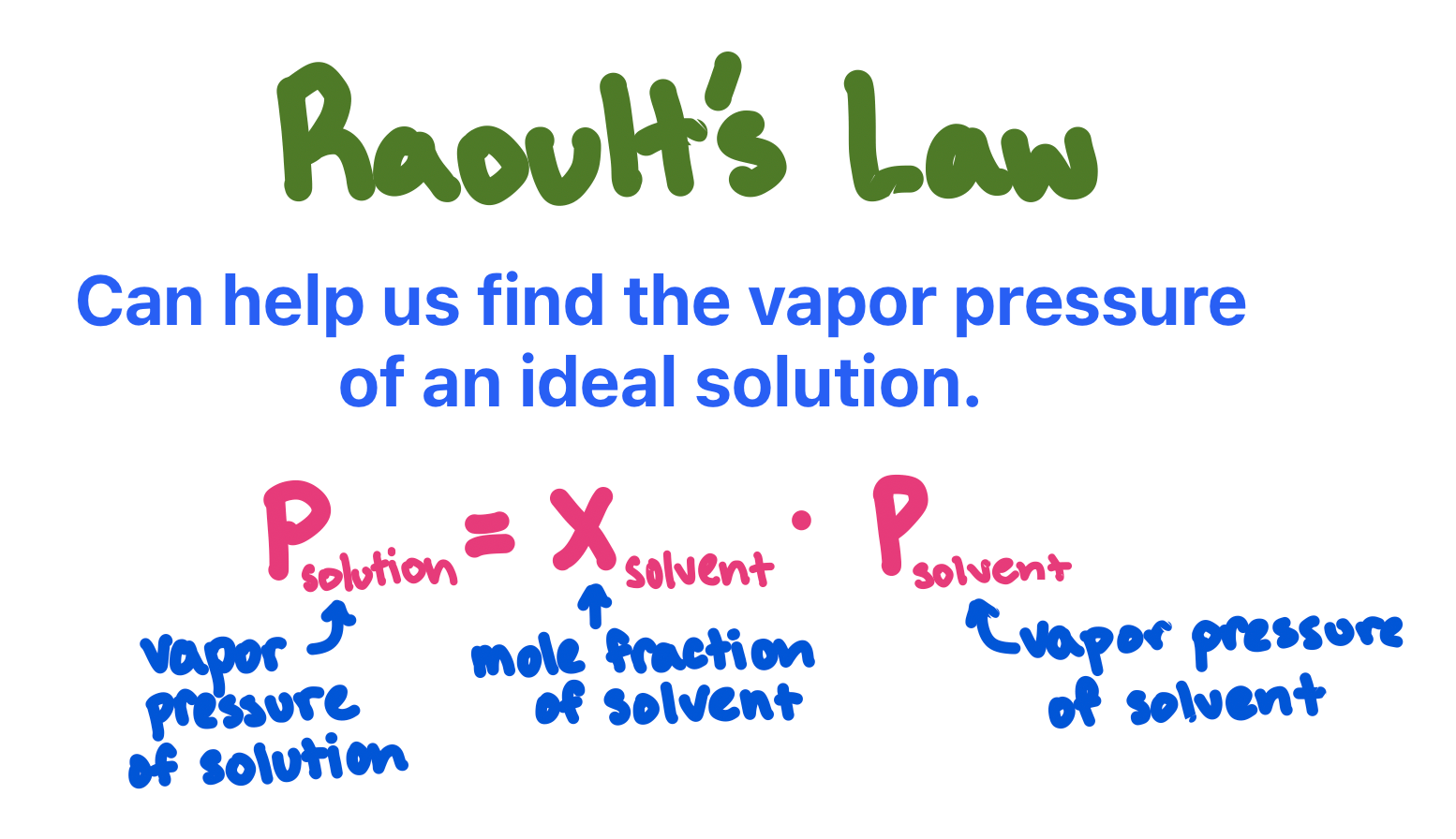
To find the vapor pressure, we use Raoult's law. The formula is .
-
is the new vapor pressure. We call it partial pressure.
-
is the mole fraction of the solvent solution.
- is the vapor pressure of the pure solvent.
To find the change in the vapor pressure, we use the formula .
Raoult's Law Practice Problem
Previously, we studied freezing point depression and boiling point elevation. In our example problems, we examined the effects of ethylene glycol in car engines. Let's calculate the vapor pressure change from adding ethylene glycol to water.
Again, we'll say we mixed one gallon of antifreeze solution (about 3.8 liters). The ratio of ethylene glycol to water is 1:1. The density of ethylene glycol is . Its molar mass is . The vapor pressure of pure water is at . Calculate the change in water's vapor pressure from adding ethylene glycol.
Step 1: Use dimensional analysis to calculate the moles of ethylene glycol and water.
- A shortcut is to know that the molar concentration of water is . So, .
Step 2: Calculate the mole fraction.
Step 3: Use Raoult's law to calculate the new partial pressure of water.
Step 4: Subtract the final and initial pressures to find the change.