Визначення коефіцієнту реакції

Interactive · 1 question

Reaction Quotient

What Is a Reaction Quotient?

  • A reaction quotient, Q, is used to determine what direction the reaction is going in

  • When the reaction quotient is compared to the reaction rate, K, it can tell if the reaction is in the forward or reverse direction, or if the reaction is at equilibrium

  • When Q < K, the reaction is in the reverse direction
  • When Q > K, the reaction is in the forward direction
  • When Q = K, the reaction is at equilibrium
Image showing how the comparison between Q and K can find the direction of the reaction

Image source: Caroline Monahan

Calculating the Reaction Quotient

  • The reaction quotient can be calculated using different units depending on the information given for a problem (note, the formula remains the same)
  • Most of the time the units of the reaction quotient (Qc) are in moles per liter (molarity) which would be compared to Kc
  • The reaction quotient can also be calculated using pressure (QP) which would be compared to Kp
Image showing the formula for the reaction quotient (Q= [products]/[reactants]

Image source: Caroline Monahan

Practice Problem Walk-Through:

A scientist mixes 0.680g NH3NH_{3} with 0.356g HClHCl in a 0.4L flask to form 0.597g NH4ClNH_{4}Cl, the KcK_{c} is 21.3, in what direction is the reaction going?

Chemical Equation: NH3NH_{3} + HClHCl → NH4ClNH_{4}Cl

1) Calculate the number of moles for the reactants and the products

  • NH3NH_{3}: 0.680g⋅1mol17.031g0.680g\cdot\frac{1mol}{17.031g} = 0.0399mol

  • HClHCl: 0.356g⋅1mol36.458g=0.356g\cdot\frac{1mol}{36.458g}= 0.00976mol

  • NH4ClNH_{4}Cl: 0.597g⋅1mol53.491g=0.597g\cdot\frac{1mol}{53.491g}= 0.0112mol

Note: the values being divided are the molar mass of each compound

2) Calculate the molarity (mol/L) of the reactants and products

  • NH3NH_{3}: 0.0399mol0.4L=\frac{0.0399mol}{0.4L}= 0.0998mol/L

  • HClHCl: 0.00976mol0.4L=\frac{0.00976mol}{0.4L}= 0.244mol/L

  • NH4ClNH_{4}Cl: 0.0112mol0.4L=\frac{0.0112mol}{0.4L}= 0.028mol/L

3) Plug the molarities into the reaction quotient equation

QcQ_{c} = [products][reactan⁡ts]\frac{\left[products\right]}{\left[reac\tan ts\right]} = [NH4Cl][NH3][HCl]\frac{\left[NH4Cl\right]}{\left[NH3\right]\left[HCl\right]}

QcQ_{c} = (0.028)(0.0998)(0.0224)=\frac{\left(0.028\right)}{\left(0.0998\right)\left(0.0224\right)}= 11.5

4) Compare the reaction quotient to reaction rate to determine the direction of the reaction

  • QcQ_{c} = 11.5 versus KcK_{c} = 21.3

  • Q < K which means that the reaction is going in the reverse direction!

Now Try a Problem!

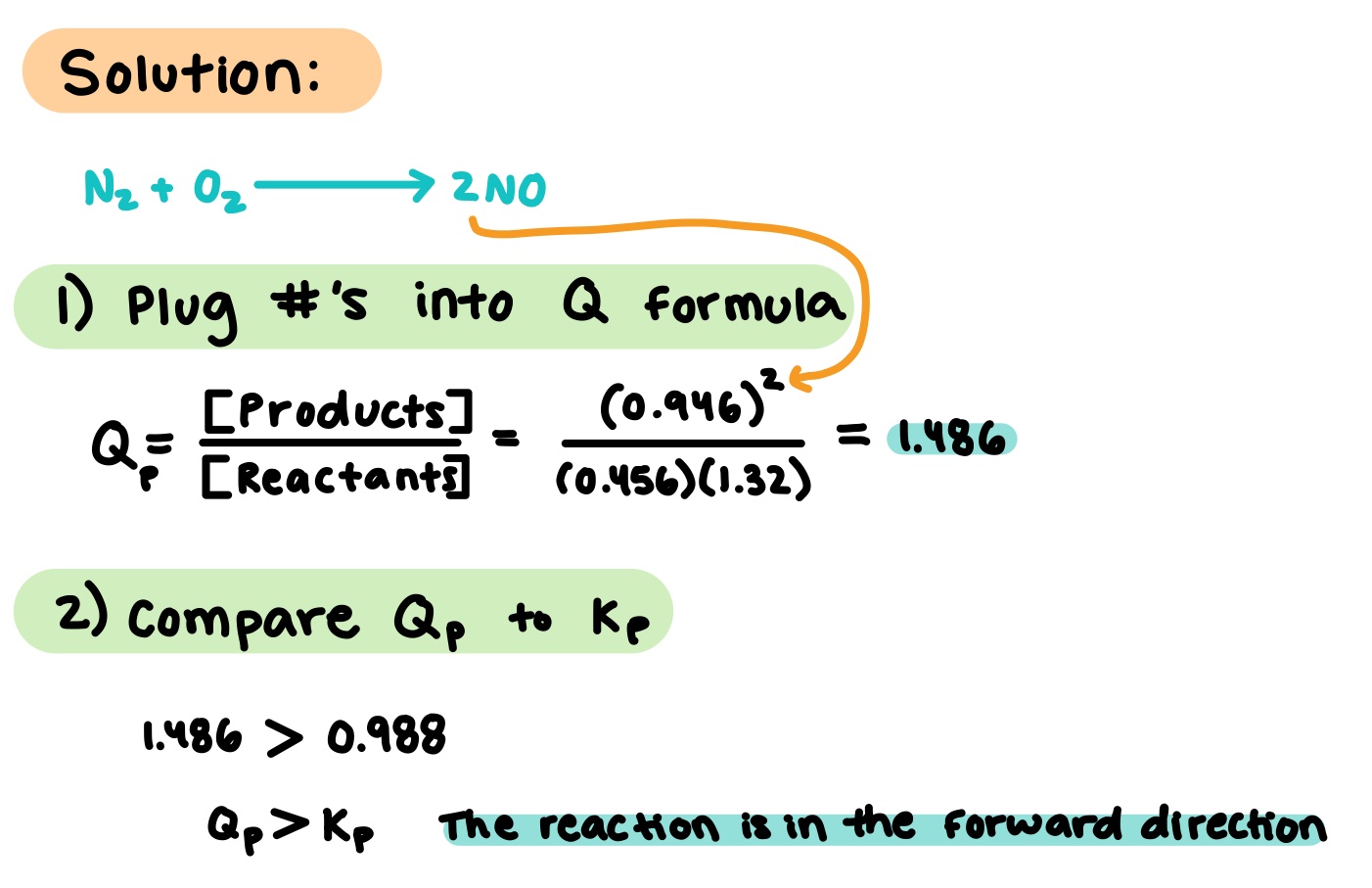
A student mixes 0.456atm of N2N_{2} gas with 1.32atm of O2O_{2} gas to form 0.946atm of NO, the KpK_{p} = 0.988, what direction is the reaction in?

  • N2N_{2} + O2O_{2} → 2NO2NO
Choose one answer

Read · 2 min

Chemical reactions are fun! Sometimes, they go to completion and produce beautiful colors or explode! But sometimes, a chemical reaction is reversible. We can have a mixture of products and reactants. Most often, we talk about reversible reactions at equilibrium. The forward and reverse reactions have equal rates. We know how to calculate the equilibrium constants. We can use solution concentration or gas pressure. But, let's say we have an equilibrium reaction that hasn't reached equilibrium. How do we predict the reaction's direction?

Reaction Quotient

The reaction quotient calculation (Q)(Q) is the same as the equilibrium constant. We divide the molar concentrations of the products and reactants. We raise each concentration by its mole ratio. After calculating it, we compare it to KeqK_{eq}.

  • Q=[Products][Reactants]=[C]c[D]d[A]a[B]bQ=\frac{[Products]}{[Reactants]}=\frac{[C]^{c}[D]^{d}}{[A]^{a}[B]^{b}}
  • Q>KeqQ>K_{eq}, the reaction favors the products. The reverse reaction predominates until we reach equilibrium.
  • Q<KeqQ<K_{eq}, the reaction favors the reactants. The forward reaction predominates until we reach equilibrium.
  • Q=KeqQ=K_{eq}, the reaction is at equilibrium.

Example Problem

Carbon dioxide gas reacts with water to form carbonic acid. Carbonic acid is a weak polyprotic acid. So, it has two equilibrium reactions. The equilibrium constants are 4.5×10−74.5\times 10^{-7} and 4.5×10−114.5\times10^{-11}. Compare the reaction quotient and equilibrium constant. The concentrations are [H2CO3]=5.0×10⁻¹⁰[H_{2}CO_{3}]=5.0\times10^{-10}, [HCO3−]=4.3×10⁻¹²[HCO_{3}^{-}]=4.3\times10^{-12} and, [CO32−]=3.5×10⁻¹¹[CO{3}^{2-}]=3.5\times10^{-11}. Let's say our pH is 6.7.

  • H2CO3⇌H++HCO3−⇌H++CO32−H_{2}CO_{3} \rightleftharpoons H^{+} + HCO_{3}^{-} \rightleftharpoons H^{+} + CO_{3}^{2-}
  • Now, we can calculate the reaction quotient for each reaction.
  • Q1=[products][reactants]=[H+]×[HCO3−][H2CO3]=10−6.7×(4.3×10−12)5.0×10−−10=1.71×10⁻⁹Q_{1}=\frac{[products]}{[reactants]}=\frac{[H^{+}]\times[HCO_{3}^{-}]}{[H_{2}CO_{3}]}=\frac{10^{-6.7}\times (4.3 \times 10^{-12})}{5.0\times10^-{-10}}=1.71\times10^{-9}
  • Q2=[products][reactants]=[H+]×[CO3−][HCO3−]=10−6.7×(3.5×10−11)4.3×10−12=1.6×10⁻⁶Q_{2}=\frac{[products]}{[reactants]}=\frac{[H^{+}]\times[CO_{3}^{-}]}{[HCO_{3}^{-}]}=\frac{10^{-6.7}\times (3.5\times10^{-11})}{4.3\times10^{-12}}=1.6\times10^{-6}
  • Q1>Keq,(1)Q_{1}>K_{eq,(1)} so, the reaction favors the products.
  • Q2>>Keq,(2)Q_{2}>>K_{eq,(2)} so, the reaction favors the products.
  • This is what we would expect. Our first reaction produces excess products. But, the first reaction's products are the second's reactants. So, we also generate more products for the second reaction. Both reactions will reverse to achieve equilibrium.

Video

(Video) The Reaction Quotient

By Bozeman Science

In this video, Mr. Andersen explains the reaction quotient. He starts by explaining what the reaction quotient is. Then, you'll see a demonstration of a chemical reaction. The concentrations change throughout the chemical reaction. Along the way, Mr. Andersen calculates the Q value. This is a concise and clear explanation of the reaction quotient.

Type a concept, like “slope” or “photosynthesis”.

↑ ↓ to choose · Enter to openSearch explanations and problems