Read · 1 min
To determine the solubility of a material, we use the solubility product constant, .
Take the dissolution of solid barium fluoride, . Barium fluoride dissolves according to the following equilibrium:
Recall the general form of the equilibrium constant, :
In the case of barium fluoride, one might be led into the trap of assuming that the equilibrium constant is . However, since is a pure solid in the reaction, it does not have a concentration, so the equilibrium expression simply becomes: Since it is only a product of the concentrations of the products, it is called the solubility product constant. For , the solubility product constant is at 298 K.
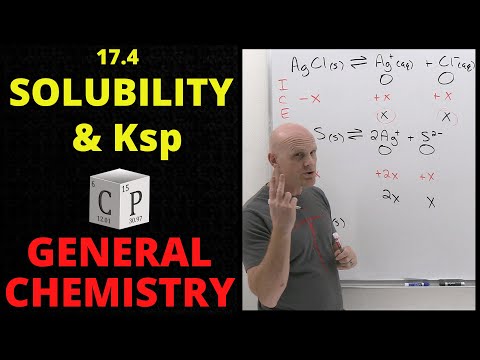
However, one must be careful, as the solubility product constant differs from the solubility of a substance. The solubility of a substance refers to the "" that is found when one completes the ICE table to solve for the change in concentrations. For barium fluoride, (at 298 K). This is the final concentration of barium ions in solution. The final concentration of fluoride ions is twice this value, since 2 moles of ions and 1 mole of ions are produced for every mole of that dissolves.