Способи розв'язування систем лінійних та квадратних рівнянь: спосіб виключення змінних

Before this, knowСпособи розв'язування систем лінійних та квадратних рівнянь: спосіб підстановки

Interactive · 3 questions

Using the Elimination Method to Solve Linear-Quadratic Systems

The elimination method uses addition and subtraction to combine the equations in your system. Think of it like smooshing the equations together. This works best when adding or subtracting the equations eliminates one of the variables entirely.

Here is a refresher on using the elimination method with just linear equations, in case you need it.

Let's take a look at an example to see how this works.

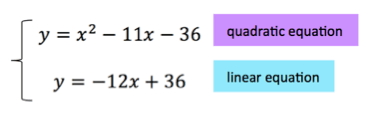
$y = x^2 - 11x - 36$ (quadratic) and $y = -12x + 36$ (linear).

Image source: by Hannah Bonville

How do we know that y=x2−11x−36y=x^2-11x-36 is the quadratic equation in our system?

Choose one answer

Illustrated · 3 min

A linear-quadratic system of equations is a system of equations where at least one equation has linear terms, and at least one equation has quadratic terms. The "standard" example is where one equation is quadratic, and the other is linear. Specifically, these are systems

y=f(x)y=g(x)\begin{align} y &= f(x) \\ y &= g(x) \end{align}

where ff is a quadratic function and gg is a linear function.

As you read on, keep in mind that the principle we're using to solve these systems is the same as a system of equations that is only linear.

Our first system is

y=x2+5x+9y=x+21\begin{align} y &= x^2 + 5x + 9 \\ y &= x + 21 \end{align}

Which variable do we eliminate? The xxs are harder to eliminate because there are quadratic and linear xx terms in the system. Each equation only has a yy in it, and no y2.y^2. So, we subtract the second equation from the first. This gives us

y−y=(x2+5x+9)−(x+21)y - y = (x^2 + 5x + 9) - (x + 21)

Everything on the left side cancels. This is why we chose this elimination. No more yys!

0=(x2+5x+9)−(x+21)0 = (x^2 + 5x + 9) - (x + 21)

Just combine like terms on the right-hand side and get

0=x2+4x−120 = x^2 + 4x - 12

This is a quadratic equation we can factor readily:

0=(x+6)(x−2)0 = (x + 6)(x - 2)

Then by the Zero Product Property, we know that either x=−6x = -6 or x=2x = 2.

Solve a Linear-Quadratic System by Elimination. {y=x^2+5x+9, y=x+21}. Eliminate (in this case, subtract): {y=x^2+5x+9 - (y=x+21) --> 0=x^2+4x-12}.  --> Solve: 0=(x+6)(x-2) --> x=-6, x=2.

Image source: By Caroline Kulczycky

This is one of the ways in which linear-quadratic systems often differ from just linear ones. We often get two solutions. What happens now is we have to solve for yy using each value of xx separately. But once we substitute, the procedure is the same as we are used to for the linear systems. If x=2,x = 2, then using the equation y=x+5y = x + 5 gives

y=x+5=2+5=7y = x + 5 = 2 + 5 = 7

Thus (2,7)(2, 7) is one solution of the system. If on the other hand x=−6x = -6, then we can use y=x+5y = x + 5 again, but this time it gives us

y=x+5=−6+5=−1y = x + 5 = -6 + 5 = -1

So our other solution is (−6,1)(-6, 1).

It so turns out that any system of the form

y=f(x)y=g(x)\begin{align} y &= f(x) \\ y &= g(x) \end{align}

where ff is quadratic and gg is linear can be tackled with this technique. However, the quadratic equation in xx that results can't always be factored, and it might not even have solutions. If there are no solutions then we stop, just like in the linear problems.

Let's look at another system.

y+6=x(y+3)2=x2−2x−20\begin{align} y + 6 &= x \\ (y + 3)^2 &= x^2 - 2x - 20 \end{align}

The way we chose which variable to eliminate in the first problem was based on which variable only had linear terms appearing in the system. The problem is, y,y2,x,y, y^2, x, and x2x^2 all appear in this system (we have to expand (y+3)2(y + 3)^2 to have a y2y^2 term, but it's there in disguise). So we can't just use the same technique. We can still do an elimination, but it's going to be trickier to identify. We have to eliminate both linear and quadratic terms of the same variable, which will be done in steps.

One option is to leave the x2x^2 alone and focus on eliminating the linear xx terms. Multiply the first equation by 22 and our system becomes

2y+12=2x(y+3)2=x2−2x−20.\begin{align} 2y + 12 &= 2x \\ (y + 3)^2 &= x^2 - 2x - 20. \end{align}

Now if we add the two equations, the 2x2x terms cancel out, leaving

2y+12+(y+3)2=x2−20.2y + 12 + (y + 3)^2 = x^2 - 20.

This equation still has two variables, which is worrisome. There's a pretty cheeky way around this, though. We have found a third equation that is true and is "closer" to eliminating a variable than the second equation was. So now we look at the system

y+6=x2y+12+(y+3)2=x2−20\begin{align} y + 6 &= x \\ 2y + 12 + (y + 3)^2 &= x^2 - 20 \end{align}

We need to make an x2x^2 term appear in the first equation so we can get rid of the one in our new second equation. This can be done by squaring both sides of the first equation, which gives

(y+6)2=x2(y + 6)^2 = x^2

As a result we're looking to compare the equations

(y+6)2=x22y+12+(y+3)2=x2−20.\begin{align} (y + 6)^2 &= x^2 \\ 2y + 12 + (y + 3)^2 &= x^2 - 20. \end{align}

We can subtract the second of these equations from the first, removing the last instances of x2.x^2.

(y+6)2−2y−12−(y+3)2=20.(y + 6)^2 - 2y - 12 - (y + 3)^2 = 20.

This is just a one-variable equation now; it just took two eliminations to get there: one of x,x, and one of x2.x^2. Let's expand the squares and combine like terms.

(y+6)2−2y−12−(y+3)2=20⇒y2+12y+36−2y−12−y2−6y−9=20⇒12y+36−2y−12−6y−9=20⇒10y+36−12−6y−9=20⇒10y+24−6y−9=20⇒4y+24−9=20⇒4y+15=20⇒4y=5⇒y=54\begin{align} (y + 6)^2 - 2y - 12 - (y + 3)^2 &= 20 \Rightarrow \\ y^2 + 12y + 36 - 2y - 12 - y^2 - 6y - 9 &= 20 \Rightarrow \\ 12y + 36 - 2y - 12 - 6y - 9 &= 20 \Rightarrow \\ 10y + 36 - 12 - 6y - 9 &= 20 \Rightarrow \\ 10y + 24 - 6y - 9 &= 20 \Rightarrow \\ 4y + 24 - 9 &= 20 \Rightarrow \\ 4y + 15 &= 20 \Rightarrow \\ 4y &= 5 \Rightarrow \\ y &= \frac{5}{4} \end{align}

We only have one solution for yy. This is because as soon as we got an equation only involving yy, the y2y^2 terms cancelled out with each other. So we don't need to worry, we just need to find one value of x.x.

One of our original equations was

y+6=xy + 6 = x

We can use this to find the value of xx when y=54y = \frac{5}{4}:

x=y+6=54+6=54+244=294x = y + 6 = \frac{5}{4} + 6 = \frac{5}{4} + \frac{24}{4} = \frac{29}{4}

Finally, then, our solution is (294,54)\left(\frac{29}{4}, \frac{5}{4}\right).

If your system only has linear terms in one of the variables, look to eliminate that variable right away and solve for the other one. If the system has quadratic terms in both variables, then other tricks are required. Of course, if all else fails you can try substitution or graphing methods.


Video · + 2 min read

(Video) Using Elimination to Solve Linear-Quadratic Systems of Equations

by Anusha Rahman

In this lesson, Anusha Rahman goes over how to solve a linear-quadratic system of equations using elimination.

Summary

The title "Linear-Quadratic System of Equations" sounds really terrifying, but it's simple once you break it down. Think of a system of equations with...

  • Linear: a linear function! For example, y=3x+4y=3x+4
  • Quadratic: a quadratic function! For example, x2+4x+9x^2+4x+9

Solving this type of system is solved almost identical to solving a linear system of equations, but there a couple of slight differences, so we'll dive in deeper to see those!

Example

Say we have this linear-quadratic system of equations. Find the solution. y=2x−7y=2x-7 y=x2+2x−16y=x^2+2x-16

Similar to what we did with a linear system of equations, we can subtract one equation from the other. Let’s put them on top of each other.

$[y=x^2+2x-16]-[y=2x-7]$

Image source: by Anusha Rahman

When you stack equations on top of each other, make sure you align the "like" terms.

Now, we'll go ahead and subtract!

$[y=x^2+2x-16]+[-y=-2x+7]$

Image source: by Anusha Rahman

Remember to watch the negative signs when you are subtracting! You want to distribute the negative signs to all values in the bottom equation.

After elimination, we're left with: x2−9x^2 -9 Our next step is to factor! We can see that this is a difference of cubes. Our factored values are: (x+3)(x−3)(x+3)(x-3) The zero product property tells us that: x=3,−3x=3, -3 Here is where we diverge from a linear system of equations. We have two solutions! Let’s find out what the y-values are, so can find out what the point is.

For x=3x=3, y=2(3)−7y=2(3)-7 =−1= -1 So, (3,−1)(3,-1) is one solution.

For x=−3x=-3, y=2(−3)−7y=2(-3)-7 =−13= -13 So, (−3,−13)(-3,-13) is the other solution.

Always check your work!

A good way to double check your solution is to graphically figure out where the two functions meet. The coordinate points should match!

Let's first look at the graph for y=2x+7y=2x+7.

Graph for $y=2x+7$.

Made using Desmos

Now let’s look at the graph for y=x2+2x−16y=x^2+2x-16.

graph for $y=x^2+2x-16$

Made using Desmos

Let’s now look at the graph with both functions. The points of intersection are the two solutions for this linear-quadratic system.

Intersection graphs of $y=2x-7$ and $y=x^2+2x-16$.

Made using Desmos

The points of intersection matched, so we know our solutions are correct!

Type a concept, like “slope” or “photosynthesis”.

↑ ↓ to choose · Enter to openSearch explanations and problems