
Interactive · 4 questions
+5 contributors



Squaring Binomials
Squaring Binomials Using FOIL

Image source: by Caroline Kulczycky
Suppose that we are tasked with squaring the binomial . In order to do this, we must first enclose that binomial in parentheses and give it the appropriate exponent. We want to square the binomial, which is the same as raising it to the second power, thereby creating the following expression: .
Once we've done that, it's time for us to go ahead and expand our new expression.
Which of the following expressions is equivalent to ?
Right! We can expand into .
Now, all we need to do to finish squaring our binomial is to use FOIL (i.e. multiply the expression's first, outside, inside, and last terms) and simplify the result.
Use FOIL to multiply out the expression . (What is our final product?)?
Right:
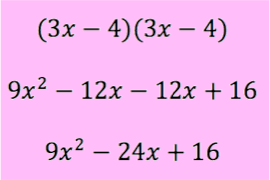
Image Source: Hannah Bonville
You'll probably find FOILing to be the most familiar method for squaring a binomial. However, there also exists a shortcut that we can use instead.
Squaring Binomials by Using the Formula
To understand how to use this shortcut, let's first consider the generic binomial , in which and stand for two arbitrary monomials.
Since all binomials follow the form , a binomial's square will always follow the form of our generic binomial's square: .
This means that, once we've determined which terms in a particular binomial stand for the and terms in its generic form, we can use the expression as a formula for figuring out that binomial's square.
Note: if the binomial we're squaring contains a plus sign, then its product will solely contain plus signs. However, if the binomial we're squaring contains a minus sign, then its square will use a minus sign between the expression's first two terms.
Let's look at an example in which we put this technique to use.
Consider the expression . Which term inside the parentheses is our squared binomial's term (recall that the generic form of a binomial is )?
Yup! Now, which term inside those parentheses is our squared binomial's term (again, recall that the generic form of a binomial is )?
Once we've figured out which terms in our squared binomial stand for the and terms in a binomial's generic form, we can then plug those terms into our formula and simplify (note that, since the two terms inside of the binomial we're squaring are connected by a plus sign, we're using the version of our formula that solely contains plus signs):
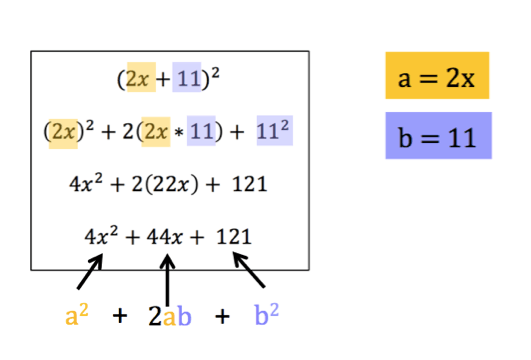
Image Source: Hannah Bonville

