Множини: Як знаходити підмножини?

Before this, knowМножини: Що таке форма списку?

Video · + 2 min read

(Video) What is a Subset?

by Don't Memorise

This video by Don't Memorise covers sets and subsets with some real life examples.

Summary\large{\text{Summary}}

Suppose that you took a trip to a museum (let's call it museum AA) that specialized in Egyptian pottery, and then took a trip to the Metropolitan Museum of Art.

In this situation, you would note that all of the kinds of things that are present in museum AA are also present in the Met; we would say that museum AA covers a subset of the genres of art that museum BB does.

It works the same way with numbers.

Say that we have some set that contains the numbers 1,2,1, 2, and 33; let's call it set AA. Now, suppose that we also have some other set called set BB that contains the numbers 1,2,3,4,1, 2, 3, 4, and 55. Since all of the elements that are contained in set AA are also contained in set BB, we can say that set AA is a subset of set BB, and we can write that in mathematical notation like so: A ⊆BA\ \subseteq B

Also, returning to my first example, notice how museum AA and the Met do not both contain the same exact genres of art. Likewise, in my second example, our two sets do not contain the same exact elements. This means that our set AA is a strict subset of set BB, and we can express that like so: A ⊂BA\ \subset B

You can think of the "subset of" and "strict subset of" symbols as being analogous to the symbols for "less than or equal to" and "less than": a bar underneath the symbol dictates that the two items being compared are allowed to be "equal," and the absence of this bar dictates just the opposite.

Finally, let's talk about how the empty set, notated mathematically as ∅\varnothing, fits into all of this.

Suppose you have a bowl of fruit containing three apples, two bananas and one orange. We can express this fruit bowl as a set like so: {a,a,a,b,b,o}\left\{a,a,a,b,b,o\right\}

Now, suppose we remove each piece of fruit from the bowl until we are left with an empty bowl. Since this leftover emptiness is in fact part of the collection of fruits that were initially inside of the bowl, we can say that "nothing," or the empty set, is a subset of the set we described above: ∅⊆{a,a,a,b,b,o}\varnothing\subseteq\left\{a,a,a,b,b,o\right\}

Going by this logic, we can say that "nothing," or the empty set, is in fact a subset of all sets, including both of the sets that we discussed prior to this example.

How many subsets does the set {1,2,3,4}\left\{1,2,3,4\right\} have?

Choose one answer

No recipe to follow

These problems have no steps to copy. You have to understand the idea well enough to bend it to a new purpose. These are real problems from the AMC 12 and AIME, the national math competitions for middle and high school students, each with a worked solution on LIVE by Po-Shen Loh.

Video · + 1 min read

(Video) Subsets and Proper Subsets

by HCCMathHelp

In this video, HCCMathHelp explains how to find subsets and proper subsets.

Summary\large{\text{Summary}}

Let's talk terminology.

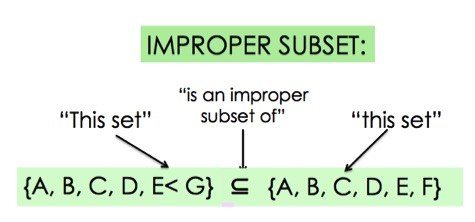
Subsets: A subset is a set that's entirely made of elements that are also in another set. If you wanted use math notation to say that AA was a subset of BB, you would write A⊆BA \subseteq B.

Supersets: A superset is a set that contains all of the elements that are in a smaller set. If BB has all of the elements of AA in it, and then maybe some other ones that aren't in AA, we can say that BB is a superset of AA. (We can also say that AA is a subset of BB.)

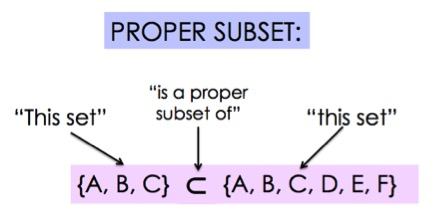
Proper Subsets: A proper subset is a subset that doesn't just equal its superset. In other words, it's a subset with fewer elements than its superset. The symbol for a proper subset is ⊂\subset.

That might have gotten weird. Let's try it out with a couple of sets: A={2,3,4,5,6}B={2,3,4,5,6}C={2,4,6}\begin{align} A &= \{2, 3, 4, 5, 6\}\\ B &= \{2, 3, 4, 5, 6\}\\ C &= \{2, 4, 6\} \end{align}

True or false: A⊆BA \subseteq B

Choose one answer

Interactive · 6 questions

Subsets and Complements

First, we'll discuss subsets; then, complements.

Subsets

Before we talk about subsets, you should get yourself familiar with sets themselves.

A set of shapes.

Image source: by Hannah Bonville

A subset is part of a set. All of the elements in a subset must be in the original set.

A null set is a set with no elements.

Consider the set of shapes pictured above. Here are some sample subsets (in picture form). The subsets are in the blue, transparent circles.

The subsets of each set of shapes.

Image source: by Hannah Bonville

Notice how the subsets are only made up of things that were in the original set. There's nothing extra added in. The number of subsets is 33, and the number of elements in the set is 99. This is a finite set. The elements of the set are all shapes.

Now, let's try with sets written in roster form:

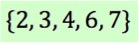
{2, 3, 4, 6, 7}

Image source: by Hannah Bonville

Which of the choices below are subsets of this set? (Check off all correct answers)

Choose all correct answers

Interactive · 4 questions

Let A,BA, B be sets. We say that AA is a subset of BB (which we can write as A⊆BA \subseteq B) if all the elements in AA are also elements of BB.

We can write this all as A⊆BA \subseteq B if ∀x∈A\forall x \in A, x∈Bx \in B.

  • The ⊆\subseteq symbol means "is a subset".
  • The upside-down A (∀\forall) means "for all".
  • The weird "E" looking symbol (∈\in) means "exists in".

Example:

Let's define a set that we'll call AA. A={1,2,3,{4,5}}A = \{1, 2, 3, \{4, 5\}\}

  • The set {1,2}\{1, 2\} is a subset of AA.
  • The set {1,2,3}\{1, 2, 3\} is another subset of AA
  • The set {1,2,3,{4,5}}\{1, 2, 3, \{4, 5\}\} is ALSO a subset of AA

But wait! The set {4,5}\{4, 5\} is NOT a subset of AA, because {4}\{4\} and {5}\{5\} aren't in AA by themselves. Instead, they're in another set that's PART of set AA.

So we can say {4,5}∈A\{4, 5\} \in A (the set {4,5}\{4, 5\} is in AA) or {{4,54, 5}} ⊆A\subseteq A (the set made up of the set {4,5}\{4, 5\} is a subset of AA), but we CAN'T say {4,5}⊆A\{4, 5\} \subseteq A.

On the other hand, we can say both that 2∈A2 \in A (the number 22 is part of AA) and that the set {2}\{2\} is a subset of AA.

Test Yourself!

Alright, let's try it out on two sets! B={1,3,{1,2}}C={1,2}\begin{align} B &= \{1, 3, \{1, 2\}\}\\ C &= \{1, 2\} \end{align}

Is the set {1,2}⊆B\{1, 2\} \subseteq B?

Choose one answer

Type a concept, like “slope” or “photosynthesis”.

↑ ↓ to choose · Enter to openSearch explanations and problems