
Illustrated · 3 min
Disclaimer: there are many types of supernovae, however, this lesson will focus specifically on Type 1A supernovae.
So without further ado, let us explore the wonders of a Type 1A supernova
White Dwarfs and Our Sun
Our sun will go out with a whimper, rather than a bang. First, the loss of its primary fuel source (helium) will begin the first phase of its core contractions. It will grow larger- falling off the main sequence and becoming a red giant, engulfing Mercury, Venus, and possibly the Earth.
The heat and pressure that the sun's "new" core comes with are enough to fuse helium- something smaller stars cannot do.
From here, the sun will slowly begin to lose layers of its convective zones until it is just a small, dense, white dwarf.
Despite having its radius greatly reduced our sun will continue to be highly luminous in the first few billion years or so of it's white dwarf phase. This is because what hasn't been blown off into space has contracted back into a much smaller volume. As we all know- when particles get packed closely together, things get hot (according to physics)!
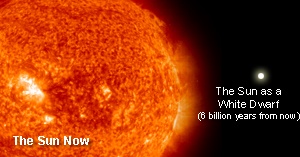
Now you might ask why how any of this is relevant to a type 1A supernova. That's a very good question which it's got a very good answer: a white dwarf is the first piece of the reciepe for a type 1A supernova.
Type 1A supernova: Small but Mighty
A very obvious question is: will our sun become a type 1A supernova?
Unfortunately, no, it will not. This is because this type of supernova requires more than a white dwarf to be ignited. It actually needs to be part of a binary system. Either with a star much larger than itself or with another white dwarf.
But why does it need another star?
Weirdly enough it seems that the affinity towards theft isn't just a trait humans posses, but also stellar bodies. White dwarfs in binary systems will accrete the other star's mass- causing the white dwarf to approach the Chandrasekhar limit.
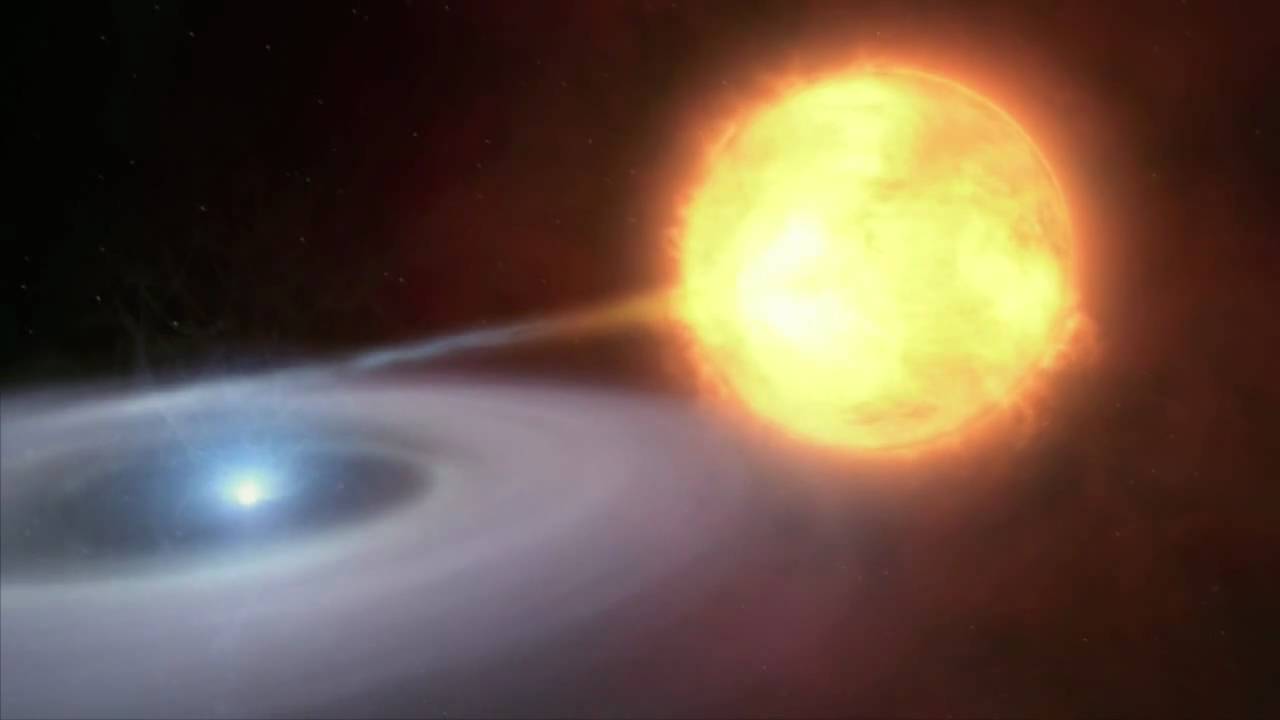
Here we see a white dwarf draining its companion star
The Chandrasekhar Limit
I've just introduced a new concept, so let's try break it down.
Logically, we know that particles of like charge repel one another. This leads us to the idea of the electron degeneracy pressure, or simply put, the repulsive force of electrons that will allow white dwarf's to not fully collapse.
However, there are limits to what electrons can do, and therefore there is an upper limit to the mass any electron-degeneracy object can have. In a white dwarf we call this limit the Chandrasekhar limit.
Essentially a white dwarf cannot exceed 1.44 solar masses or one of two things happen:
-
The neutron-degeneracy pressure builds and creates a neutron star, and if it too exceeds the upper mass limit for a neutron-degeneracy object, it becomes a black hole
-
A runaway nuclear reaction begins to take place in the core and sets off a big bang known as a Type 1A supernova
Pretty cool, right?
Finally, I am duty bound to tell you one last thing about type 1a supernovae.
1a Supernovae and Standard Candles
These types of supernovae are indeed a type of standard candle, or some astronomical object that has a predictable luminosity (If you'd like to know more about standard candles I've written an article about them here on Expii).
They can be considered as such all because of the Chandrasekhar Limit. We know that white dwarfs can only have a certain amount of energy because they go nova only when they've reached a mass about 1.44 times greater than that of our sun.
Therefore, each supernova will have the same absolute magnitude. By determining their apparent magnitude mathematically we can definitely determine their distance.
These standard candles are almost like mile markers in space, helping us determine roughly how far things are away from us at nearly any point in the universe.
Small but mighty, type 1a supernovae never cease to amaze!