Video

(Video) Expii Explores: The Quadratic Formula ft. Dwayne Reed (ALGEBRA RAP)

by Expii

This song by Dwayne Reed and the Expii team covers the structure and use of the quadratic formula.

Summary\large{\text{Summary}}

Most quadratic equations can be solved by factoring, but there are some that can't. Let's look at an example.

x2+x−9=0x^2+x-9=0

The factor pairs for −9-9 are (−1,9)(-1,9), (1,−9)(1,-9), and (−3,3)(-3,3). These pairs all multiply to make −9-9, but none of them add to 11. This means we cannot factor this polynomial.

However, we can still find the solutions to this problem using the quadratic formula: x=−b±b2−4ac2ax= \frac{-b\pm \sqrt{b^2-4ac}}{2a}

This looks a little daunting until we remember the general form of a quadratic equation. ax2+bx+c=0ax^2+bx+c = 0

All of the parts of the formula can be taken from our equation. Let's list out the values of a,b,a, b, and cc from the given equation. x2+x−9=0a=1b=1c=−9\begin{align}x^2+x-9&=0\\ a&=1\\ b&=1\\ c&=-9\end{align}

Now, let's plug these values in.

x=−b±b2−4ac2ax=−(1)±(1)2−4(1)(−9)2(1)x=−1±1−(−36)2x=−1±372\begin{align} x&= \frac{-b\pm \sqrt{b^2-4ac}}{2a}\\ \\ x&=\frac{-(1)\pm \sqrt{(1)^2-4(1)(-9)}}{2(1)}\\ \\ x&= \frac{-1 \pm \sqrt{1-(-36)}}{2}\\ \\ x&= \frac{-1 \pm \sqrt{37}}{2}\\ \end{align}

The ±\pm sign means that there will be two different solutions to this problem.

x=−1+372x=xANDx=−1−372\begin{align}x&= \frac{-1 + \sqrt{37}}{2}\\ \\ &\phantom{x=x}\text{AND}\\ \\ x&= \frac{-1 - \sqrt{37}}{2} \end{align}

Check what you really know

If you can solve a contest problem with this idea, you know it well. If not, you know exactly what to review. These are real problems from the AMC 8, AMC 12 and AIME, the national math competitions for middle and high school students, each with a worked solution on LIVE by Po-Shen Loh.

Video

(Videos) Quadratic Formula

by mathman1024

This video by mathman1024 explains the quadratic formula.

Summary\large{\text{Summary}}

There are many ways to find the solutions to a quadratic equation, including factoring, graphing, and using the quadratic formula.

Given a quadratic function in the form ax2+bx+c=0ax^2+bx+c=0 the formula says: x=−b±b2−4ac2ax=\frac{-b\pm\sqrt{b^2-4ac}}{2a} The steps to solve problems with this formula are:

  1. Put all the term on one side so the equation is in the form ax2+bx+c=0ax^2+bx+c=0
  2. (Optional) Write to the side what the aa, bb, and cc are equal to.
  3. Apply quadratic formula.

The first example he does is x2=5x+9x^2=5x+9.

First we move all the terms to one side.

x2=5x+9x2−5x−9=5x+9−5x−9x2−5x−9=0\begin{align} &x^2=5x+9\\ &x^2{\color{#8925AE}{-5x-9}}=5x+9{\color{#8925AE}{-5x-9}}\\ &x^2-5x-9=0 \end{align}

Let's make a quick reference to our aa, bb, and cc values.

a=1b=−5c=−9a=1\\b=-5\\c=-9

Finally, let's apply our new friend, the quadratic formula.

x=−b±b2−4ac2ax=−(−5)±(−5)2−4(1)(−9)2(1)x=5±25−(−36)2x=5±612\begin{align} &x=\frac{-b\pm\sqrt{b^2-4ac}}{2a}\\ &x=\frac{-{\color{#8925AE}{(-5)}}\pm\sqrt{{\color{#8925AE}{(-5)}}^2-4{\color{#8925AE}{(1)(-9)}}}}{2{\color{#8925AE}{(1)}}}\\ &x=\frac{5\pm\sqrt{25-(-36)}}{2}\\ &x=\frac{5\pm\sqrt{61}}{2} \end{align}

Interactive · 3 questions

The Quadratic Formula

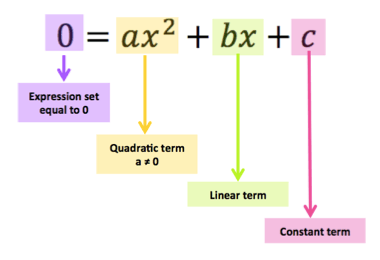
Before we dive in, let's recall an important step for all quadratic equations. We need to set the equation equal to 00.

Set ax^2 + bx + c equal to 0  to turn an expression into an equation

Image source: by Hannah Bonville

Using the Quadratic Formula

Sometimes, factoring just doesn't work. You might try every set of factors and find that nothing fits. Maybe you're completing the square or graphing. When this is the case, you can solve a quadratic equation using the quadratic formula.

Note: this formula can ALWAYS be used to solve quadratic equations. For that reason, in the real world, it's often much easier to use it first, especially if you can't immediately recognize a factoring pattern.

So, let's solve algebraically. Here's the formula:

Quadratic Formula: Given a quadratic equation in the form ax^2+bx+c=0, you can find the solutions using the quadratic formula: x=-b±sqrt(b^2-4ac)/2a

Image source: By Caroline Kulczycky

Fight your gag reflex. This is a literal equation with lots of variables, but it's actually not as gross as it looks; we promise!

We're solving for xx (as always), so we need to plug in values for a,b,a, b, and cc. Recall that these values from are in the original equation. ax2+bx+c=0ax^2 + bx + c = 0

Since the equation includes ±\pm, we'll be getting two possible values for xx. That means that the function crosses the xx-axis two times, both are real solutions. This is the same as factoring a quadratic.

Let's try using the quadratic formula on this: x2+4x−12=0.x^2 + 4x - 12 = 0.

In our quadratic equation, what is the value of coefficient aa?

Choose one answer

Read · 1 min

The quadratic formula can be used to solve any equation in the form ax2+bx+c=0ax^2+bx+c=0. However to really understand it, we must derive the whole equation. We begin: ax2+bx+c=0ax^2+bx+c=0 We now divide both sides by aa, yielding: x2+bax+ca=0x^2+\frac{b}{a}x+\frac{c}{a}=0 We move ca\frac{c}{a} to the other side and add (b2a)2(\frac{b}{2a})^2 to both sides. This gives us:

x2+bax+(b2a)2=−ca+(b2a)2x^2+\frac{b}{a}x+(\frac{b}{2a})^2=-\frac{c}{a}+(\frac{b}{2a})^2

Looking at the left side of this equation, we notice that it can be described by (x+b2a)2(x+\frac{b}{2a})^2. We substitute this in giving us: (x+b2a)2=−ca+(b2a)2(x+\frac{b}{2a})^2=-\frac{c}{a}+(\frac{b}{2a})^2 We expand the (b2a)2(\frac{b}{2a})^2 giving us b24a2\frac{b^2}{4a^2}. We now multiply the −ca-\frac{c}{a} by 4a4a\frac{4a}{4a}, giving −4ac4a2-\frac{4ac}{4a^2}. For the whole equation we now have: (x+b2a)2=−4ac4a2+b24a2(x+\frac{b}{2a})^2=-\frac{4ac}{4a^2}+\frac{b^2}{4a^2}. Putting the right side all over 4a24a^2 gives us b2−4ac4a2\frac{b^2-4ac}{4a^2}. We now have:

(x+b2a)2=b2−4ac4a2(x+\frac{b}{2a})^2=\frac{b^2-4ac}{4a^2}

We now solve for xx. We take the square root then move the b2a\frac{b}{2a} over. We have: x+b2a=b2−4ac4a2x+\frac{b}{2a}=\sqrt{\frac{b^2-4ac}{4a^2}}

x=−b2a±b2−4ac4a2x=-\frac{b}{2a}\pm\sqrt{\frac{b^2-4ac}{4a^2}}

Note the ±\pm because we are taking both the positive and negative square roots. Taking the square root of the denominator give us:

x=−b2a±b2−4ac2ax=-\frac{b}{2a}\pm\frac{\sqrt{b^2-4ac}}{2a}

Setting it over 2a2a we have. x=−b±b2−4ac2ax=\frac{-b\pm\sqrt{b^2-4ac}}{2a} This is the quadratic formula.

When the discriminant is negative, the solutions involve imaginary numbers and imaginary square roots. That means that the quadratic formula produced complex roots.

Solutions involving ii may need to be simplified using powers of imaginary numbers.

Type a concept, like “slope” or “photosynthesis”.

↑ ↓ to choose · Enter to openSearch explanations and problems