Illustrated · 1 min

Thin-layer chromatography (TLC) is a common method to monitor reaction and purification progress. It functions by separating molecules based on their polarity.
How It Works
TLC plates are coated with silica gel. A highly polar material that functions as the stationary phase. The sample is spotted onto one end of the plate next to a standard. The plate is then placed into a beaker with a small amount of mobile phase in it. The mobile phase is a non-polar solvent; hexanes and diethyl ether are common choices. The solvent moves up the plate and carries the sample with it. When the solvent reaches the end of the plate, the plate is removed, imaged, and analyzed. This is diagrammed below.
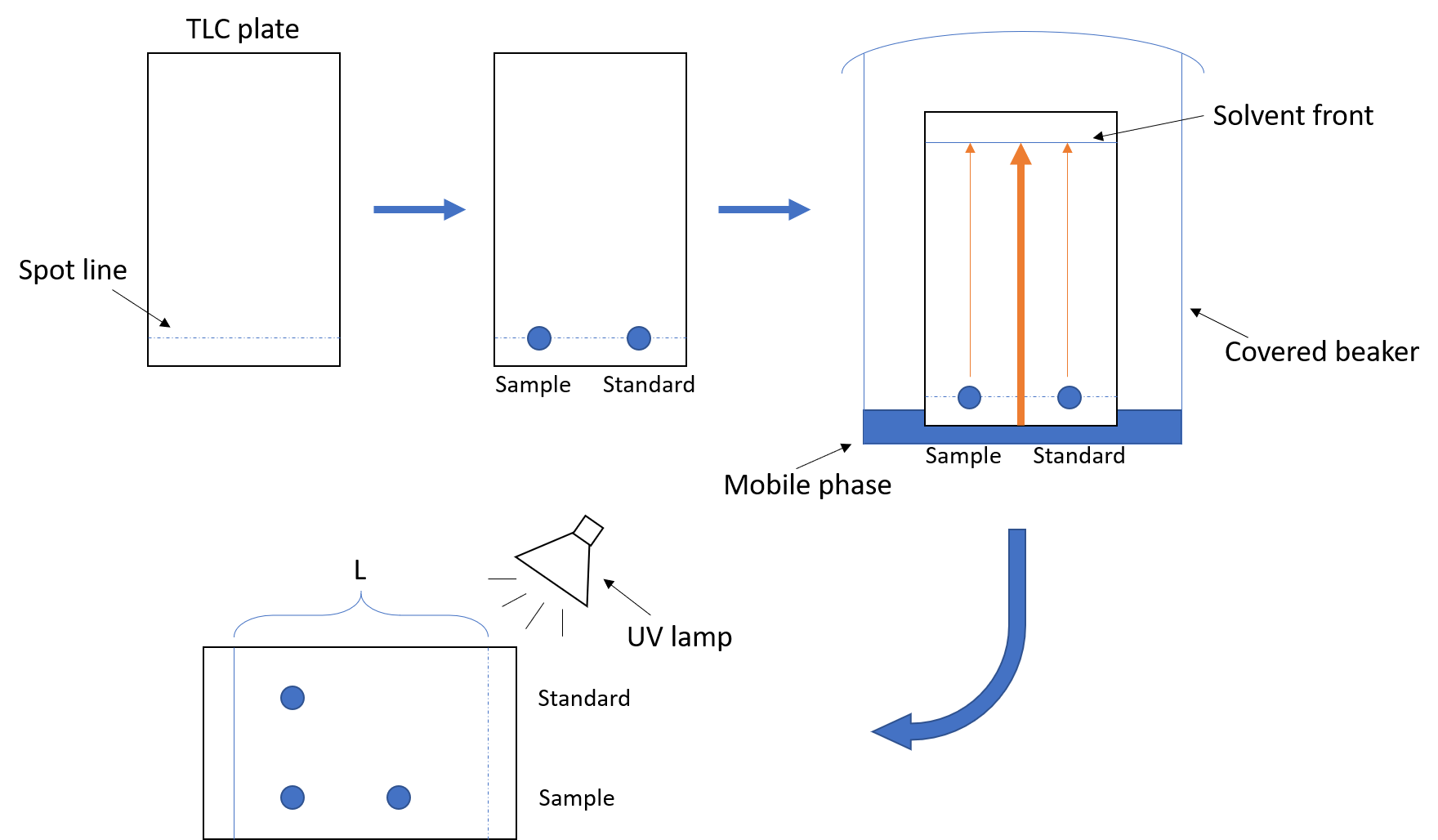
Image by Jasper Brown
TLC plates are most commonly imaged using a UV (254 nm) light. For this reason it is important that the sample absorbs UV light. After being imaged the TLC plate is analyzed based on how far the spots have traveled. If a spot appears in the same distance in multiple samples or standards, they are the same molecule. Using this the presence or absence of each chemical can be tested. A reaction can be tested for completion either by using the reactant as a standard and seeing if the it is absent in the sample, or by using the product in the standard and making sure that is the only spot in the sample.