Read · 4 min
Right now, I am cooking pulled pork in my crock-pot. The liquid broth in the bottom of the pot is vaporizing. When the vapor reaches the lid, it condenses. Why? The lid is cooler than the pot. As it heats, I'm beginning to see more and more condensation. In about eight hours, my pork will finish cooking. I'll eat a delicious, savory dinner.
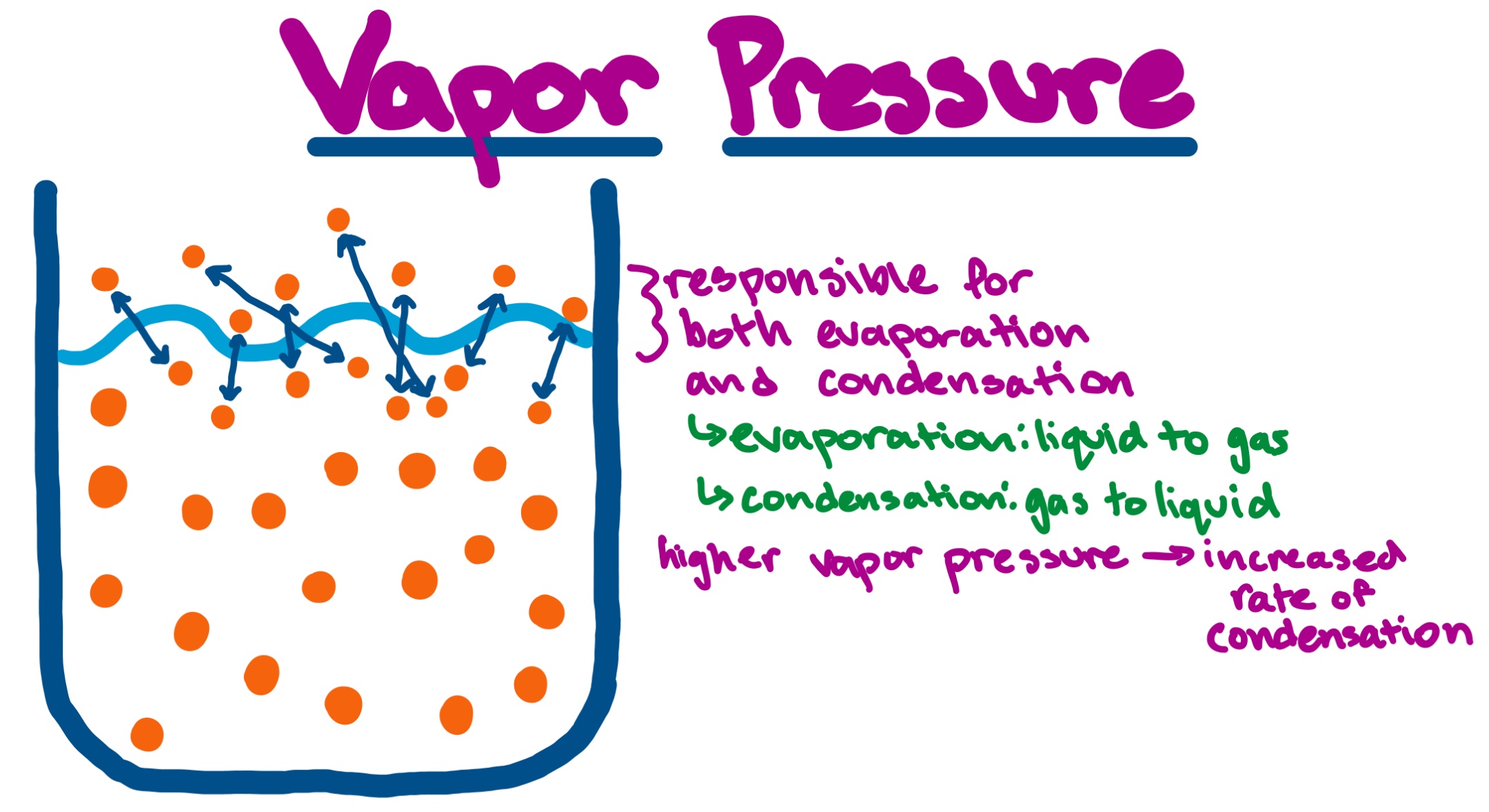
Let's talk about the chemistry of the broth inside my crock-pot. The broth is mostly water. It starts as a pool of liquid. On the surface, the molecules experience cohesion via hydrogen bonding. But, some molecules will have enough translational kinetic energy to overcome the hydrogen bonds. They escape the surface and become gasses. As I heat the broth, more water molecules have enough kinetic energy to become gaseous. Soon, the broth will be boiling. Then, a lot of water molecules will be in the gas phase. The pressure inside my crock-pot increases as more water molecules become gaseous. I'm observing an example of vapor pressure.
Vapor pressure is the force generated by a vapor in a closed system. It must be at equilibrium with its condensed phase. In my crock-pot example, the condensed phase is the starting pool of broth. Remember, Le Chatelier's principle tells us that equilibrium is temperature-dependent. So, we have to state our temperature. The chemical equation would look like at Y kelvin.
Vapor Pressure in Solids
We can also observe vapor pressures from solids. Recall that the physical change from solid to gas is sublimation. Gas to a solid is deposition. In a solid, some atoms or molecules have enough energy to transition to the gas phase. Those molecules exert pressure on their container. The vapor pressures of solids are much lower than liquids.
What Affects Vapor Pressure?
You might be wondering if the volume of liquid affects the vapor pressure. It might surprise you that it doesn't. Only temperature affects vapor pressure! Vapor pressure is all about energy. Imagine you have one liter of water and fifty liters of water at the same temperature. The average kinetic energy is the same. So, both will have the same vapor pressure.
What about surface area? Again, no effect. The surface area does affect evaporation. But, that's because water is not at equilibrium with the air. So, the molecules will keep diffusing into the air. But, vapor pressure is in a closed system at equilibrium. Some gas molecules collide with the surface and reenter the liquid phase. At equilibrium, the rate of liquid to gas equals the rate of gas to liquid. So, even with a larger surface area, the rates are the same.
Besides temperature, the only thing that does affect vapor pressure is intermolecular forces. The strength of a liquid's Van der Waal's interactions will determine how easily it becomes a gas. The molecules need enough kinetic energy to overcome the cohesive force. So, molecules that experience dispersion forces will have a high vapor pressure. Molecules with dipole-dipole or hydrogen bonding will have a lower vapor pressure.
As an example, let's consider the transition metal mercury. It is a liquid at standard temperature and pressure (STP). But, mercury has metallic bonds. They are strong bonds. So, we would expect mercury to have a low vapor pressure. At STP, mercury has a vapor pressure of 0.00022 kilopascals. In contrast, water's vapor pressure is 3.2 kilopascals. That's a huge difference! Remember that pascals are the SI unit for pressure.
Boiling
A substance's boiling point is when its vapor pressure equals atmospheric pressure. Atmospheric pressure is the pressure caused by gasses in our atmosphere. As you go higher in elevation, atmospheric pressure decreases. So, at higher elevations, liquids boil at lower temperatures. For example, Washington D.C is two meters above sea level. So, the boiling point of water is barely below 100 degrees celsius. But, Denver, Colorado, is 1673 meters above sea level. Water boils at only 94 degrees celsius in Denver!
Pressure Cookers
My crock-pot is not a closed system. There is a small hole in its lid to release some of the pressure. We don't want the pressure to build up. At significant pressures, the glass lid could break. That would be a mess! Remember, glass is an amorphous solid that is below its glass transition point. So, it is very brittle.
A more accurate example is a pressure cooker. You might call it an instant pot. A pressure cooker uses a rubber gasket to seal the pot. Today, I plan to use my instant pot to steam green beans. I'll place a pool of water underneath the steaming basket. As the water heats, it will vaporize. The gaseous water molecules will collide with the green beans. The collisions transfer energy. So, my green beans begin to heat up which, cooks them. Because it seals, the instant pot can reach very high pressures. Mine cooks food at 11.6 psi. That's just under 80 kilopascals!