Що таке геометрична прогресія?

Video · + 2 min read

(Video) Geometric Progressions

by Eddie Woo

Here's some videos by Eddie Woo going over geometric series and sequences.

Recall that each successive term in an arithmetic progression has a common difference, dd.

In this video he goes over: ∘ Geometric Progressions∘ Sum of a Geometric Series∘ Proving a Geometric Series\\\begin{align} &\circ\text{ Geometric Progressions}\\ &\circ\text{ Sum of a Geometric Series}\\ &\circ\text{ Proving a Geometric Series} \end{align}

Geometric Progressions

A geometric progression takes the idea of an algebraic progression and modifies it slightly. The idea for a geometric progression is to have a common multiplication or a common division. In other words, each successive term in a geometric progression has a common ratio, rr.

For example, when we listed all the even numbers, we saw they got bigger by two every time. Now what if we multiply by two instead? This would be a geometric progression. If we were to start at 1, the series would look like: 1+2+4+8+16+⋅⋅⋅(1×20)+(1×21)+(1×22)+(1×23)+(1×24)+⋅⋅⋅\begin{array}{rrrrrc} 1+&2+&4+&8+&16+&\cdot\cdot\cdot\\ (1\times2^0)+&(1\times2^1)+&(1\times2^2)+&(1\times2^3)+&(1\times2^4)+&\cdot\cdot\cdot \end{array}

When we wrote a general series for arithmetic progression we got: a1+(a1+d)+(a1+2d)+⋅⋅⋅a_1+(a_1+d)+(a_1+2d)+\cdot\cdot\cdot A general series for geometric progression is similar. a1+a1r+a1r2+a1r3+⋅⋅⋅a_1+a_1r+a_1r^2+a_1r^3+\cdot\cdot\cdot

The arithmetic progression nthn^{\text{th}} term looked like: an=a1+(n−1)da_n=a_1+(n-1)d For the geometric progression, the nthn^{\text{th}} term looks like: an=a1rn−1a_n=a_1r^{n-1}

(Video) Geometric Progressions

by Eddie Woo

Sum of a Geometric Series

With arithmetic progressions, the sum of the nthn^{\text{th}} term is: Sn=n2[2a1+(n−1)d]S_n=\frac{n}2[2a_1+(n-1)d]

Now what about the geometric progression? We know the series looks like: Sn=a1+a1r+a1r2+⋅⋅⋅+a1rn−3+a1rn−2+a1rn−1S_n=a_1+a_1r+a_1r^2+\cdot\cdot\cdot+a_1r^{n-3}+a_1r^{n-2}+a_1r^{n-1} To turn this into a more digestible form, we're going to multiply through by the common ratio, rr. rSn=a1r+a1r2+a1r3+⋅⋅⋅+a1rn−2+a1rn−1+a1rnrS_n=a_1r+a_1r^2+a_1r^3+\cdot\cdot\cdot+a_1r^{n-2}+a_1r^{n-1}+a_1r^n

If we look at these above one another we see that they have some common terms. Sn=a1+a1r+a1r2+⋅⋅⋅+a1rn−3+a1rn−2+a1rn−1rSn=a1r+a1r2+a1r3+⋅⋅⋅+a1rn−2+a1rn−1+a1rnS_n=a_1+a_1r+a_1r^2+\cdot\cdot\cdot+a_1r^{n-3}+\boxed{a_1r^{n-2}}+\boxed{a_1r^{n-1}}\\ rS_n=a_1r+a_1r^2+a_1r^3+\cdot\cdot\cdot+\boxed{a_1r^{n-2}}+\boxed{a_1r^{n-1}}+a_1r^n Actually all the terms are common except for two. Sn=a1+a1r+a1r2+⋅⋅⋅+a1rn−3+a1rn−2+a1rn−1rSn=a1r+a1r2+a1r3+⋅⋅⋅+a1rn−2+a1rn−1+a1rn\begin{alignat}{2} S_n&=\color{#8925AE}{\boxed{a_1}}+&&a_1r+a_1r^2+\cdot\cdot\cdot+a_1r^{n-3}+a_1r^{n-2}+a_1r^{n-1}\\ rS_n&=&&a_1r+a_1r^2+a_1r^3+\cdot\cdot\cdot+a_1r^{n-2}+a_1r^{n-1}+\color{#8925AE}{\boxed{a_1r^n}} \end{alignat} Now we want to subtract these two. When we do this all the common terms will end up canceling. rSn−Sn=a1rn−a1Sn(r−1)=a1(rn−1)Sn=a1(rn−1)r−1\begin{align} rS_n-S_n&=a_1r^n-a_1\\ S_n(r-1)&=a_1(r^n-1)\\ S_n&=\frac{a_1(r^n-1)}{r-1} \end{align} This is the way we write the sum formula for the nthn^{\text{th}} term.

Some people or textbooks write it differently but they mean the same thing. Sn=a1(rn−1)r−1⇔Sn=a1(1−rn)1−rS_n=\frac{a_1(r^n-1)}{r-1}\quad\Leftrightarrow\quad S_n=\frac{a_1(1-r^n)}{1-r}

Suppose now we had a geometric series that was getting smaller. Let's think about how we'd find the sum. 1+12+14+18+⋅⋅⋅1+\frac12+\frac14+\frac18+\cdot\cdot\cdot This series is known as a limiting sum or finite sum. It reaches a number and doesn't continue any further, where as when we multiplied by 22 that went up to infinity (an infinite sum).

Proving a Geometric Progression

To prove an arithmetic progression we wanted to show that an+1−an=an−an−1a_{n+1}-a_n=a_n-a_{n-1}

Instead of subtraction, to prove that something is a geometric progression we want to use division. an+1an=anan−1\frac{a_{n+1}}{a_n}=\frac{a_n}{a_{n-1}}

No recipe to follow

These problems have no steps to copy. You have to understand the idea well enough to bend it to a new purpose. These are real problems from the AMC 8, AMC 12 and AIME, the national math competitions for middle and high school students, each with a worked solution on LIVE by Po-Shen Loh.

Video · + 1 min read

(Video) A Quick Intro to Geometric Sequences

by PatrickJMT

This video by PatrickJMT teaches about geometric sequences and the common ratio.

Summary\large{\text{Summary}}

A geometric sequence is a sequence of numbers where each term after the first term is found by multiplying the previous one by a fixed non-zero number, called the common ratio.

Usually we let r=common ratior=\text{common ratio}.

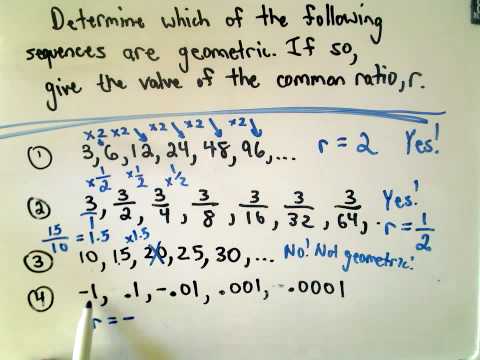
Example 1

3,6,12,24,48,96,⋯3,6,12,24,48,96,\cdots

Notice that we multiply by 22 to get from 33 to 66. Then, we multiply by 22 again to get from 66 to 1212. You have to multiply by 22 to get to each next term. Therefore, this is a geometric sequence and the common ratio is r=2r=2.

Example 2

3,32,34,38,316,332,364,⋯3,\frac32,\frac34,\frac38,\frac3{16},\frac3{32},\frac3{64},\cdots

Notice that we multiply by 12\frac12 to get from 33 to 32\frac32. Then, we multiply by 12\frac12 again to get from 32\frac32 to 34\frac34. You have to multiply by 12\frac12 to get to each next term. Therefore, this is a geometric sequence with a common ratio of r=12r=\frac12.

Example 3

10,15,20,25,30,⋯10,15,20,25,30,\cdots

This sequence isn't looking geometric. In fact, it seems arithmetic since each term increases by 55. One way to check is to look at the ratios between two sets of consecutive terms. 1510=322015=43\frac{15}{10}=\frac32\\ \frac{20}{15}=\frac43 They don't have the same ratio. Therefore, this sequence isn't geometric.

Example 4

−1,0.1,−0.01,0.001,−0.0001-1,0.1,-0.01,0.001,-0.0001

This sequence is hard to tell. If you ever have trouble, just check the ratios. 0.1−1=−110−0.010.1=−110\frac{0.1}{-1}=-\frac{1}{10}\\ \frac{-0.01}{0.1}=-\frac{1}{10} They have the same ratio! Make to check the other term as well. But for speed, I'm going to spoil that this sequence is geometric! The common ratio is r=−110r=-\frac1{10}.

Illustrated · 1 min

Maximum Depth Exceeded: Fun with Sequences and Python, Part 4

To read part 3 of this story, go here.

A geometric sequence is one for which you multiply the same number to any term in the sequence to get the next one. Let's build a geometric sequence b0,b1,b2,...b_0, b_1, b_2,... by picking a value of b0b_0 and then building a recurrence formula. My lucky number is 11,11, so let's set b0=11.b_0 = 11.

Now we can pick a number to multiply by. Let's try 3.3. This means for any term in the sequence, we multiply it by 33 to get the next one, so its recurrence formula is

bn=3×bn−1.b_n = 3 \times b_{n - 1}.

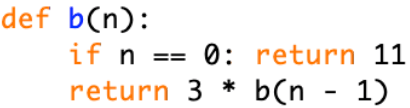
We take the value of b0b_0 and the recurrence formula and build it into a Python function:

b(0) = 11, b(n) = 3*b(n - 1)

Image by Joshua Siktar

If we plug in b(n)b(n) for different values of n,n, we'll generate the sequence.

To see what happens, go to the next explanation in the series here.

Interactive · 1 question

Geometric Sequences

With geometric sequences, you multiply each previous term by a common ratio. For example, 2,4,8,16,32...2, 4, 8, 16, 32... , where the common ratio is: 22.

Here is the formula for geometric sequences:

geometric sequences
$a_n=a_1r^{n-1}$
a_n=n^{th} term
a_1=1^{st} term
r=common ratio

Image source: by Anusha Rahman

The geometric sequence formula is: an=a1rn−1a_n=a_1r^{n-1}

Let's look at an example.

What is the 4th4th term of the sequence with a first term of 22 and a common ratio of 55?

Choose one answer

Type a concept, like “slope” or “photosynthesis”.

↑ ↓ to choose · Enter to openSearch explanations and problems